EU To Cut Greenhouse Gases Radically By 2050

Global Climate Change (32).jpg

“European Commission/EU 2050 Roadmap: To cut greenhouse gas emissions by at least 80% by 2050 compared to 1990.”

=================================================================

Note from author: Read the whole European Commission 2050 Roadmap here (Energy Roadmap 2050) in the European Union.

As mentioned in one of my earlier articles upon climate leadership and climate action, greenhouse gases are gases in Earth´s atmosphere that absorb and emit radiation, causing an “artificial” greenhouse effect that warms our planet. The primary greenhouse gases in Earth´s atmosphere include water vapor, carbon dioxide, methane and ozone. To understand the greenhouse better, do watch this video published by NASA Earth Observatory:

The Greenhouse Effect


Connect with me on Twitter @annemariayritys – for climate-related posts only @GCCThinkActTank & to receive my posts delivered personally to you, do subscribe to my newsletter at Leading With Passion


Countries Must Take Individual Climate Action in Addition To Universal Agreements

Global Climate Change (31).jpg

“European Commission: In the EU, each of the EU member states has also put in place its own domestic actions that build on the ECCP measures or complement them.”

====================================================================

Note from author: What is your country doing to combat human-caused climate change? And you personally, what are your contributions to more ethical and ecological choices in your life, overall? If you are unsure, you can start by calculating your personal carbon footprint: WWF: How Big Is Your Environmental Footprint?

We can all do something, and a large number of small contributions will make a big difference. In my personal life, I do currently commute mainly by either walking, cycling, or, by using public transport. I recycle everything possible: biological waste, paper, metal, glass, plastic (yes, we finally have plastics recycling in Finland!), and textiles. I also try to make smarter choices in general regarding personal consumption, starting from electricity to how I use fresh water (at home). Although Finland is one of the leading countries in the world regarding environmental issues/protection, we still have a lot of work ahead of us in order to improve things.

Connect with me on Twitter @annemariayritys – for climate-related posts only @GCCThinkActTank & to receive my articles/posts delivered personally to you, click the subscribe-button at Leading With Passion


Forests Are Our Planets Lungs

Global Climate Change (29).jpg

“WWF: Forests are home to many of the world´s most endangered wildlife. They also protect the Planet by absorbing carbon dioxide (CO2), a major source of pollution that causes climate change.”

================================================================

Note from author: Forests are crucial to our planet, not only are they home to thousands of species, but do also act as the “lungs” of Earth by absorbing environmentally damaging gases and pollution. Forests cover 31 % (4 billion ha) of our world´s land surface, down from 5.9 billion hectares pre-industrially. (Earth Policy Institute. 2012). Sustainably managed forests provide essential goods and services and play an important role in sustainable development. (FAO. 2015).

Deforestation is a serious problem. If necessary measures are not taken, there is a risk of our rain forests vanishing within a century. (The Guardian. January 23rd 2017. We are destroying rain forests so quickly they may be gone in 100 years). Despite of these shattering facts, there can be light at the end of the tunnel if and when we take measures to change the course of this trend. Some countries have realized the importance of forests and trees for the well-being of our environment, including fauna, flora and ourselves as a human race. In Pakistan, over one billion trees have been planted within two years as a national project to restore lost forests. (World Atlas. August 14th 2017. In Only Two Years, Pakistan Has Planted One Billion Trees). In addition, Norway has become the first country in the world to ban deforestation. (EcoWatch. June 8th 2016).

To gain a deeper insight into forestry and deforestation worldwide, study this report published by FAO in 2015: Global Forest Resources Assessment 2015.

Connect with me on Twitter @annemariayritys – for climate-related posts only @GCCThinkActTank – to receive my articles/posts delivered personally to you, do subscribe to my newsletter at Leading With Passion

Climate Change Threatens All Life On Earth

Global Climate Change (28).jpg

“WWF: Humans and wild animals now face challenges for survival because of climate change. More frequent and intense drought, storms, heat waves, rising sea levels, melting glaciers and warming oceans can directly harm animals, and wreak havoc on people´s livelihoods and communities.”

Connect with me on Twitter @annemariayritys – for climate-related posts only @GCCThinkActTank & to receive my articles/posts delivered personally to you, do subscribe to my newsletter at Leading With Passion

Climate Change Fundamental Threat To All Species

Global Climate Change (27).jpg

“WWF: Climate change poses a fundamental threat to the places, species and people´s livelihoods WWF works to protect. To adequately address this crisis we must urgently reduce carbon pollution and prepare for the consequences of global warming, which we are already experiencing.”

======================================================================

Note from author: As reported by environment correspondent Ian Johnston in Independent on February 14th 2017, at least 700 species that are facing extinction are hit by climate change. A study by Frontiers in Marine Science reveals that many fish species have altered their areas or increased their depth ranges along with environmental changes, i.e. rising sea temperatures. In Finland, the endangered Saimaa ringed seal (there are only 360 left), suffers not only from fishing nets, but also from vanishing icecaps. (Suomen Luonnonsuojeluliitto 2017).

Connect with me on Twitter @annemariayritys – for climate-related posts only @GCCThinkActTank – to receive my articles/posts delivered personally to you, do subscribe to my newsletter at Leading With Passion

Renewable Energy Sector Increases Employment

Global Climate Change (26).jpg

“Amnesty International and Greenpeace International: Greenpeace´s 2015 Energy (R)evolution scenario demonstrates that the transformation to 100% sustainable energy would increase employment in the energy sector.” (Joint Statement: Greenpeace – Amnesty International. December 8th 2015).

=====================================================================

As published by Business Insider Nordic on January 26th 2017, jobs within the solar energy industry are growing 12 times faster than the US economy. The fastest growing profession in the United States, on the other hand, is wind turbine technician. Fortune Energy  reported similar findings on January 27th 2017, with reference to the Environmental Defense Fund´s (EDF) Climate Corps program and continuing with a statement that solar and wind energy jobs in the U.S.A. have grown by around 20 per cent annually in the past years. Read the whole report here.

According to Phys.org, the renewable energy sector employed 9.8 million people worldwide in 2016. Bloomberg reports (May 25th 2016) that solar energy jobs in the U.S.A. surpassed the amount of jobs in the oil and gas industries.

Connect with me on Twitter @annemariayritys – for climate-related Tweets only @GCCThinkActTank – to receive my articles/posts delivered personally to you, do subscribe to my newsletter at Leading With Passion


Renewable Energies Necessary To Stop Climate Change

Global Climate Change (25).jpg

“Amnesty International and Greenpeace International: Greenpeace´s 2015 Energy (R)evolution scenario proposes a pathway to a 100% sustainable energy supply based on renewable energy by showing how it is possible to drastically reduce CO2 emissions as climate science demands, and make redundant new oil exploration in the Arctic and deep sea waters such as off the coast of Brazil.” (Joint Statement: Greenpeace – Amnesty International. December 8th 2015).

==================================================================

Note from author: As mentioned in one of my earlier posts upon climate change, renewable energy sources (RES) derive energy from sunshine, wind, ocean and/or geothermal heat. Despite of some of the opposition these sources of energy face, such as wind energy turbines killing birds in their natural environment, RES cause less damage to the environment and pose less risks than the burning of fossil fuels (coal), oil drilling and nuclear energy. Harnessing energy from the sun is so powerful that we could power the whole world by harnessing 1% of solar energy in the Sahara alone. (Forbes. September 22nd 2016). In some countries, for example in the United Arab Emirates, citizens who generate their own solar energy at home can now sell residual solar energy back to the grid IRENA: Renewable Energy Market Analysis in The GCC Region, 2016

According to the World Energy Council (resources 2016 summary), oil is currently still the world´s leading fuel, with 32,9% of total global energy consumption, natural gas with currently 22% market share, wind energy 7%, and coal providing 40% of total global electricity. Hydropower is currently the leading RES, with up to 71% of all renewable electricity by the end of 2015.

Solar energy, on the other hand, as this article from CleanTechnica on June 12th, 2015, states, now has increased to around 1% of current global electricity consumption, a yet tiny share taking into consideration the immense potential provided to us through the sun alone.

Connect with me on Twitter @annemariayritys – for climate-related posts only @GCCThinkActTank – to receive my articles/posts delivered personally to you, do subscribe at Leading With Passion.

Climate Change Major Threat To Human Rights

Global Climate Change (24)

“Amnesty International and Greenpeace International: States must abide by their human rights obligations in all aspects related to climate change. They must end all forms of discrimination and guarantee gender equality; guarantee the right to information; ensure the right to participation of affected people; and ensure the right to freedom of expression, association and peaceful assembly.” (Joint Statement: Greenpeace – Amnesty International. December 8th 2015).

======================================================================

Note from author: In (Western) democracies, citizens are used to freedom of speech, which is, however, not the case in many countries around the world. According to a survey conducted by PEW RESEARCH CENTER in 2015 (Spring 2015 Global Attitudes Survey) and with reference to an article with these indicators/results published by the The World Economic Forum (WEF), the United States ranks as number 1. globally regarding freedom of speech. Where Finland and the other Nordic countries rank according to this particular survey from 2015 is unclear. Furthermore, according to Reporters Without Borders´ Press Freedom Index 2013, Finland ranks as the best nation in the world when it comes to press and speech freedom. As a citizen of a county where you can freely and safely express yourself, it is not always easy to understand how different the situation is in many other countries around the world.

Connect with me on Twitter @annemariayritys – for climate-related posts only @GCCThinkActTank & to receive my articles/posts delivered personally to you, do subscribe to my newsletter at Leading With Passion – thank you.

Climate Change Causes More Deaths

Global Climate Change (23).jpg

“Amnesty International and Greenpeace International: Between 2030 and 2050, climate change is expected to cause approximately 250 000 deaths per year, from malnutrition, malaria, diarrhoea and heat stress.” (Joint Statement: Greenpeace – Amnesty International. December 8th 2015).

===============================================================

Note from author: The in/direct causes of climate change are manifold, one event leading to another, like a domino effect as I wrote in one of my previous posts. Extreme heat waves, for example, pose an increased risk for people who already are suffering from some disease, e.g. those with cardiovascular problems. For example this report: Heat-waves: risks and responses, published by the WHO, suggests that high air temperatures can affect human health, possibly leading to additional deaths even during current climatic conditions.

Connect with me on Twitter @annemariayritys – for climate-related posts only @GCCThinkActTank & to receive my articles/posts delivered to you personally, do subscribe to my newsletter at Leading With Passion

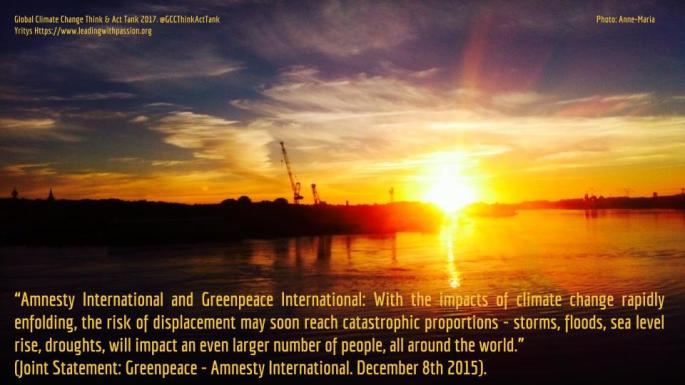
Climate Change Increases Population Displacements

Global Climate Change (22)

“Amnesty International and Greenpeace International: With the impacts of climate change rapidly enfolding, the risk of displacement may soon reach catastrophic proportions – storms, floods, sea level rise, droughts, will impact an even larger number of people, all around the world.” (Joint Statement: Greenpeace – Amnesty International. December 8th 2015).

======================================================================

Note from author: When I drafted this post about a month ago (created an illustrated presentation about climate change using a number of sources, including Amnesty International and Greenpeace International), there were yet no signs of hurricanes Harvey or Irma, that hit coastal areas in Texas, U.S.A., the Caribbean and Florida hard in the past three weeks. Natural disasters are more common in some places around the world. These have a common denomination: climate hot spots.

What we witnessed in 2004 in South East Asia, perhaps the worst tsunami throughout history of mankind, hit not only a number of countries in South East Asia including Sri Lanka, Thailand and Indonesia, but also affected many countries indirectly, especially with all the tourists visiting the countries that were hit by the massive tsunami in 2004 that caused at least 250.000 human deaths, and who knows how many animals on land, and underwater. The lessons learned from this catastrophic event that shocked everyone around the world included the fact that the countries that were hit by the tsunami, since then introduced early warning systems. Nevertheless, rebuilding a society after a major natural disaster takes time, and we can only guess what kinds of traumas these kinds of events leave in people.

Nothing in comparison with the South East Asian tsunami in 2004, we experience more and more floods and rain in Europe too. In 2016, a good old friend of mine who lives in Germany, personally told me about floods in Nordrhein-Westfalen, and how devastated citizens were since they felt that they did not receive the support they needed from the state. In Finland too, we have had increasingly much rain, wind, and floods this year. So far it seems like this is no major problem, but if glaciers keep melting at the current pace, causing more rainfall around the world, what can we expect?

Connect with me on Twitter @annemariayritys – for climate-related posts only @GCCThinkActTank – to receive my articles/posts delivered personally to you, do subscribe to my newsletter at Leading With Passion – looking forward to receiving your comments and feedback. Thank you.