Tips For Taking Climate Action

Global Climate Change (59).jpg

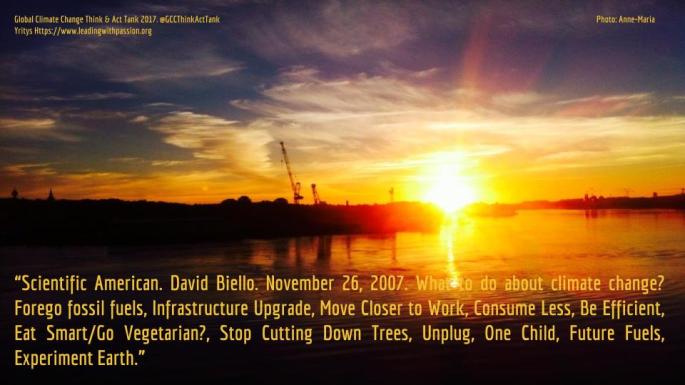
“Scientific American. David Biello. November 26, 2007. What to do about climate change? Forego fossil fuels, Infrastructure Upgrade, Move Closer to Work, Consume Less, Be Efficient, Eat Smart/Go Vegetarian?, Stop Cutting Down Trees, Unplug, One Child, Future Fuels, Experiment Earth.”

===============================================================

There are many ways of making (small) adjustments as both an individual, a business, as a society and as a country to protect our environment, starting from changing legislation/regulations, improving production and packaging, using better materials and recycling. While in many countries majority of waste ends up in land fills, Sweden has become so efficient in recycling that the country is even IMPORTING waste, having made it into a lucrative business by using waste as a source of energy:


Connect with me on Twitter @annemariayritys – for climate-related posts only @GCCThinkActTank & to receive my newsletter delivered personally to you, subscribe to Leading With Passion

Why Minimizing Food Waste Matters

22218257_10154821251232093_6531398439288589655_o
Photos: Anne-Maria Yritys 2017. All rights reserved.

I picked more than 30 liters of mushrooms during last weekend, on Sunday alone 20 liters. Cantharellus cibarius, Craterellus cornucopioides & Cantharellus tubaeformis. They all belong to the same mushroom family, cantharellus. Safe to eat even raw.

I tried to sell them online, locally, but it seems that no one wants them so I have to prepare them & put them in the fridge/dry some of them. At least I know what I am going to eat this Winter… mushroom soup, mushroom pie, mushroom in every dish…


I do not know what the problem is. Mushrooms are tasty, rich with e.g. vitamin D and protein. I mean, no one is obliged to stop eating steaks/meat, but just to make you aware that there are other options too. I eat basically everything, although I try to eat more vegetables and less (red) meat. I know how hard it is to change old habits, but small adjustments from everyone lead to big results. We do not have to eat animals every day.
The number of vegetarians/vegans is constantly growing around the world. Humanity has been farming for about 10.000 years now, but it takes a lot more energy to grow plants, then feed them to animals that get slaughtered so that humans can eat them. Take some time to reflect upon your personal food consumption. Are there any changes you can make, and if, what are they? According to most dietitians, eating less meat is actually healthier than eating red meat every day.
It is also a devastating fact that currently our world produces food for at least 10 billion people, and about half of all food is being THROWN AWAY. At the same time, people go hungry in some areas of the world. How is this possible? E.g. France has made a legislation that it is FORBIDDEN for groceries to throw away any food. Any food that cannot be sold must be donated.

There is a huge imbalance in what we consume/need/produce, not only concerning the agricultural sector. At the same time, we have created systems where yields are being maximized at the cost of quality, and soils suffering. So basically we produce more on smaller plots but we have to eat more to get all necessary vitamins etc. Do you think this is normal?

I have personally tasted almost everything. The worst thing I was ever served was veal brain in Greece, and I refused to eat it. But I have tried lamb kidneys, reindeer tongue and all sorts of things. Mushrooms appeal more to me than viscerals. It is basically the only thing I refuse to eat. Or blood dishes, which is a specialty here in Tampere. Blood sausages. I just cannot eat some animal´s blood.

I would also never eat ANY endangered species, including any snakes, bears, whales, sharks etc. I hope you feel and act the same way. And that you make sure when you consume marine products, you know they are not endangered/caught by sustainable fisheries. E.g. concerning tuna fishing is that a lot of dolphins get caught in fishing nets. Make sure to buy MSC certified seafood only, unless you are fishing yourself and know that your methods won´t harm the marine environment.

One more benefit of mushrooms: they are very low in fat. Basically, mushrooms are FAT FREE. Excellent diet, of course, when you eat safe mushrooms (not all of them are consumable).
Thank you for reading. I am looking forward to your comments and feedback. You can connect with me on Twitter @annemariayritys and/or @GCCThinkActTank. To receive my posts delivered personally to you, subscribe to LeadingWithPassion

How Can We As Consumers Prevent Climate Change?

Global Climate Change (58).jpg

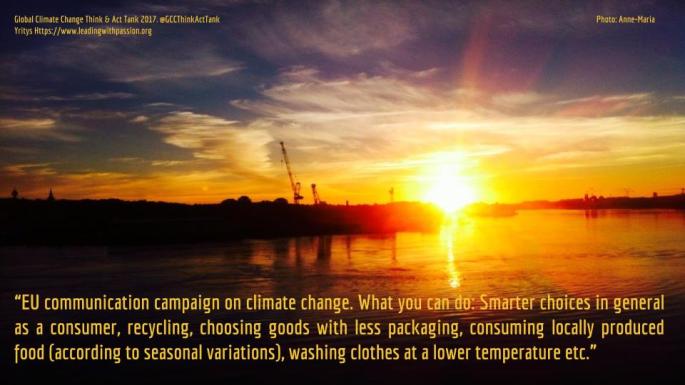
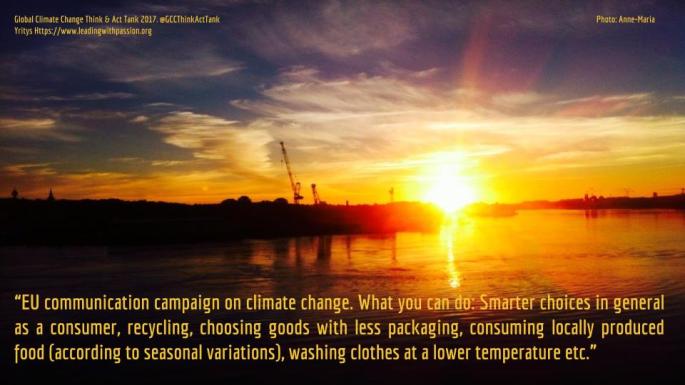
“EU communication campaign on climate change. What you can do: Smarter choices in general as a consumer, recycling, choosing goods with less packaging, consuming locally produced food (according to seasonal variations), washing clothes at a lower temperature etc.”

Watch this TEDxHamburg speech to learn What One Person Can Do About Climate Change, speaker Ella Lagé:


Connect with me on Twitter @annemariayritys – for climate-related posts only @GCCThinkActTank and to receive my newsletter delivered personally to you, subscribe to Leading With Passion

What Can We As Consumers Do About Climate Change?

Global Climate Change (57).jpg

“EU communication campaign on climate change. What you can do: Use more public transportation and cycling, turning down the heating by only one degree Celsius can cut off as much as 10% off a household energy bill.”

===================================================================

Note from author: There are numerous actions that each and one of us can take as consumers/individuals. The responsibility of tackling climate change does not lie only on the shoulders of businesses and countries, nor is anyone communicating about climate action just for fun. There are real reasons behind e.g. the Kyoto Protocol, the Paris Agreement and the UN Sustainable Development Goals. What is often forgotten is that it is not enough to have these goals on paper, but we have to EXECUTE and live up to them. And, the best way to do so is to start making (even small) adjustments in your personal life, by e.g. recycling and consuming more smartly in general. When consumers start making different choices, producers and businesses/corporations have no other option than to start improving their business practices, unless they already have done so. It is also essential to prevent and tackle corruption around the world, for many a good cause is suffering due to e.g. corruption.

Connect with me on Twitter @annemariayritys – for climate-related posts only @GCCThinkActTank & to receive my newsletter delivered personally to you, subscribe to Leading With Passion
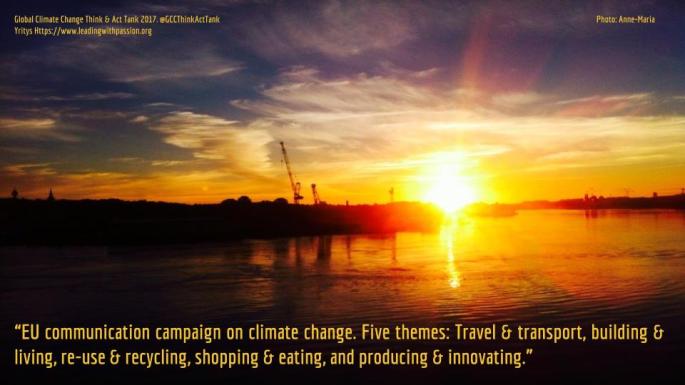
What Does The EU Communication Campaign On Climate Change Include?

Global Climate Change (56).jpg

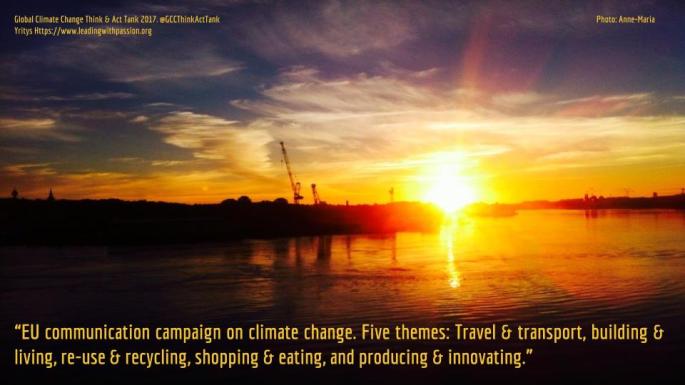
“EU communication campaign on climate change. Five themes: Travel & transport, building & living, re-use & recycling, shopping & eating, and producing & innovating.”

=================================================================

Not only is the EU campaigning and working towards transforming economies into become more sustainable. In the United States, e.g. former Vice President, politician and environmentalist Al Gore launched the Climate Reality Project, educating Americans and people from around the world concerning climate change. Watch “The Human Impact of Climate Change”:


Connect with me on Twitter @annemariayritys – for climate-related posts only @GCCThinkActTank & to receive my newsletter delivered personally to you, subscribe to Leading With Passion
 

The EU Takes Climate Change Very Seriously

Global Climate Change (55)

“EU communication campaign on climate change. European Commission Video Material 2014.” EU communication campaign on climate change


What kinds of thoughts does this message awaken in you?

Looking forward to your comments and thoughts: ___________________________________________________

___________________________________________________

___________________________________________________


Connect with me on Twitter @annemariayritys – for climate-related posts only @GCCThinkActTank & to receive my newsletter delivered personally to you, subscribe to Leading With Passion

Climate Change A Threat To Regional And International Security

Global Climate Change (54).jpg

“EC. Climate Change Factsheet 2015: Climate change could threaten regional and international security by triggering or aggravating conflicts, famines and refugee movements.”

Note from author: For more information about the topic, see e.g. the following data:


Mother Jones: Syria’s Climate-Fueled Conflict, In One Stunning Comic Strip

Phys.org: Is Syria really a ‘climate war’? The links between drought, migration and conflict

Climate change increases the risk of war, scientists prove

Connect with me on Twitter @annemariayritys – for climate-related posts only @GCCThinkActTank & to receive my newsletter delivered personally to you, subscribe to Leading With Passion
 

Coral Reefs Are Suffering From Climate Change

Global Climate Change (53).jpg

“EC. Climate Change Factsheet 2015: Coral reefs are already suffering extensive damage at current levels of warming.”

===========================================================

Note from author: As explained in the embedded video, produced and published by the World Resource Institution, coral reefs are animals, polyps, that are vital to the overall health for our planet.


Furthermore, with a reference to World Resources Institute, coral reefs are dying and suffering around the world due to various human activities, and warming oceans. Not only is this a significant threat to coral reefs and a number of fish species that depend upon coral reefs, but to humanity and our world in general. Coral reefs are essential to the whole food chain in our world.

Connect with me on Twitter @annemariayritys – for climate-related posts only @GCCThinkActTank & to receive my newsletter delivered personally to you, subscribe to Leading With Passion


Extreme Weather Events Increasing Due To Climate Change

Global Climate Change (51)

“European Commission. Climate Change Factsheet 2015: Extreme weather events are becoming more frequent or more severe. Their impacts include reduced water availability and crop yields, endangering food production.”

============================================================

Note from author: With a reference to my previously published posts about climate change and to everything we witness in our direct environment, through traveling, through contacts and friends all over the world, or through media in general, EXTREME weather events have become more frequent. In Finland, where I today live, we are still lucky not to have too extreme weather events, however, the climate here is changing too, making weather forecasts more unpredictable, increasing rainfall (and, snowfall – in 2017, we had snowfall several times in the month of May here in Southern Finland which is not usual), while when we earlier had Winter starting in November or December, we now rarely have snow until the month of January in southern Finland. Even in the north (in Lapland) snow in the early winter months has at times become so rare that artificial snow has to be used in order to make e.g. skiing possible. Even here in Finland, and in parts of the world where one might think that climate change is not a threat, changing weather patterns and too much rain risk crops and whole yields. We cannot afford to endanger agriculture and food production anywhere in the world, since these are at the core of our ability to thrive and to survive as human beings.

Connect with me on Twitter @annemariayritys – for climate-related posts only @GCCThinkActTank & to receive my newsletter delivered personally to you, subscribe to Leading With Passion


Climate Change Impacts Human Health

Global Climate Change (52)

“European Commission. Climate Change Factsheet 2015: Climate change has direct impacts on human health. E.g. heatwaves contribute to thousands of premature deaths. Global warming may also encourage the spread of tropical diseases.”

====================================================================

Note from author: According to a number of sources, including the National Geographic, deadly heatwaves could threaten majority (74%) of humankind by 2100, unless we manage to diminish carbon and greenhouse gas emissions and lower Earth´s temperatures. A study published by Nature Climate Change in June 2017 states that up to a third of the Earth´s population today is faced with deadly climatic conditions for at least 20 days per year. Many of us do like sunshine and warm weather, but when these become extreme, or even causing a significant number of deaths, it is no longer enjoyable or healthy. With extreme weather events, including floods and heat waves, there is also an increased risk of tropical diseases spreading in completely new ways and into new areas, and a risk of tropical diseases worsening the situation in regions that already are affected by these.

Connect with me on Twitter @annemariayritys – for climate-related posts only @GCCThinkActTank & to receive my newsletter delivered personally to you, subscribe to Leading With Passion