Climate Change Has Serious Impacts On Our Global Environment

Global Climate Change (50).jpg

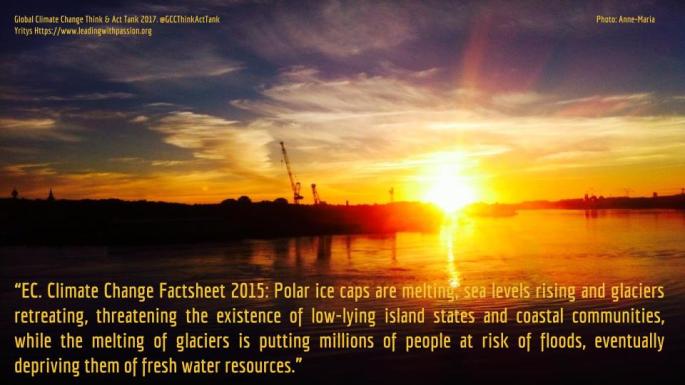
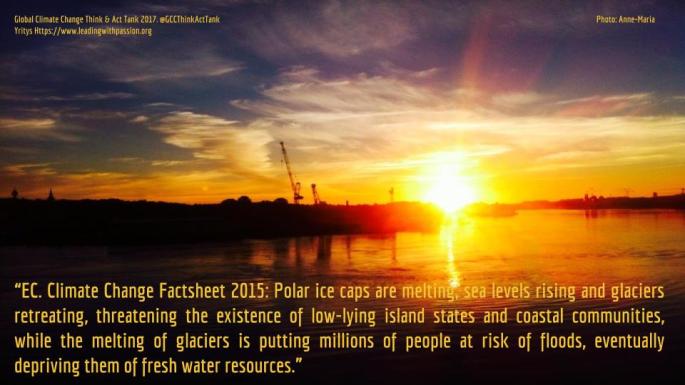
“European Commission. Climate Change Factsheet 2015: Polar ice caps are melting, sea levels rising and glaciers retreating, threatening the existence of low-lying island states and coastal communities, while the melting of glaciers is putting millions of people at risk of floods, eventually depriving them of fresh water resources.”

===================================================================

Note from author: We are experiencing floods around the world in many areas as a consequence of natural hazards. Some geographical regions, also called “climate hot spots”, are affected more than others. The ability of a certain region to recover from an extreme weather event, as we recently have witnessed e.g. in the coastal area of Texas, Florida, Puerto Rico and in many other regions around the world, varies. Not only is this a question of how severe the weather event is, but also a question of e.g. construction and infrastructure.

To see a complete list of all (recent) floods around the world, visit FloodList

You may be surprised by the fact how common floods are around the world. In Europe alone, according to the European Environment Agency, the number of flood events from 1980 to 2010 was registered to a total of 3,563 floods, and the number is expected to increase five fold by 2050. Reported by the UN, flood disasters around the world affected 2.3 billion people and killed 157.000 between 1995-2015.

Connect with me on Twitter @annemariayritys – for climate-related posts only @GCCThinkActTank & to receive my newsletter delivered personally to you, subscribe to Leading With Passion
 

How Can Greenhouse Gases Be Removed From Earth´s Atmosphere?

Global Climate Change (49).jpg

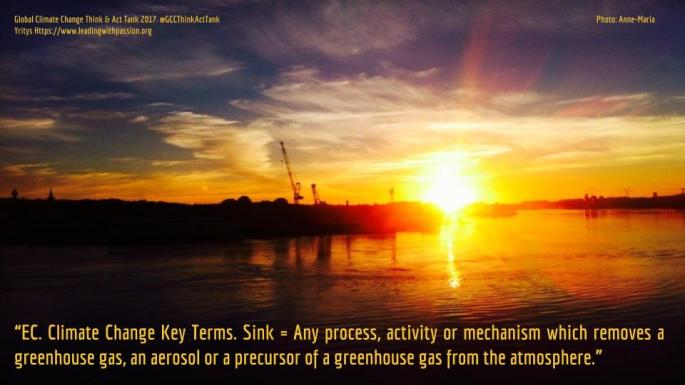
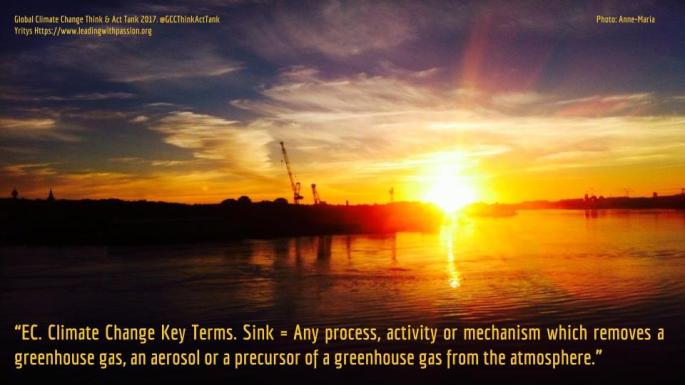
“EC. Climate Change Key Terms. Sink = Any process, activity or mechanism which removes a greenhouse gas, an aerosol or a precursor of a greenhouse gas from the atmosphere.”

===========================================================

Note from author: As stated by The Environmental Literacy Council, greenhouse gases in Earth´s atmosphere play a significant role by creating an artificial greenhouse effect and thus warming the Earth´s overall temperature, leading to a number of consequences around the globe, such as melting glaciers and the rising of sea levels. Furthermore, when discussing the release of greenhouse gases into Earth´s atmosphere we refer to a source, while a sink “is a reservoir which takes up a chemical element or compound.” (The Environmental Literacy Council). In the United States, the Environmental Protection Agency (EPA) has since the early 1990´s prepared the Inventory of U.S. Greenhouse Gas Emissions and Sinks. This annual report by the EPA reveals detailed statistics and an inventory of U.S. Greenhouse Gas Emissions and Sinks from 1990-2015. (EPA 2017).

Connect with me on Twitter @annemariayritys – for climate-related posts only @GCCThinkActTank & to receive my newsletter delivered personally to you, subscribe to Leading With Passion
 

What Is Low-Carbon Technology?

Global Climate Change (48).jpg

“European Commission. Climate Change Key Terms. Low-carbon technology = Technology which results in reduced emissions of carbon dioxide compared with conventional technology.”

==============================================================

Note from author: According to the European Commission, Europe is a world leader in terms of low carbon technologies which help both reducing greenhouse gas emissions AND creating new employment and growth, a strong indicator that speaks for the fact that sustainable economic development IS possible. According to VTT´s (VTT Technical Research Centre of Finland Ltd) Low Carbon Finland 2050 strategy, Finland aims to reduce greenhouse gas emissions with 80 % by 2050 reflecting the European Union´s policies.

Connect with me on Twitter @annemariayritys – for climate-related posts only @GCCThinkActTank & to receive my newsletter delivered personally to you, subscribe to Leading With Passion
What Is The Kyoto Protocol?

Global Climate Change (47).jpg

“European Commission. Climate Change Key Terms. Kyoto Protocol = An international agreement, linked to the United Nations Framework Convention on Climate Change, which commits industrialised countries to reducing greenhouse gas emissions.”

==================================================================

Note from author: “The Kyoto Protocol is an international agreement linked to the United Nations Framework Convention on Climate Change, committing its Parties by setting internationally binding emission reduction targets.” (UNFCC 2017. Kyoto Protocol).

According to the Kyoto Protocol, which was signed in 1997 and entered into force in 2005, developed nations carry a heavier load while primarily responsible for the current amount of GHG (greenhouse gas) emissions in Earth´s atmosphere, yet the responsibilities are common but differentiated. Some adjustments to the protocol were adopted in Doha in 2012, the Doha Amendment to the Kyoto Protocol (UNFCC 2017. Kyoto Protocol).

The goal of the Kyoto Protocol is to lower emissions from six different GHG´s: carbon dioxide (CO2), methane (CH4), nitrous oxide (N2O), sulfur hexafluoride (SF6), hydrofluorocarbons (HFC´s), and perfluorinated chemicals (PFC´s). (Kyoto Protocol).

The Kyoto Protocol has as per today 83 signatory countries, and 192 parties. See the complete list here: UNFCC – Status of Ratification of the Kyoto Protocol. The good intentions of the Kyoto Protocol today, still, face challenges since carbon dioxide levels in the Earth´s atmosphere are rising at an alarming rate despite of the many technological advancements and transformations into a dominance of renewable energy sources in many countries.

However, not to speculate but the situation may look very different within only a few years or by 2030 with the current developments and actions being taken around the world, especially in nations like China which has taken rather drastic actions to improve not only the country´s domestic situation, heavily affected by pollution and smog, but in taking a leadership role and investing heavily into renewable energy production e.g. in many countries on the African continent.

Connect with me on Twitter @annemariayritys – for climate-related posts only @GCCThinkActTank and to receive my newsletter delivered personally to you, subscribe to Leading With Passion.


What Purpose Does The IPCC Serve?

Global Climate Change (46).jpg

“EC. Climate Change Key Terms. Intergovernmental Panel on Climate Change (IPCC) = A scientific intergovernmental body established to provide decision-makers and others interested in climate change with an objective source of information about climate change.”

===================================================================

Note from author: It is worthwhile to notice that the IPCC provides not only decision-makers, but everyone interested in climate issues, with a significant amount of data and reports. All the publications and reports by the IPCC can be accessed here: IPCC – Intergovernmental Panel on Climate Change.

Connect with me on Twitter @annemariayritys – for climate-related posts only @GCCThinkActTank & to receive my newsletter delivered personally to you, subscribe to Leading With Passion
What Is A Green Climate Fund?

Global Climate Change (45).jpg

“EC. Climate Change Key Terms. Green Climate Fund = Operating entity provided for under the Copenhagen Accord to support projects, programmes, policies and other activities in developing countries related to mitigation.”

====================================================================

Note from author: The Green Climate Fund was established by United Nations Framework on Climate Change (UNFCC) Green Climate Fund, in 2009 with a target to raise 100 billion USD by 2020 to fund clean energy projects (startups). For more information, see Green Climate Fund and Climate Finance and Markets – Green Climate Fund.

This post serves only for educational purposes and is not to be considered as any kind of financial or investment advise.

Connect with me on Twitter @annemariayritys – for climate-related posts only @GCCThinkActTank & to receive my newsletter delivered personally to you, subscribe to Leading With Passion

What Is The Purpose of EU ETS?

Global Climate Change (44).jpg

“EC. Climate Change Key Terms. EU Emissions Trading Scheme (EU ETS) = Company-level “cap-and-trade” system of allowances for emitting carbon dioxide and other greenhouse gases, launched by the EU in 2005.”

===================================================================

Learn more by watching this video published by the European Commission – The EU Emissions Trading System Explained:


Connect with me on Twitter @annemariayritys – for climate-related posts only @GCCThinkActTank & to receive my newsletter delivered personally to you, subscribe to Leading With Passion
What Is An ERU (Emission Reduction Unit)?

Global Climate Change (43)

“European Commission. Climate Change Key Terms. Emission reduction unit (ERU) = Unit generated from a Joint Implementation activity, certifying an emission reduction of one tonne of carbon dioxide (CO2) equivalent.”

=================================================================

As stated in one of my previous posts, corporations and countries worldwide (can) trade emission reduction units (ERU´s) as commodities to “even out” carbon dioxide (CO2) consumption and through these trading systems provided fund sustainable development projects in developing countries. For more information about ERU´s, see for example Australian Government Clean Energy Regulator where ERU´s are explained in detail.

ERU´s are financial products that are traded as futures on both primary and secondary markets, and the prices vary accordingly. By funding an ERU project the investor trades carbon as a commodity, linked to a specific sustainable development project. See also FERN – Trading carbon: How it works and why it is controversial.

Note from author: This post serves only as learning and informational material and is by no means any kind of investment advice. 

Connect with me on Twitter @annemariayritys – for climate-related posts only @GCCThinkActTank & to receive my newsletter delivered personally to you, subscribe to Leading With Passion
What Is Climate Change Mitigation?

Global Climate Change (42).jpg

“EC. Climate Change Key Terms. Climate change mitigation = Action to reduce the net amount of greenhouse gases released into the atmosphere, and thus help to slow down the process of climate change resulting from human activities.”

===================================================================

Note from author: Since repetition is the mother of all learning, it is good to remain an eternal student and have an open-mind regarding just about anything. Many things, such as climate change terminology, may seem ordinary, but it is important to understand the very basic issues in order to increase one´s comprehension about an important matter. Even better: if and when you take the time not only to learn new things, but also teach your knowledge to others, you can rest assured that you will personally benefit and learn as well. We learn 95 % of the things we teach others, which is why everyone should not only be a life-long learner but also a teacher whenever possible.

As a repetition, the term climate change mitigation refers to decreasing the net amount of greenhouse gases released through human activities into our atmosphere. Climate and environmental research indicates the amount of polluting greenhouse gases that we release into Earth´s atmosphere through human activities, such as agriculture/farming, transportation/traffic, and all human consumption. To combat this development, businesses and countries now increasingly much invest into clean technologies, such as renewable energy sources, including solar energy. To remove the impact of human-caused greenhouse gases in Earth´s atmosphere, it is necessary for all of us to change our consumption habits, and the way we conduct business, into (more) sustainable solutions.

Connect with me on Twitter @annemariayritys – for climate-related posts only @GCCThinkActTank & to receive my newsletter delivered personally to you, do subscribe to Leading With Passion
What Is Climate Change?

Global Climate Change (41).jpg

“EC. Climate Change Key Terms. Climate change = A change of climate which is attributed directly or indirectly to human activity that alters the composition of the global atmosphere and which is in addition to natural climate variability observed over comparable time periods.”

==================================================================

Note from author: Climate has changed throughout the history of Earth many times. With a reference to National Geographic Society/Education, climates around the Earth do change, however, with a slow pace. The Earth has, in history, been a warmer place, but has also gone through several ice ages according to research. However, when we now speak about climate change, we refer to human-caused climate change, which has scientifically been proven to be caused by us human beings releasing immense amounts of greenhouses gases into Earth´s atmosphere. These greenhouse gases, invisible to the human eye, contribute to an (artificial) greenhouse effect, warming up the climate around Earth. Unless absorbed e.g. by trees, forests, and plants and transformed by them into oxygen, greenhouse gases continue to warm up our Earth, including warming seas and oceans, causing Earth´s natural balance to shake. This has finally been realized around the world, and is been taken into consideration in e.g. urban planning projects, and in the planting of new trees around the world.

Connect with me on Twitter @annemariayritys – for climate-related posts only @GCCThinkActTank & to receive my newsletter delivered personally to you, do subscribe to Leading With Passion