How Do Inspiring Leaders Create Change?

The time is always right to do what is right. -Martin Luther King Jr. 

How many truly inspiring leaders do you know? People who have contributed to creating waves of change through vision, action and continuous selfless efforts in improving circumstances, people and societies.

What differentiates inspiring leaders different from other people? Are they truly so different from others? Perhaps yes, but most probably not. Anyone can be an inspiring leader – it is a question about willingness and readiness to accept joy, inspiration, and positive thoughts, leading to positive actions, creating a positive environment and seeing how your personal world starts changing, leading to positive changes in your environment as well.

Being positive in a negative situation is not naive. It is leadership. -Ralph Marston

Being, and becoming an inspiring leader is something that you have to work upon every day, until it becomes a habit and a way of life. Everyone, even the most inspiring leaders, has weak moments, which is of course humane. Inspiring leaders know how to cope with feelings of fear and discomfort through acceptance and an ability to transform these lower-frequency energies into higher energy vibrations that lead to positive results.

Inspiring leaders will do what it takes to: 

  1. Continuously develop themselves and their self-knowledge

Inspiring leaders know both their strengths and their weaknesses, and are willing not only to accept these but also capable of admitting that they do have weaknesses. Being conscious and knowing yourself are the basics for continuous personal development. Sometimes personal development is taking two steps forward and one step back, but as long as you keep going you will develop.

2. Empower themselves and people around them

Inspiring leaders know how to empower others, but most importantly – they know how to empower themselves. A leader has to be confident enough to feel and be personally empowered before knowing how to empower others.

The best leaders gain power by giving it away. 

3. Embrace failure

Failures are a part of success. The most successful of leaders may have failed a zillion times, but they always get up and continue their work. Failure is a great teacher, and inspiring leaders accept failures as important lessons on their path to greatness and success.

Failure is not the opposite of success. It is part of success. 

4. Stay in motion

No matter how slow a process sometimes may seem, or how long it may take to achieve a goal(s), inspirational leaders always stay active and in motion. Even inspiring leaders have moments of lost inspiration, but nevertheless they stay in motion working towards reaching their goals and working towards results, knowing that inspiration will follow them on their journey.

5. Co-operate and partner up with others

Inspiring leaders sometimes work alone, but they also know the importance of cooperation, partnering up with others and investing into teamwork. People are at the core of all action for inspiring leaders because they know that without other people, they would be alone in this world. People make a difference. People are important. 

6. Listen more than they speak

Inspiring leaders listen more than they speak. Listening to others demonstrates that you are interested in learning more about what a person has to say, and to offer. Listening to oneself is also important. 

When you talk, you only repeat what you already know. If you listen, you may learn something new. -The Dalai Lama

7. Develop their emotional intelligence

Inspiring leaders either are emotionally intelligent, or they want to be. Emotional intelligence is something we can all develop in ourselves, and emotional intelligence can be more important than IQ when it comes to succeeding in life.

Educating the mind without educating the heart is no education at all. -Aristotle

8. Let others lead and succeed

Inspiring leaders are all about developing and growing leadership around them, and they enjoy seeing other people succeed. They know how to work in a team and understand the importance of shared leadership.

9. See the potential in others

Inspiring leaders see the potential in other individuals and know how to get results together with, and with the help of others. Inspiring leaders know that everyone has his/her unique strengths that are essential in contributing and in creating results.

10. Understand that change is a continuous, universal process

Truly inspiring leaders are willing to live their passion, inspiration, and dreams, passing them on to people around them. Inspiring leaders will always find their way to other people’s hearts.

  1. Grow throughout life, realizing that inspiring leadership is a life-long journey rather than a short-term trend.

Inspiring leadership brings with it, and creates, long-lasting changes in people and in societies. Being an inspiring leader is about giving more than you expect back, being willing to help others, serving and valuing people around you. Inspiring leadership is authentic, being and expressing who you truly are, caring, daring, and deep. Inspiring leadership does not care about age, gender or other external qualities, but rather focuses upon internal factors that, when correctly channeled, have the capacity of creating and establishing long-term inspiration in the external world.

May your choices reflect your hopes, not your fears. -Nelson Mandela

Author ́s note: I first wrote and published this post on my website and on LinkedIn on August 26th, 2015 (four years ago today). Today, I made some minor adjustments to the post. This post has been one of my most read and shared posts on LinkedIn (316 reshares on LinkedIn), at the time when LinkedIn still featured articles in different categories. This article/post was featured in the Leadership & Management category. Anne-Maria Yritys, August 26th 2019. 


How Can You Increase Your Influence in Society?

The key to successful leadership today is influence, not authority (Kenneth Blanchard)

The best leaders of the 21st century are those who are active, constantly evolving, focusing increasingly much upon influence and empowerment rather than upon authority, leading through example, learning from their mistakes (and making mistakes in the first place), accepting mistakes and the learning process followed by the allowance of making mistakes, emotionally intelligent, humane, close to nature, and ready to throw themselves into creativity, seeing endless possibilities through action-oriented learning and development, be it in themselves, or in other individuals.

Never underestimate the influence you have upon others, and thus, on society around you, regardless of your background or current professional title. 

How can you influence people, and change society, then?

Influence begins with your daily activities, the choices you make in your daily life, and about your future. Influential people do not always even recognize their personal influence, but even the slightest spark you as an individual are capable of creating in another individual may lead to significant development, and changes in society. The results are not always immediate, but be aware of the fact that your inner fire will be reflected upon everyone in your society, and thus lead to significant improvements in society, or to decreased satisfaction among people surrounding you. We all have our personal life paths that have influenced the people we have become, and all our current and future actions will definitely lead to, and have an impact upon how society around us will develop now, and in the future.

How then, as an individual, can you make a difference and influence people and society around you???

  • Be prepared and willing to engage in long-term work, personal development and continuous learning.

The first rule of becoming a true developer and change-maker in society is to embrace personal learning, development, and humility. Always be open to engaging in dialogue, listening to people, and learning from real life and through experiences.  True maturity emerges from the ability to stay open-minded, curious, and tolerant together with the willingness to grow as a spiritual being and as an individual.

  • Do not expect quick results.

Humanitarian and influential work requires more than you think. Be prepared to engage in work and make efforts that become visible only in X years from this moment, rather than focusing upon getting short-term results in three months. Of course, short-term work is significant as well, but real influence starts with the ability to create lasting, long-term changes in individuals and in society.

  • Be honest, authentic, and true to you.

True leadership and influence begins with the ability or remaining true to yourself, your authentic individuality, and in how you would like to see society around you. It is not always easy to close your ears and other senses, but authenticity requires for you to be capable of envisioning the current state and a future you would like to envision before being capable of creating it in reality. Always keep your ears open when listening to others, but also remember that your purpose in society is not in accepting everything as it is, the status quo, but rather in reshaping and redefining the future you want for yourself, and for the people around you.

  • Stop dreaming and start acting.

No one will ask you, so you will have to take action yourself. Do not expect anyone to lead you on the way. Instead, get active and start living in a way that reflects who you truly are, and how you would like to see society evolve around you.

  • Drop your professional title.

Professional titles are not an entitlement, nor a guarantee about the quality of the work you do. Very often people have beautiful titles, but look deeper into what is included in their job title. Do they live up to the expectations of their job title, or are they merely “products of their environments”, governed and controlled by their employer?

  • Meditate, sleep well, and relax.

Influence requires a peaceful mind, so be prepared to cut unnecessary activities and people from your direct personal life, and instead focus upon activities that bring you joy, make you feel empowered, and that offer your personal development activities. Leaders have a tendency of overworking themselves, so please remember to learn to say no as well, and to get the rest and recuperation that you truly need, and deserve.

  • Set your goals high, always expect more from yourself than from people around you, but also remember to forgive yourself and not to be too demanding upon the expectations you demand from yourself, or from other people.

We all wish to accomplish certain things in our lives, but remember to remain humane, and never expect other people to accomplish something that you would not be capable of achieving personally. I have always wondered how certain people are capable of expecting things they would never be capable of achieving themselves. True leaders know the way, show the way, and remain humane in the process of setting an example and in leading the way. True influencers and leaders do not only set an example, but are also capable of living up to the expectations.


What is Your Purpose and Responsibility in Society?

We Are All Actors. Being a Citizen is Not Living in a Society. It is changing it. (Augusto Boal)

What kind of country do you live in? Are you living in a developing economy, or in a welfare state? Or, in a transitory state? Or, in a failed state? If in a failed state, you are most probably not even capable of reading this post, since a failed state is a) either in some sort of crisis (e.g. war) or b) not allowing its citizens to surf the Internet, or even participate in social networking, and social networking/professional business sites, such as LinkedIn.

Market fundamentalism is out, as is belief in comprehensive state interventionism. (Gylfason & al. Nordics in Global Crisis. Vulnerability and resilience. 2010. 20.)

Whichever kind of state you are living in, it is worthwhile noticing that your state, including its governance and legal aspects, have a major influence upon the economic development, and possibilities, for the country´s citizens. Many citizens in countries, feeling non-empowered, believe they have no influence upon their surroundings. This, however non-empowering it may sound, is a false belief. Every citizen has a voice, and the possibility of influencing the economic, and thus societal, developments in their country.

In Welfare States, including Finland (situated in Northern Europe) the outbreak of the financial crisis in 2008, often compared to the Great Slump of the 1930s (or even worse), and the economic events of the past years, together with the current economic situation both on micro and macro levels, intertwined with estimates and forecasts for the future have certainly given many, not only economists, but in general citizens of the world food for thought.

Milton Friedman about Welfare State Dynamics

Many countries have been hit hard by the crisis, and have not yet recovered – including several small, open economies, vulnerable to, and severely affected by, global developments. However, some of the shocks were internally created, leaving some of the responsibility of “cleaning up the mess” to domestic institutions, and policies. (Gylfason & al. Nordics in Global Crisis. Vulnerability and resilience. 2010. 21).

Coe, N., Kelly, P., and Yeung H.W.C. Economic Geography: A Contemporary Introduction. 2007, have discussed the role of different kinds of states and firms in economy, with a purpose to pinpoint how these, together with supra-national institutions, shape economic processes. The discussion about the changing role of the state in an era of globalization, together with the demonstration of why geographical scales matter when re-configuring a state, is also of out most relevance.

A state has several functions:

– A state is the guarantor and institution of economic activities dealing with financial crisis, guaranteeing national economic instruments, securing international economic treaties, property rights and the rule of the law.

– A state is the regulator of economic activities such as market regulation, and the regulation of economic flows.

– A state is the architect of the national economy, including trade policies, strategic industrial policies, attracting FDI (foreign direct investment), and regional development policies.

– A state is an owner of public enterprises.

– A state is the provider of public goods and services, such as infrastructure, healthcare, transport, and education.

– A state has also political-economic influence upon mergers and acquisitions, through regulatory control.

– On a geographical scale, a state plays a role on international, macro-regional, intra-national, and local levels.

The vast amount of different types of states existing today is divided into:

– Neoliberal states (North America, Western Europe, and Australasia).

– Developmental states (Asia and South America).

– Transitional states (Eastern Europe, Russia, China, Southeast Asia).

– Welfare states (Nordic countries and some European countries).

– Weak and Dependent states and

– Failed states

In a reconfiguration of the state, following can be taken into consideration:

– A State is a dynamic set of institutions.

– The nation-state is a dynamic entity capable of self-transformation

– Rise of corporate power and global finance

– A nation-state is powerless in controlling inward and outward investments, or is it?

– The political-economic geographies, together with the mutually dependent relationship between state/firm

– The different power-relationships between states within the global economy

– The interaction between states/firms/markets.

– Nation-states shape profoundly the economic activity within and across their borders.

– The state itself is always implicated or involved in directing processes through conscious decisions.

– Nation-states remain critical institutions through which international, regional, and local economic issues are evaluated and acted upon.

– Economic governance on international and sub-national scales, upscale: international organizations such as UN, IMF, World Bank, and WTO, together with macro-regional groupings such as EU, APEC, NAFTA, ASEAN, NEPAD, SAARC, CARICOM, and MERCOSUR.

– Hollowing out the state = state functions taken over by public-private partnerships and private forms of regulation QUANGO = Quasi-Autonomous Non-Governmental Organizations

– Leading business media Beyond the State?

– State control is uneven in its operation and effectiveness

Traditional welfare states, such as Finland and Sweden, have not avoided the global crisis, the reasons for which include the level of openness, and the dependence on exports of investment goods. Both Finland and Sweden experienced an equally severe slump in the early 1990´s with the difference that it was at large homemade. Lessons learned from the 1990´s crisis include that early signs of financial fragility need to be taken seriously, and policy planning needs to base upon worst-case scenarios. The current crisis, still ongoing, includes problematic consequences: public finances have deteriorated, unemployment is high, and significant structural changes in the economy are taking place. (Gylfason & al. 2010. 21; 118).

Restoring public finances can be taken care of in many ways, as suggested by Gylfason & al. (2010. 28):

– Public consumption and transfer payments can be cut

– Composition of expenditure directed in a growth-friendly way

– Smooth flow and functioning of infrastructures, including communication

– Well-functioning education system and funding of research

– Broadening the tax base by raising the employment rate

– Changing the structure of taxation in a way that encourages economic growth, i.e. reduction of taxes on productive economic activity, corporate and labor taxes, and an increase in taxes on consumption, natural resources and real estate.

Due to globalization, the mutual interdependence between countries is stronger than ever, suggesting that there is a need for stronger international, and global, cooperation in areas including trade policy, financial regulation and supervision, macroeconomic policy and actions to prevent climate change. (Gylfason & al. 2010. 31).

However complex policies are, the maintenance of a welfare state, and economics, includes the following:

– A democratic system with equal rights and possibilities for all citizens

– A solid infrastructure in terms of access to services such as education, and healthcare

– A balanced economy, with little deficits

– A lucrative, innovative environment attracting FDI and sustainable economic growth

– A taxation policy attracting firms, which in turn create jobs and employ citizens

– A taxation policy that is attractive for all kinds of firms, including small enterprises 

These are measures that, in a welfare economy, are expected to be taken care of by the state, and therefore, through public policies. Firms, on the other hand, choose to operate and invest in markets capable of offering them attractive conditions, and an optimization of factors included in a PESTLE analysis.

However important the role of the state, or a nation, a state is always being constructed by its citizens. Citizens who have the possibility of influencing their direct and indirect surroundings, including their personal lives, their neighborhoods, the politics of their country and so forth. In fact, every single action, and every single effort made by an individual in a country, has direct and indirect impacts upon the developments in the nation in question.

Thus, your personal efforts, however small they may seem, always do have an impact upon the society you are living in. Never underestimate your capability of influencing, changing, and developing society and people around you, because often, small actions and improvements lead to giant leaps and changes in (economic) development.

:::::::::::::::::::::::::::::::::::::::::::::::::::::::::::::::::::::::::::::::::::::::::::::::::::::::::::::::


The Importance of Small Business in Any Economy

"Digital Hand on Earth". Freedigitalphotos.net.
“Digital Hand on Earth”. Freedigitalphotos.net.

Great companies start because the founders want to change the world, not make a fast buck. (Guy Kawasaki)

Are you a passionate individual with good ideas, creativity, and a can and will do attitude, ready to work towards realizing your dreams? Good, because these are some of the most important prerequisites for starting your own business. If you also have risk-tolerance and see the opportunity in everything and are willing to run against your fears, entrepreneurship may be the thing for you.

Small is beautiful. 

Have you ever thought about the reasons for being employed, rather than being self-employed? Or why, in the first place, you are working for an enterprise rather than starting something of your own?

There is no such thing as security in the corporate world. 

Nice, if you are working for a large corporation, but in fact, how much security can your large employer give you? If you really are looking for security, make sure to start your own business instead, because large corporations do offer you anything but security.

More than 50 % of all business worldwide is SMALL business. Thus, the importance of small business is extremely important in and to any economy. Without small business/es, the world would not be the same. 

And, by starting (and, perhaps growing) your own business, you not only take charge of your own finances, but also make sure to remain independent and untouched by the strategic decisions (including mass-layoffs) made by large employers, who often could not care less about their most important asset – their human capital.

Reasons for starting your own business vs. staying employed:

Further reasons for starting your own business:

– You want to be your own boss rather than having everything dictated to you

– You are enthusiastic, hard-working, result-oriented, forward-thinking, and progressive

– You are tired of sending your CV or resume to employers, companies and organizations that do not see your potential, or, if they do, rather hire someone cheaper, less qualified or less progressive => You are tired of wasting your precious time, energy, knowledge and skills on sending applications to firms where robots rather than real people read your CV, with your CV ending up in the trash before a real human being has even seen it. Instead of wasting your time upon useless activities, you might as well use your time for more important activities, such as starting your own business and creating your own rules.

And, if your society does not support entrepreneurship, make sure to start your business in a country which does support it, including essential and relevant things enabling successful entrepreneurship, such as an enough big market, a rewarding rather than punishing taxation policy for (small) businesses. In other words, an innovative, accepting and progressive market economy allowing for entrepreneurs to thrive.

Entrepreneurs and their small enterprises are responsible for almost all the economic growth in the United States. (Ronald Reagan).

The same quote applies to all other economies in the world as well! Your business is needed. 

 Do something today that your future self will thank you for. 

Life, and entrepreneurship, is not about finding yourself. It is about creating yourself. 

Innovation and entrepreneurship are the best ways and opportunities to grow the economy. 

The true entrepreneur is a doer, not a dreamer. 

You can never cross the ocean until you have courage to lose sight of the shore. (Christopher Columbus).


GCC Think Act Tank cover 2019

CSR Deficit = Modern Day (Corporate) Imperialism?

"Business Team Stacking Hands". Freedigitalphotos.net.
“Business Team Stacking Hands”. Freedigitalphotos.net.

Overcoming poverty is not a task of charity, it is an act of justice. Like Slavery and Apartheid, poverty is not natural. It is man-made and it can be overcome and eradicated by the actions of human beings. Sometimes it falls on a generation to be great. YOU can be that great generation. Let your greatness blossom. (Nelson Mandela).

In these days of globalism, a new digital era triggering change in communication and increasing awareness across nations, corporate social responsibility and actions towards improving circumstances and conditions are more actual than ever.

Consumers can no longer be fooled. After a century of industrialization mankind is finally realizing that our past actions have been a foundation for a new sustainability needed to save planet Earth from destruction.

Learning takes time, and requires repetition, but fortunately our globe is inhabited by individuals who have managed to take the necessary steps to progress and take the necessary actions towards creating a completely New Green Economy.

Examining and evaluating the developments of the 20th Century gives us the possibility to build an image about the most significant changes that took place, and how much society has changed since then. One only needs to take a look at significant developments shaping and changing our societies in the past decade, or two decades, only. Things we hardly knew about 20 years ago are today evolving and affecting us all more than we could ever have imagined.

The 21st century will be different. We are in the middle of a transforming global economy, where intelligent and morally aware, responsible individuals will reshape economies in completely new ways, enhancing economic development across our globe, leading to completely new ways of life and increased well-being of all citizens across the world.

New standards and actions will lead to improvements in global businesses operations, and in how states are being led. Individuals and corporations involved in corruption and unethical practices will have to step aside, giving way to conscious leaders both rebuilding and developing businesses and societies in a fresh manner, excluding anything outside generally accepted and legal behavior.

The importance of corporate social responsibility, including ecology, social responsibility, and taxation (including changes in how e.g. thin capitalization and transfer pricing currently used at micro-economic level), can no longer be neglected. Future trends are being created, and the lessons learned from past mistakes are a foundation for wiser actions now, and in future.

Business has a responsibility of giving back to the community.

Today we are making a difference for tomorrow.

Conscious capitalism is mindfully making decisions and staying core to your purpose (Kate Walker, Conscious Capitalism)

We hired a CSR person at Twitter, years before we hired our first sales person, to make sure we had a culture and impact of doing good. (Biz Stone).

Three types of Corporate Social Responsibility:

1. Environmental

2. Philanthropic

3. Ethical

:::::::::::::::::::::::::::::::::::::::::::::::::::::::::::::::::::::::::::::::::::::::::::::::::::::::::::::::::::::::::::::::::

Thank you for taking time to make it your daily habit to execute social responsibility, be it in your private or business life. Thank you also for reading, liking, commenting, and sharing your experiences about corporate social responsibility. 

:::::::::::::::::::::::::::::::::::::::::::::::::::::::::::::::::::::::::::::::::::::::::::::::::::::::::::::::::::::::::::::::::

GCC Think Act Tank cover 2019

Why & How to Invest Ethically

"Business Graph". Freedigitalphotos.net.
“Business Graph”. Freedigitalphotos.net.

It takes 20 years to build a reputation and five minutes to ruin it. If you think about that, you´ll do things differently. (Warren Buffet). 

Ethical investing, also known as socially responsible investing (SRI), sustainable, socially conscious, or “green” investing – a dear child has many names according to an old Nordic saying – is a rapidly evolving investment strategy seeking to consider both financial return and social good.

SRI, the origin of which dates back centuries e.g. to Jewish law and Halal or Shariah (religious teachings of Islam), encourages corporate practices that promote environmental stewardship, consumer protection, human rights, and diversity – in short: SOCIAL JUSTICE.

SRI can be characterized as follows:

  • Embraces peace and nonviolence
  • environmental stewardship
  • Protects consumers
  • Respects human rights and diversity
  • Is socially conscious
  • Promotes healthy working conditions!

SRI, including the integration of an evaluation of ESG (environmental, social, and governance) factors in decision-making processes focuses upon improving financial performance without neglecting the well-being of all stakeholders. Furthermore, community investing, a part of SRI, directs capital to people in low-income, at-risk communities through socially conscious investors who seek to support these towards reducing poverty, creating jobs, providing affordable housing, and financing small business development.

Factors influencing growth of Socially Responsible Investing:

  • Increased information and knowledge among investors
  • Environmental issues and sustainability
  • Long-term interest
  • Performance
  • Availability
  • Values and authenticity
  • Corporate scandals
  • Women and female leadership

The UN Principles for Responsible Investment (PRI), encouraging investors to adopting socially responsible investment strategies, were developed by an international group of institutional investors based upon environmental, social, and corporate governance issues, taking into consideration transparency, corruption, board structure, shareholder rights, business ethics, risk management and executive compensation:

These principles are:

PRI 1: Incorporation of ESG issues into investment analysis and decision-making processes.

PRI 2: Active ownership and incorporation of ESG issues into ownership policies and practices.

PRI 3: Appropriate disclosure on ESG issues by entities invested in.

PRI 4: Promoting acceptance and implementation of the PRI´s within the investment industry.

PRI 5: Co-operation towards effective implementation of the PRI´s.

PRI 6: Active reporting on activities and progress made in implementing the PRI´s. (United Nations. The Six Principles for Responsible Investment. 2015).

WHY invest ethically?

By investing ethically you directly and indirectly contribute to a better and improved world.

Ethical investing is based upon long-term planning and upon creating lasting value rather than merely reaping the benefits of get-rich-quick schemes and other forms of unethical investing.

Through ethical investing you/your business acts morally correct and you can sleep your nights tightly without a burden on your consciousness.

How to invest ethically?

There are countless ways of investing ethically, depending upon your (financial) resources. Investing is a very broad term including investments in your personal development, education, healthcare (perhaps the most important investments you can ever make in your life), but investments other than those in your personal life include real estate and various kinds of securities.

When investing in real estate and securities on your own, make necessary background checks about your investments, such as:

Get to know the facts such as corporation´s annual reports, including CSR activities, employee retention/turnover figures + other details concerning employee benefits (especially when investing directly in stocks).

If you are a direct investor in small cap businesses, an angel investor etc., make sure you know the details/have enough information about the owners credibility, the businesses plan for the upcoming years. As a startup/angel investor especially, make sure you have the possibility and right to participate in planning the future of the company.  

In fund-investing, make sure you know the fund policy and everything you need to know about the companies + other relevant facts about the fund. 

When trusting a service-provider with your capital by letting them invest on your behalf, make sure to:

Know your service-provider well enough. Check their background, regardless of the size of the service-provider. The size is no guarantee for more reliable/better service. 

Make sure your service-provider has the knowledge, skills, and professionalism needed in order to make wise long-term decisions on your behalf. You can do this by choosing a service-provider who/that has the necessary qualifications/ experience in investing, and by making sure that your service provider supports the rules of ethical investing and UN´s PRI´s + follows the rules of sustainable, long-term investing rather than taking unnecessary risks with your hard-earned/saved capital. 

See and read the terms of agreement provided to you by your service provider. Various service-providers charge different kinds of fees, but the fee(s) are no indicator about investment ethics or performance.

Make sure you understand the investment well enough, and refrain from investing in products that you have no comprehension about. Please let your service-provider explain the investment products to you. Any reliable, professional investment-provider is capable of explaining the investment structure/product to you in a comprehensive manner.  

::::::::::::::::::::::::::::::::::::::::::::::::::::::::::::::::::::::::::::::::::::::::::::::::::::::::::::::::::::::::::::

This blog post has been written only for informational purposes, and is not an offer to buy or sell or a solicitation of an offer to buy or sell any security, product, service or investment. The opinions expressed in this post do not constitute investment advice. The information provided herein or in any communication possibly linked to this blog post is not intended for distribution to, or use by, any person or entity in any jurisdiction or country where such distribution or use would be contrary to law or regulation. Neither the information, nor any opinion contained in this post constitutes a solicitation or offer by the author to buy or sell any securities, futures, options, shares, funds, or other financial instruments or provide any investment advice or service. 

:::::::::::::::::::::::::::::::::::::::::::::::::::::::::::::::::::::::::::::::::::::::::::::::::::::::::::::::::::::::::::::::::

Thank you for investing ethically, and for learning more about ethical investing. If you would like a personal consultation with me regarding your investment planning, please contact me directly. 

How Socially Progressive Are You?

Economic growth without social progress lets the great majority of people remain in poverty, while a privileged few reap the benefits of rising benefits. (John F. Kennedy)

Is your business/state on a level that allows for social progression, or is your only purpose to generate as much capital as possible without any social progress planning? Can people feel safe and socially valued when entering your territory, or do you treat people in-equally? If so, perhaps you might as well design a “DO NOT ENTER” sign on your business card, place a similar sign on your website and prohibit tourists from traveling to your country. Aware consumers have no interest in traveling to places, or spending money upon unethical businesses/products, or in unethically managed countries/states. And, the number of conscious tourists/consumers is constantly growing.

Social progress index measures multiple dimensions of social progress in a state, leading to greater human well-being, abolishing poverty and corruption. (Socialprogressimperative.org. 2015). See Social Progress Index figure below for details:

As the figure above illustrates, the social progress index measures basic human well-being needs in comparison to GDP (Gross Domestic Product), which simply is an indicator for the average per capita income in a country. The main differences between SPI and GDP are as illustrated in following figure:


Socially progressive people, countries, and businesses have some things in common. These include following facts:

These businesses, organizations, people and governments are non-corrupted.

We all know what corruption signifies. Keep your ethics at a high standard and refrain from corruption.

These businesses, organizations, people and governments are working for (a) purpose(s) rather than only for the purpose of maximizing profits at any cost.

Please make it your purpose to refrain from merely making a profit, to redirecting your profits to benefit higher causes, such as healthcare, paying taxes rather than avoiding them, enabling education for all citizens + a number of other commonwealth causes.

Planning long-term initiatives rather than living only three months ahead at a time.

We see, and have seen, enough of businesses and corporations incapable of planning more than three months ahead. If this is the case in your large corporation, or in your state, you may as well outsource your planning to a consulting firm that knows how to support you in creating a long-term, sustainable plan. Stop sprinting – instead, focus on building a sustainable future and healthy practices in your operations.

Watch following video about the Social Progress Imperative to learn and understand more about GDP and SPI:

Thank you for reading, reflecting, commenting, for taking action to create sustainable business, and for sustainable organizational development.

~~~~~~~~~~~~~~~~~~~~~~~~~~~~~~~~~~~~~~~~~~~~~~~~~~


Sustainable Societies Developed by Ethical & Responsible Individuals

It takes less time to do things right than to explain why you did it wrong. (Henry Wadsworth Longfellow)

As citizens of planet Earth, those of us who have been fortunate enough to have access to education and good living standards have to take responsibility and progressive actions in order to improve living conditions for less fortunate individuals.

There are certainly many ways of contributing to sustainable global development, starting with using the knowledge that we have in responsible ways through integrating ethics and sustainability into our societies, into our business practices, and into political activities. In fact, into all activities, be it political or non-political.

According to forecasts by the UN, two-thirds of all world population will live in water scarcity in 2025. If and when this occurs, it is not difficult to understand that this will affect every single citizen of the world either directly or indirectly. Actions need to be taken NOW.


Currently about 57 million children worldwide have no access to primary schooling. The reasons behind this vary, starting from the fact that there is a shortage of about one million teachers in the regions affected (the situation is worst in Sub-Saharan Africa, but also many other geographical regions worldwide suffer from shortages in the very basic human needs, and human rights). Those who have the privilege of education ought to realize how important it is for all children worldwide to have access to primary AND secondary education, and support the development of regions where education is a luxury that currently only wealthy families can afford for their children.

Primary and secondary education is a cost that poor families cannot afford. Instead, poor parents are obliged to send their children to work rather than giving their children the opportunity to work themselves out of poverty through the benefits that education could offer them.

Around 168 million children worldwide work every day instead of going to school. Girls are obliged to drop out of school more often than boys, due to cultural traditions supporting the old beliefs that a girl is a burden for a family rather than a gift like a male child. Nevertheless, both boys and girls are being exploited and utilized as workforce, many of them working long hours in hazardous working environments or forced into becoming child soldiers (in certain areas).

The majority of child labor occurs in Asia and the Pacific, and Sub-Saharan Africa. The reasons for this vary – often due to the fact that poor parents prefer sending their children to work because they need the money to support their families, or, parents prefer sending their children to work because the job is too poorly paid – thus, it “makes more sense” to send the child to the poorly paid, often hazardous job (slavery?). Agriculture is by far the largest sector employing children. Child labor is a violation against human rights, and against the UN Convention of the Rights of the Child.

Why, in a world with so many laws, conventions, declarations, standards, policies, and transparent business processes, do we still have to face child labor and lack of education?

Poor people, including children of poor families, without any external support or support from their state´s governments, are weak to defend themselves taking into consideration the fact that they lack the skills and knowledge to defend themselves and their human rights. Our world has 750 million illiterates alone. Having no reading or writing skills makes it so much more difficult for an individual to improve his/her living standards, unless given the opportunity to learn these basic human skills for thriving and having access to a human life.

Developing sustainable societies and economies brings along many benefits for mankind and helps us leave a legacy for our children and for generations to come, rather than destroying our planet through unethical business practices, ignorance and intolerance.

What are the benefits of creating, and developing ethical and sustainable business/societal practices? A few suggestions to start with:

SAVE OUR PLANET AND ITS INHABITANTS. Sad but true: Our world is running out of water. Instead of panicking, take action NOW and do what you can to improve/prevent the situation. It is not hard to figure out what an impact water shortage will have upon all mankind. If one region runs out of water, it most definitely will have a huge impact on all other regions worldwide as well, leading to significant problems around the world.

IMPROVE YOUR BUSINESS PROCESSES AND MAKE THEM TRANSPARENT (UNLESS THEY ALREADY ARE). Your business activities and consumption have direct and indirect impacts on just about everything, including child labor. It is never too late to make a difference.

SUPPORT ORGANIZATIONS & GOVERNMENTS TO TRANSFORM AND TO GIVE ALL CHILDREN ACCESS TO BOTH PRIMARY AND SECONDARY EDUCATION. Education improves people´s lives and helps them to work themselves out of poverty & to develop their societies. It is a long-term investment serving us all.

EMPOWER WOMEN WORLDWIDE. Women are suffering in many countries (in fact, in most countries worldwide), and the suffering of women increases the suffering of children as well. The best way to help children is to help their mother´s first.

PLEASE SPREAD THIS MESSAGE AND TAKE ACTION. It will benefit us all.

The Importance of Developing an Effective Ethics Program (The ACFE):

Ethical behavior is doing the right thing when no one else is watching – even when doing the wrong thing is legal (Aldo Leopold)

A leadership strategy without ethical clarity produces moral and economic bankruptcy (Bill Donahue)

Our Planet does not need more successful people. Our planet craves for more peacemakers, healers, restorers, storytellers, and lovers of all kind. (The Dalai Lama)

Ethics is the aesthetics of the soul. (Pierre Reverdy)

Thank you for reading, reflecting, commenting, for taking action to improve living conditions for all human beings.


Why Your Projects Fail and Suggestions for Improvement

"We Need to Improve the Plan". Freedigitalphotos.net
“We Need to Improve the Plan”. Freedigitalphotos.net

The P in PM is as much about People Management as it is about Project Management (Cornelius Fichtner)

Are you a project manager whose projects have failed more often than succeeded? Well, congratulate yourself for still having the title project manager, because if you had participated in The American Apprentice, Mr. Trump would already have fired you. No hard feelings though – it is nothing personal, it is only business, citing Mr. Trump.

And, to comfort you: you are most probably not alone with the problem, since most projects actually do fail, due to a number of reasons at the core of which are poor requirements, a poor scope definition (poor planning) from the beginning AND communication problems.

A project, according to the Project Management Institute, is a temporary endeavor undertaken to create a unique product, service, or result. Furthermore, a project usually has a definite beginning and an end. The target has been met once the project´s objectives have been met, or when the need for the project ceases to exist. Projects can last for years, even decades, depending upon their social, economic, and environmental impacts. In other words, a project can vary from a set of regular (daily, weekly) tasks with the purpose to reach a certain goal to more serious projects which indeed can last for years or even for decades.

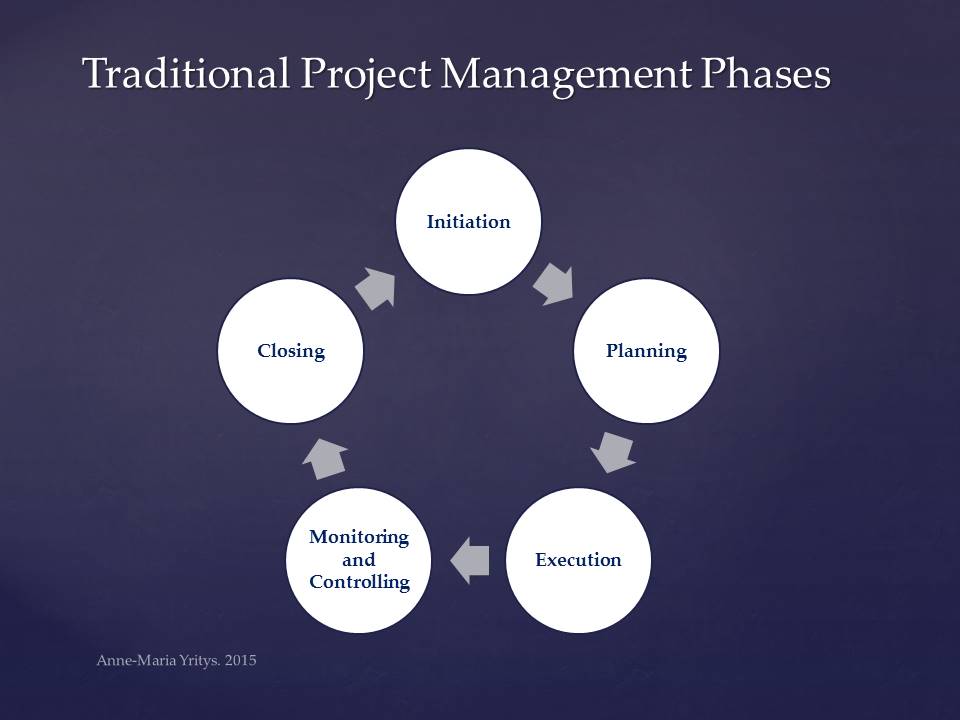
As applicable to business (and development projects), successful project management requires skillful application of a wide range of knowledge, tools and techniques in order to meet the requirements. Traditional project management distinguishes five process groups as the illustration below simply demonstrates:

Dia1

Depending upon the nature and the complexity of the project, various project management techniques can be utilized. Traditional project management, very structured, requires being well-organized, and as a supportive guide I can warmly recommend the American Project Management Institute´s “A Guide to the Project Management Body of Knowledge (PMBOK® Guide)”, a comprehensive book including all technical details required for managing a project, from product life cycle management to project communications management. It even includes a chapter about how to handle interpersonal communication.

Although project management, as anything else in (business) life, cannot be learned solely from books, the PMBOK serves as an excellent guide to almost any project. Of course, the guide can be accustomed to the nature, length, and complexity of the project. Here, as with anything else, common sense is applicable.

Furthermore, managing a project requires for the project manager, and the project team to:

– Identify requirements – without requirements, the project would not be needed in the first place

– Addressing needs, concerns, and expectations of the stakeholders

– Balancing the competing project constraints including at least the following requisites:

Dia1

As said, projects vary significantly from type, purpose, length, and complexity. An example of a long-term, complex, global, societal, and economical project are the United Nations Millennium Development Goals. The goals were set (the project was initiated) in 2000, with a deadline in 2015. So far, only three of the eight goals have been met, although significant progress has been made in each of the goals. Analysis regarding the reasons for failure is certainly possible, and assumption is that analysis is being made upon these within the UN organization. Despite of failing to reach all the goals within the project timeline, the UN in co-operation with different instances is already planning new goals, and continues its important work towards improvement of socioeconomic circumstances in geographical regions most affected e.g. by poverty.

Another type of project management is Agile PM.

Logic will get you from A to B. Imagination will take you everywhere. (Albert Einstein)

Whereas traditional management theory (and traditional project management) assumes that

– Regulating change requires rigid procedures

– Hierarchical organizational structures establish order

– Increased control results in increased order (organizations must be rigid and static)

– Employees are interchangeable particles of the organizational machine (rat race?)

– Problems are mainly solved through reductionist task breakdown and allocation

– Projects and risks can be managed only through complex up-front planning

Agile project management professionals, on the other hand, look for emerging management principles based upon “new science” of complexity exploiting an understanding of autonomous human behavior gained through studying living systems in nature. Complex adaptive systems (CAS), and complexity scientists have studied the collective behavior of living systems in nature: flocking of birds, schooling of fish, marching of ants and the swarming of bees, discovering that while the individual “agents” in these complex adaptive systems possess only local strategic rules and capacity, their collective behavior is characterized by an overlaying order, self-organization, and a collective intelligence that is greater than the sum of the parts.

CAS has been applied successfully in several areas, including economics, and management. In CAS, the (project) manager becomes an adaptive leader, encouraging constant feedback and collaboration. CAS in Agile PM enhances the ability to deal with change, views organizations as elastic, fluid systems composed of intelligent human capital, and an overall humanistic problem solving approach. Every project needs a leader, and in Agile Methodologies the PM is rather a leader than a taskmaster with qualities such as vision, communication skills, and soft management skills, in addition to technical and organizational skills. (Agile Project Management. http://www.ccpace.com; Highsmith, J. 2004. Agile Project Management).

Agile Project Management, as Traditional Project Management, can be used in any kind of setting. Both methodologies can also be combined, utilizing the best parts of each in order to create the best possible result(s).

In summary, the most common reasons for project failure are:

– Poor planning in the first place, and poor requirements definition

– Unrealistic goal(s) from the beginning (dreaming, having goals and optimism is wonderful, but goals also need to be realistic) => Poor Scope Definition

– Miscalculations regarding time and budget

– Too many projects at once (project manager and team members are overloaded with work)

– Poor leadership (and thus poor project execution, e.g. teams are not integrated well enough)

– Poor communication

– Technological problems (although, depending upon the project – may be of most relevance in IT and technology projects)

– Poor risk calculation, and management

How to avoid project failure: 

SELECT A QUALIFIED PROJECT MANAGER, WHO KNOWS HOW TO SET UP A PROJECT TEAM AND HOW TO LEAD PEOPLE. (REMEMBER: TASKS ARE BEING MANAGED, PEOPLE ARE BEING LEAD).

SET REALISTIC GOALS. IT IS NICE TO DREAM BIG, BUT TO AVOID FAILURE, REALISM IS NECESSARY.

PLAN THE PROJECT THOROUGHLY, INCLUDING THE DEFINITION OF REQUIREMENTS, ORGANIZATION AND RISK MANAGEMENT OF THE PROJECT.

SET A REALISTIC TIME FRAME AND DEFINE AN APPROPRIATE BUDGET WITH A +/- CALCULATION.

MAKE SURE NOT TO OVERLOAD EMPLOYEES WHO ALREADY ARE INVOLVED IN (MANY) OTHER PROJECTS. MAKE SURE THAT PROJECT MEMBERS HAVE ENOUGH TIME, ENERGY AND ENTHUSIASM FOR THE REALIZATION OF THE PROJECT.

FOCUS ON LEADERSHIP RATHER THAN ON MICRO-MANAGEMENT, ESPECIALLY WHEN IT COMES TO LONG-TERM PROJECTS.

LEARN HOW TO COMMUNICATE EFFICIENTLY. COMMUNICATION SKILLS CAN ALWAYS BE DEVELOPED, HOWEVER GREAT A COMMUNICATOR YOU BELIEVE YOURSELF TO BE.

FORMULATE A RISK MANAGEMENT PLAN FOR YOUR PROJECT, INCLUDING POSSIBLE RISKS AND THEIR MINIMIZATION + WHAT ACTIONS NEED TO BE TAKEN IN CASE OF EMERGENCY.

AUDIT THE PROJECT ON A REGULAR BASIS WITH THE HELP OF PROFESSIONAL, UNBIASED AUDITORS.

Chaos in the world brings uneasiness, but also allows the opportunity for creativity and growth (Tom Barrett)

Reasons for Project Failure (IAG Consulting):

~~~~~~~~~~~~~~~~~~~~~~~~~~~~~~~~~~~~~~~~~~~

Thank you for reading, reflecting, commenting, and for sharing your experiences about successful/unsuccessful project management.


Societal Development Methods

We have learned how to develop five-minute and even one-minute managers. But we would do better to ask ourselves what it takes to be an executive who helps build a better future. (1000ventures.com. Continuous Improvement). 

Societies can be developed, changed, and improved in a number of ways. It is worth noticing that societies are always made up of people, who are the driving force behind all societal development, and who are in the center of creating a culture allowing for sustainable, economic growth to take place. Geography, and natural living conditions including climate/micro climate are factors that cannot be influenced by individuals, although recent development including the fact that geoengineering in fact does have an impact upon e.g. weather conditions and global warming, demonstrates that even geographical aspects can be influenced by man, often in a rather negative manner.

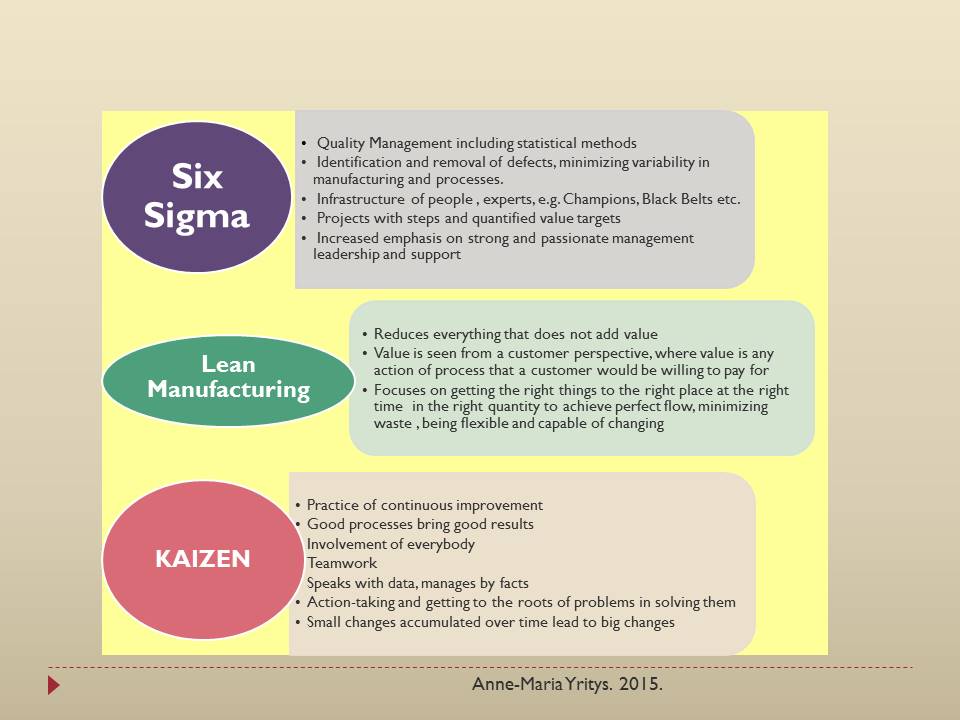
This article reflects upon Six Sigma, Lean Manufacturing (now combined and known as Lean Six Sigma) and Kaizen, and upon how these methodologies of improvement can be implemented not only in businesses and organizations, but also in all kinds of societal contexts in order to bring order to “chaos”, the usage of these methodologies as tools in transformation processes with the purpose of changing, improving and developing environments and societies.

Lean Six Sigma and Kaizen, methodologies of continuous improvement designed for, and relying upon, collaborative team efforts, have the common goal of improving performance through removing waste. According to iSixSigma, the roots of Six Sigma go back to the 18th century, although Six Sigma as a trademark was registered, and the techniques developed, by Motorola in the late 20th century. Since then, Six Sigma has been successfully used in industries and sectors in order to improve quality, and in removing defects. Lean Manufacturing as a management philosophy centers on reducing everything that is not of value. In previous years, Lean Six Sigma has become a combined methodology using both lean manufacturing and Six Sigma. Kaizen (KAI = Change, ZEN = Good), is a Japanese practice of continuous improvement, involving everyone in the process where many small changes, when practiced by everyone regularly, eventually result in bigger, positive changes and improvements.

Illustration of core ideologies in Six Sigma, Lean Manufacturing and Kaizen:

Dia1

Diaz Otero (LeanImpact.org. Effectiveness of Aid to Developing Countries: How to Improve it with Diminishing Resources?) concern about efficiency and effectiveness has increased, foremost in developed countries. With major financial cuts in international aid assistance, IGO´s and NGO´s need to improve their systems and increase effectivity. Furthermore, according to Diaz Otero, Lean Six Sigma can lead to better results even in transformation projects, and in improving people´s lives in developing countries.

As an example, in Zambia, economic and social progress has been made possible through implementing Kaizen. The Government of Zambia, in cooperation with the Japanese Government, successfully imported and facilitated the Kaizen management model both in the private and public sectors in Zambia, leading to benefits in both production levels and in the quality of products. Through implementation of Kaizen, Zambia managed to rise from being a country of low-income status into the lower margins of middle-income. (saisprogramme.com. Zambia innovating its way out of poverty with the Kaizen management model).

World Vision, a global non-governmental organization established by American evangelist Bob Pierce to help children orphaned in the Korean War in 1950, has expanded and today includes community development, disaster preparation/ response, and advocacy for the poor. Transformation development programs are today implemented in almost 100 countries worldwide. World Vision, today run by business professionals, strives to integrate the best business methods in line with the organization´s values. The organization has successfully applied Kaizen, Lean and Six Sigma methodologies in East Africa. (Parris, A. 2013. Improving processes for good in East Africa).

Examples, experiences and results indicate that Kaizen, Lean and Six Sigma (or a combination of these), are methodologies leading to improvements when correctly applied and integrated into an organization or society. Applied and used by different industries, and sectors, the methodologies can be useful in many ways.

But: Are these methodologies applicable in any kind of cultural setting, and if, how can they best be integrated into societies and organizations worldwide in an effort to, and when striving for, less bureaucracy, better results, less waste, and when improving lives: in other words, when reducing factors that lead to e.g. poverty?

Certain is that people are always the driving force behind short-term, and long-term development in a society. In every state, PESTLE (Political, Economical, Sociological, Technological, Legal, and Environmental) factors have direct influence upon how the most important asset of a nation, its people, can develop, change, and improve the society it is living in (and surrounded by).

Below a video which discusses the Problems of Societal Development from the perspective of managing complexity in modern societal-systems. In essence, according to Center of Systematic Peace, the density of communication and exchange among the members of a group add resilience and persistence to the form of a social group. Furthermore, positive group dynamics include socialization and conflict management functions.

Thank you for reading, reflecting, commenting, and considering the actions your business/organization can take to improve society.