What is The Purpose and Meaning of Yin-Yang Leadership?

The dance between darkness and light will always remain – the stars and the moon will always need the darkness to be seen, the darkness will just not be worth having without the moon and the stars (C. JoyBell C.)

Sometimes at night, when the sky is clear and the stars are shining bright, I enjoy watching the huge, free painting that Universe has given us. I wonder how many others do look at the same sky, at the same time, seeing the same patterns, having the same thoughts as I do, and sharing the same vision. Since I do not understand much about astronomy, it is unclear to me why some stars seem larger, and why some stars shine brighter than others do. Are the stars in the sky a reflection of us human beings, or vice versa? What makes the difference between the stars, and the people, that seem to be shining brighter than others?

Language is the source of misunderstandings. It is only with the heart that one can see rightly. What is essential is invisible to the eye. (The Little Prince/Antoine De Saint-Exupéry)

When communicating with each other, individual to individual, regardless of title, number of years in experience, or status, there are a number of aspects worth keeping in mind as to find the yin-yang communication style. This is especially important to leaders, but might as well be equally important to any individual.

People, and the world, cannot be divided into black and white. Yet, yin and yang in communication and leadership create a balance between natural energies and forces, allowing for the combination and motion of yin and yang to generate all things in nature, and for the darkest nights to produce the brightest stars.

To explain it simply, according to the teachings of yin and yang:

  • Without struggle, there would be no progress
  • Without pain, there would be no growth
  • Without negativity, there would be no positivity
  • Without women, there would be no male (and vice versa, of course)
  • Without passiveness, there would be no activity
  • Without the moon, there would be no sun
  • Without the flood, there would be no ebb
  • Without intuition, there would be no logic
  • Without tragic, there could be no magic

How can you, as a leader, create a yin-yang leadership style? To become a yin-yang leader, you will have to develop certain qualities in yourself:

  • Yin-yang leaders care and are compassionate

As a yin-yang leader, you will care for others and for nature as much as you care about yourself. You will also care equally much for yourself as you care for others and nature. Strive for, and live in harmony and at peace with yourself, with others, and with nature. If you are not living in balance, harmony and at peace with yourself, how then can you expect to live in such a way with your environment and with your surroundings?

  • Yin-Yang leaders are excellent communicators

Yin-yang leaders develop and nurture communication skills both in themselves, leading to improved relationships through creating understanding rather than misunderstanding, learning how to truly listen to messages that are being conveyed to them rather than wanting to have the last word and to always have the need to prove themselves to others, appreciating, respecting and valuing others in their communication, and being present during dialogue.

  • Yin-Yang leaders have a high EQ and outstanding social skills

As a yin-yang leader, you have a high EQ and outstanding social skills and value these as least as much, or even more, than merely technical skills. Yin-Yang leaders know that technical skills can be taught, learned, practiced, and eventually mastered, by anyone, but having social skills is even more important.

Yin-yang leadership can be developed and learned by anyone who truly aspires to improve his/her inter-relational, communication, and leadership skills, and who has a passion for self-mastery and balance in life, and in personal/business relations. The meaning and purpose of yin-yang leadership include many aspects that are important, and essential for leaders of the 21st century, such as creating meaning and purpose in life/business (practices), developing self-mastery, creating balance in oneself and therefore also in others, improving overall communication, avoiding conflicts and learning how to handle conflict, and much more.

If your heart is a volcano, how shall you expect flowers to bloom? (Gibran Khalil Gibran)

  • Yin-Yang leaders work for the long-term benefit of humanity

Let us face the truth: after years, decades, of working in a certain manner, or with specific goals in mind, it is not easy to turn a ship and change direction. It is not easy, but neither is it impossible. We all know that human beings, businesses, and organizations need to keep continuously evolving, developing and learning in order to make progress. Without development, there is no progress, and without progress, there is no development. Why businesses and organizations in the 21st Century increasingly have to invest in developing businesses in a sustainable direction is easy to comprehend, and the future world truly does need, and deserve leaders that do know how to tap into yet unknown lands, discovering new landscapes like Christopher Columbus and his crew did a few centuries ago, and some of our ancestors even earlier than Christopher Columbus. Humanity, and our future generations, does truly deserve and need forward-thinking, humanitarian leaders.

If you correct your mind, the rest of your life will fall into place (Dr. Wayne W. Dyer):

Thank you for reading, commenting, liking, and for sharing. Thank you also for developing balance, patience, tolerance, and understanding in yourself, and for creating and nurturing the yin-yang leadership qualities already within you. 

☯☯☯☯☯☯☯☯☯☯☯☯☯☯☯☯☯☯☯☯☯☯


How Visionary Leaders Execute Strategy

“Action without Vision is Only Passing Time, Vision without Action is Merely Daydreaming, but Vision with Action can Change the World”

(Nelson Mandela)

One of the most important qualities of successful leaders is to have vision – in other words, to possess the capability of envisioning a desired future. Vision, together with the capability of taking action and thus executing what a visionary leader has imagined in her/his mind, is according to some a missing piece in the puzzle of many leader´s minds. The lack of vision in leaders often results in actions that are neither benefiting leaders themselves, nor those around them.

No matter how important it is to take action, and work towards reaching goals, visionary leaders know when it is time to step back, pause and relax instead of making drastic moves that may either be harmful to themselves and their societies/surroundings, or result in leaders adjusting their sails according to current winds blowing, making their ships sail in any direction the wind may be taking them.

"Businessman with Brain Button". Freedigitalphotos.net
“Businessman with Brain Button”. Freedigitalphotos.net

“Business Man with Brain Button”. Freedigitalphotos.net

How then, do visionary leaders adjust the sails of their ships in a way that allows for them to navigate their ships in the right direction?

Visionary leaders do share many common attributes, including:

  • Visionary leaders live with purpose and meaning

All visionary leaders are on a mission in their lives. They have found purpose and meaning in everything they do, in the actions they take, and in the actions they are willing to take. Thus, the first step in becoming a visionary leader is to find that purpose and meaning in your life/career. What are you here for? What is your purpose, and what is your meaning? What are your aspirations? What are you willing to do, and how are you willing to spend your time fulfilling that purpose and meaning?

  • Visionary leaders focus upon holistic well-being

Visionary leaders know the importance of living their lives in a way that serves, and nurtures, both their bodies and minds. Overall well-being is at the core of leading a successful life, having a purposeful career and for living the purpose and meaning of your life. This includes nurturing your body and mind in ways that serve and benefit you and others through rest, physical activity, meditation, healthy food and healthy living habits. A healthy lifestyle, thus, is essential for all visionary leaders.

  • Visionary leaders engage in, and align daily activities according to their vision

Visionary leaders know how to combine their purpose and meaning with holistic well-being, engaging in activities that enable them to realize their vision. In order to make your vision come true, you therefore have to be capable of imagining, creating, and letting go of activities and habits that do not serve your vision.

  • Visionary leaders live with a purpose of serving others

True visionary leadership can only be executed with the purpose of helping and serving others/society. How is your visionary leadership benefiting those around you, or society in general?

“Ask not what your country can do for you, ask what you can do for your country” (John F. Kennedy)

  • Visionary leaders co-operate and team up with others

Visionary leaders realize the importance of co-operation and teamwork, and understand that visions can only become reality with the help and support from a strong team, people who share the leader´s vision, or a team with many visionary leaders sharing the same vision, a willingness to co-operate, create, and find ways of making their vision come true.

“If you want to go fast, go alone. If you want to go far, go together” (African Proverb)

  • Visionary Leaders have the courage to rise above their fears

Visionary leadership requires having courage. Courage is not lack of fear, but rather the ability to act upon the things you believe in despite of, and through transformation of fears into a space of compassion, love, and passion.

  • Visionary Leaders are connected to source

In visionary leadership, being connected to source means everything. The stronger your connection to your inner wisdom and intuition is, the easier it gets to actually express and live your vision to those around you. Visionary leaders also know how to create a bridge between their heart and mind, enabling them to freely engage with themselves and with their environments in a deep, almost mystic way.

Leadership: Do You Have What It Takes? | THE RABBIT HOLE with Deepak Chopra:

Thank you for reading, commenting, liking and sharing. Thank you also for tapping into your potential of becoming a visionary leader, or, for supporting visionary leadership.


Why Your Leadership ALWAYS Matters

"Businessman and Businesswoman". Freedigitalphotos.net
“Businessman and Businesswoman”. Freedigitalphotos.net

Leadership is the capacity to translate vision into reality. Dare to lead. (Warren G. Bennis)

As we all know, there are many differences between leadership and management. Management withholds the capability of managing tasks, while leadership, and leaders, focus upon the bigger picture, including a) the capacity of leading oneself, b) the ability to lead others c) the capability of inspiring and creating whole new possibilities through leading oneself, and other people.

“Business Collage, Innovative Concept”. Freedigitalphotos.net

The difference between merely managing, or having the capacity to both manage tasks and lead people, can be demanding for anyone, wherefore true, inspiring leadership always does require inspiration, dedication, a positive mind-set, a capability to handle complex issues with optimism, passion, purpose, and vision. Management, and leadership skills, can always be trained and developed, but true, inspiring, long-lasting, changing leadership with an impact upon one´s personal life, other individuals, and society, is possible only through dedicated, long-term work and an aspiration, together with a willingness to work towards reaching a greater purpose and goal, to make a positive impact and create positive change in the environment/in a society.

As a leader with vision, your efforts have to be aligned with your whole life, and in the way you communicate, and express your life mission to other people, and society.

Your leadership does not come from position or title, but rather from a strong sense and willingness to make a positive impact, to improve society, and to help other individuals realizing why their contribution is essential, and needed, too. True leaders do not need a position or title to create change, or to make an impact, although the best of leaders will definitely create a position for themselves through dedication and hard work.

We are all humane, and leaders especially ought to, and tend to, remain easily approachable and humane. Nevertheless, even leaders need rest and sleep, and a life lived to its fullest will make its marks. However, how we grow and mature is up to us, and since spirit is stronger than our physical bodies, a determined mind will always prosper, regardless of physical age.

Your leadership will always matter. When having moments of doubt, please remind yourself about the fact that your actions and that the results of your communication and leadership are not always visible. People will not always clap their hands, or freely express their enthusiasm towards what you are doing. Let go of your doubts, and let your leadership shine – your actions and leadership do make a difference, at all times.

I want to share with you a conversation between two leadership personalities, Dr. Wayne W. Dyer, and Tony Robbins, the work of both that has inspired not only me personally, but millions of other people worldwide:

Thank you for reading, commenting, liking and for sharing this post, and for reflecting upon the messages within this article. 

==================================================

How Do Leaders Transform Intentions into Reality?

Intention leads to behaviors which lead to habits which lead to personality development which leads to destiny. (Jack Kornfield) 

Are you dealing with difficulties in one or several areas of your life? Do you sometimes, or often, feel that you have no control or power over how circumstances or things unfold, and how the course of events occurs in your life?

If you responded with a yes to one of these questions, please continue reading this post. If your life is exactly how you want it to be, you may still want to read this, and reflect upon the message.

To help you realize your true goals, achieve them, and to transform your current life situation into a more rewarding and fulfilling journey, I will share with you a few rather simple techniques/ways of creating the life that you truly deserve, a life filled with creativity, courage, inspiration, joy and passion.

  • Acceptance and awareness

Acceptance and awareness are the first steps towards creating change in your life situation. Before being capable of creating change in the situation, you will have to become aware of it. Without awareness, there is not enough understanding, and therefore no action. Learn methods of increasing your personal awareness level. Then, accept how things are, no matter how difficult or unpleasant the situation is.

  • Breath

Breathing serves as the basic mechanism for us human beings to live, and despite of its importance and its effect upon all our internal and external activity, many people take their breathing for granted and have learned a false way of breathing, meaning that many people, due to a number of reasons, breathe superficially and in a false way. The best way to drastically and quickly improve your health, life, and well-being, is to become aware and conscious about your breathing. Learn how to breathe correctly, and how to influence all your actions and your life in general through breathing. This can be done in a number of ways, and athletes of all kinds especially know the importance of correct breathing before, during, and after an exercise.

  • Divine timing

There is a time for everything, and realizing this especially when things seem extremely challenging will help you keep calm and developing your patience. Many times, not getting what you want may be a great blessing in your life, because divinity has something else in store for you. However, you also have to be ready to take action and not wait your whole life for divine timing to jump in and make things happen for you. It will, of course, but do not sit around at home waiting, letting your life pass by. Instead, get out of your shell and get involved in activities and with people who enlighten your day.

  • Energy

Life is energy. You are energy. Your thoughts, and everything you vibrate and send out to your surrounding and into the Universe, are energy. Make sure to balance your energies, let your energies be positive, thoughtful and always inspiring, because what you radiate into your surroundings will definitely create your reality, and come back to you. Your energies are powerful, so make sure to use them wisely in order to serve both your personal purpose, and the purpose and well-being of others.

  • Focus

In a world filled with distractions, it is easy to get lost if you are not focused. Therefore, learn how to focus in all your activities. Be present in every situation, and focus upon the present moment.

  • Imagination

Everything you can imagine can become a reality. Use your imagination wisely, and do not fear to express your creativity.

  • Law of attraction

You attract what you are, not what you want. Therefore, if you want to attract what you want, you have to become what you want.

  • Meditation

Meditation is the best way to embark upon the journey of transforming your positive intentions into reality, not only because of all the health-factors that regular meditation brings with it, including the facts that regular, daily meditation helps you to improve your breathing, helps you increase your awareness and therefore also consciousness, not to forget about how meditation improves your mental and physical well-being. What could be a better way of improving your life in a drastic way, with quick results when practiced on a regular basis?

  • Nutrients

How you nurture your mind is important, but how you nurture your physical body is equally important. What, when and how you eat and drink do affect your well-being holistically. Together with meditation, focusing upon your eating and drinking habits will help you transform your body, thoughts, and mind, and therefore, your whole life.

  • Positive affirmations

Make it a daily habit to practice optimistic thinking and focusing upon positive affirmations, or mantras, in your life. Inspiration is no rocket-science, and keeping yourself inspired can be done through small habits in your daily life.

  • Repetition

Achieving your true desires, nature, and goals requires for you to repeat, and live your intentions on a regular basis = always. If you cannot change your whole life immediately, start doing so by implementing small changes into your daily habits and way of living. Repeat these at all times, until your new habits have become a way of life. It may seem difficult at first, because we often want to experience quick results, but in order to make huge life changes it is necessary for you to be prepared doing some long-term work, and focus upon making the changes you wish to see in your life, and in your daily habits, permanent ways of living rather than a one-week-cure every now and then.

What Are The Benefits of Meditation:


Thank you for reading, commenting, liking and sharing. Thank you also for creating the life you want, and for improving and transforming not only the way you live your life, but also creating and contributing to positive changes in your environment.

Leadership is the wise use of power. Power is the capacity to translate intention into reality and sustain it. (Warren Bennis). 


Dear Coach, Facilitator, and Mentor

White-fronted Scops Owls. Freedigitalphotos.net

I am writing this letter to provide you with guidance and support on your exciting, upcoming, life-long learning and development journey as a coach, facilitator and mentor in your continuously evolving identity work with individuals and people who you will meet, exchange ideas and thoughts, interact and communicate with.

However important theoretical knowledge is I would like to pinpoint the fact that your role as a knowledge worker includes a number of factors that you might want to put an emphasis upon especially. After all, the greatest asset of someone involved in human/humanitarian work, is the ability, interest, and willingness to be involved with other social beings, who all have their personal beliefs, value systems, and minds. Becoming, and being a coach, facilitator and mentor is a calling, and although not comparable with the profession of a doctor or a psychiatrist, your work can greatly affect and influence those around you. Therefore, and because you have chosen to work with minds, there are certain aspects in your work that you should especially keep in mind.  These include:

  • Acceptance

Your role as a coach, facilitator and mentor (one of these, or all combined), is not to force change in other individuals. Rather, your role is to accept people and individuals as they are. Depending upon the coaching/facilitating situation, and/or the group of individuals/people you are working with, you will have to tailor your work accordingly. There are differences between coaching, facilitation and mentoring situations/sessions, but you will always have to accept people as they are and not force change in them. Rather, seek to be a role model through your own behavior and through setting an example, and let individuals find in themselves the power to become who they were meant to be.

  • Balance

You will have to be in balance with yourself in order to create balance in your learning/teaching environment. Focus upon being in balance, and notice how you can affect your environment through the expansion of your personal energies.

  • Communication

Your work is all about communication, and about developing these skills in other individuals, including not only public speaking, but also non-verbal communication and listening skills. As a coach and mentor, you will have to develop your personal communication skills in order to create and get to desired results.

  • Creativity

Life is not about finding yourself, it is about creating you. Creativity is the lifeblood of everything, so nurture, develop and make use of your creative potential and allow for others to express their creativity as well. There are many ways of communicating and expressing creativity – just let your imagination flow freely and do not be afraid of creating completely new paths through audio, visualization, or kinesthetic learning and development solutions.

  • Development

As a coach/facilitator/mentor, you will not only deal with continuous personal development and learning, but most importantly, develop individuals and people who you work with. You will also learn to understand that development occurs at all times, although you may not always see the results immediately. Sometimes, it will take years to create and to get to the results that you seek to see through your work, but learn how to use certain types of tools for receiving feedback and making sure that at least some development is noticeable within a specific time frame.

  • Empathy and emotional intelligence

Empathy is part of emotional intelligence, but emotional intelligence stretches far beyond simply being empathetic. Your life work with human beings and individuals is all about social interaction and communication that require being emotionally intelligent. Developing emotional intelligence in your personal life and in other individuals is an essential factor in achieving success through your work.

  • Identity

As a coach, facilitator, and mentor you will get in acquaintance not only with your personal identity, but also with the identities of those who you work with. Teaching is identity work.

  • Improvisation

Improvisation, drama and theatrics are developing, learning, and teaching methods that allow creativity and imagination to expand. Improvisation is also sought-after, especially in unexpected circumstances and situations. If you have no materials to work with, improvisation allows you to create learning situations using your/your student´s minds and physical bodies to create completely new learning situations.

  • Journal/Learning Diary

If not already, learn how to journal and write down your (learning) experiences, and teach the same to those you work with. A journal/learning diary may be expressed in many forms/ways. It may be very personal, or shared in public with others. It may be expressed in a number of ways, through creative writing, poems, audio, or video. Make it a regular habit, if not daily, then at least on a weekly or monthly basis.

  • Memoir

Write a memoir about your life, and about your experiences. You can combine your journal/learning diary with your memoir, and keep it only for yourself unless you are/will be ready to publish it officially at some stage in your life. Writing/keeping a journal is a great way of learning/developing, and who will most benefit from your personal learning and development, if not you yourself, as well as your students.

  • Negotiation skills

Negotiation skills are essential in all areas of life, and business. Also in coaching and developing yourself, and other individuals. Be prepared to learn more about, and develop negotiation skills because you will need these in every aspect of your life, not least in coaching/mentoring situations.

  • Objectivity and open-mindedness

Being objective is perhaps one of the most difficult skills a human being can ever possess, since all our actions are based upon our personal beliefs, and value systems. As a coach/facilitator/mentor, however, you will have to develop objectivity and be open-minded.

  • Perseverance and persuasion

Coaching, facilitating, mentoring, and life in general, are all about learning how to persevere and to persuade. However, as already once mentioned, do not force your ideas upon other people. Rather, be a role model and allow them to tap into their greatest potential through acceptance, encouragement, and allowance.

  • Spirituality

Working with your personal mind, tapping into, and working with other individual´s minds requires for you to be spiritually open-minded and constantly open to spiritual development. Do not fear about creating and developing spiritual connections with people whom you work with.

  • Tolerance

During your career, your will have to experience, and deal with a number of situations, requiring for you to be tolerant with how things, and people, behave and unfold. However much acceptance and tolerance you will have to develop in yourself, you also will have to learn how to draw boundaries and protect yourself from certain kinds of behavior. You will also have to learn how to develop a thick skin, unless you have developed this in yourself. Be tolerant, yes, but make sure to know how to act in challenging situations.

  • Uniqueness

You are a unique individual, working with other unique individuals/personalities. Always have respect for your uniqueness, but also respect the uniqueness of others.

  • Vision

As a coach, facilitator, mentor, or all of these, you will have to have vision in the work you do, and help other individuals tap into their vision in creating their futures.

  • Wisdom

It may take a lifetime to develop true wisdom, something that only experience can teach us. However, seek to develop wisdom in yourself and in your students because wisdom allows us to raise our vibrations and evolve into human beings with a higher spiritual consciousness.


What Do You Need to Succeed in Business?

I never dreamed about success. I worked for it. (Estee Lauder)

Your success in business, entrepreneurship and in life, in general, can be defined by a number of factors, and through how hard and persistent you are willing to work in order to reach your personal goals. It does not matter whether you are an apprentice, a clerk, a CEO or whatever your current title may be. Rather, forget about and drop your title and focus upon what you truly want to achieve in life.

We continuously grow and learn in and through life. What you are today may not be equal with what you want to be, and will be tomorrow.

Many people dream about being CEO´s, but as soon as they get the experience of being one, they start dreaming about becoming something else. Before you throw yourself into something because of the title (or, the money), consider the WHY. Why do you want to be XYZ? What is your purpose? And, what is your passion?

No matter what, your desires may change with time and experience. After all, we are here to develop, evolve and learn not only about our environments, but also about ourselves. How far you are willing to go in your career depends upon a number of factors, and personal qualities, in addition to your maturity as an individual.

The definition of success is personal, but succeeding in business and entrepreneurship withholds a number of internal and external attributes that you either possess or should actively develop in yourself in order to succeed in business life.

1. Know what you stand for. Know yourself, what you are about, and what you have to offer. Know the services/products you are capable of, and willing to, offer your clients.

If you do not know yourself or your business, how can you assume anyone else can? The first thing you have to do in order to become successful, is to define yourself, your values, your purpose, passion, and what you and your business have to offer.

2. Ambition.

Ambition is a natural attribute in human beings. There is nothing wrong in being ambitious. If people told you otherwise, you have to unlearn this nonsense. Be ambitious in achieving your dreams and in working for a purpose. However, learn how to distinguish between being normally ambitious and in being extremely ambitious. People may fear extreme ambition, so be aware of stepping upon other people´s toes. Nevertheless, learn how to say no and how to stand up for your personal beliefs. After all, you do not want to end up being a people-pleasing doll or anything alike.

3. Determination.

Business, and life in general, requires determination. You have to be willing to throw your hat in the ring. You have to learn how to be stronger than your fears, and even though we all have certain fears, it is necessary to learn how to win your fears and transform these into positive action. Nothing worth doing is easy, but the more actions you take, and the more you step out of your personal comfort zone, the more you will gain. Try it out and see for your self.

4. Vision.

Know yourself, your business, and have a direction. Without goals and direction your ship will simply sail across the oceans being at risk for losing both its sight, and the people on board.

5. Emotional Intelligence.

In business, entrepreneurship, life in general and in all social interaction you will have to learn emotional intelligence skills. Emotional intelligence includes a wide spectrum of capabilities, such as learning how to read people, how to cope and how to negotiate in challenging situations, but also how to protect yourself from toxic people in your environment and how to remove their power over your (business) life. Developing, and learning, emotional intelligence skills are essential for succeeding in life, and in business. I can warmly recommend for you to read Emotional Intelligence 2.0, a book written by Dr. Travis Bradberry and Jean Grives, recommended by The Dalai Lama himself, including life-changing tips in how to become more successful in your life, and in business. Do not let the lack of emotional intelligence be a hinder for your personal, and/or, business success.

6. Soft Skills.

Use your soft skills and life/professional experience to succeed. Be yourself, be authentic. People do, and will notice whether you are authentic or not. There is no point in playing roles, or in trying hard to be something else than you truly are. Get rid of your fears, and get real. People who appreciate your true, authentic nature, will find their way to you and stay around you. In a world that sometimes may feel harsh, soft skills are in real demand. The world needs authentic, true people who are capable of developing leadership and business using soft skills for success. You are the one to demonstrate those traits, and qualities, to businesses, people, organizations, and societies around you.

7. Drive, passion, purpose, and love for what you do in life.

Expressing passion, purpose, and love for everything you undertake in life and in business, will lead you to success. If you have no passion for what you do, you may as well give up and let someone else take over. Dance as if this were your last day in life – do not be afraid to sweat, nor about giving yourself fully into whatever you are practicing, as long as it serves your passions, and purposes.

8. Risk-taking capability and risk-tolerance.

All action, business, and entrepreneurship requires risk-taking capabilities. Without any risks, there cannot be any rewards. However, integrate risk management into your operational practices and never risk more than you can actually handle.

9. Self-confidence, trust in yourself in and in your future plans.

All success requires action, and action requires the ability of overcoming your fears. There is always a risk of failure, but those who want to avoid failure at all costs are never capable of taking action and vice versa. Therefore, have confidence in yourself, in the things you do and want to pursue, and create an attitude for success.

10. Learn how to plan your future, have an open mind, be determined, and willing to succeed.

Things do not always turn out, or unfold, the way we want them to, but all successful action, business, and entrepreneurship requires for its leader to be capable of planning ahead, and most preferably long-term. There is a point in living in the present moment, but future success also requires for you to be capable of planning the future of your life, and business.

11. Essential business AND people skills.

You can, and will, learn business and people skills through work and business life, but also through international business management education such as earning an MBA (or, another higher education including people management skills). If not through education, then through practical experiences. Life, and business, are about developing and creating long-term partnerships and relationships. Therefore, these skills will be essential for your success in business, and in life. Essential business skills, knowledge, understanding and wisdom also include the capability of understanding global operations holistically, understanding economics, politics, and geography.

Finally, learn through this YouTube video what Richard Branson has to say about succeeding in life, and in business:

Thank you for reading, commenting, liking and for sharing this post. Thank you also for having passion, purpose, and drive in your life, as well as using your soft skills together with your emotional intelligence.


How Do Inspiring Leaders Create Change?

The time is always right to do what is right. -Martin Luther King Jr. 

How many truly inspiring leaders do you know? People who have contributed to creating waves of change through vision, action and continuous selfless efforts in improving circumstances, people and societies.

What differentiates inspiring leaders different from other people? Are they truly so different from others? Perhaps yes, but most probably not. Anyone can be an inspiring leader – it is a question about willingness and readiness to accept joy, inspiration, and positive thoughts, leading to positive actions, creating a positive environment and seeing how your personal world starts changing, leading to positive changes in your environment as well.

Being positive in a negative situation is not naive. It is leadership. -Ralph Marston

Being, and becoming an inspiring leader is something that you have to work upon every day, until it becomes a habit and a way of life. Everyone, even the most inspiring leaders, has weak moments, which is of course humane. Inspiring leaders know how to cope with feelings of fear and discomfort through acceptance and an ability to transform these lower-frequency energies into higher energy vibrations that lead to positive results.

Inspiring leaders will do what it takes to: 

  1. Continuously develop themselves and their self-knowledge

Inspiring leaders know both their strengths and their weaknesses, and are willing not only to accept these but also capable of admitting that they do have weaknesses. Being conscious and knowing yourself are the basics for continuous personal development. Sometimes personal development is taking two steps forward and one step back, but as long as you keep going you will develop.

2. Empower themselves and people around them

Inspiring leaders know how to empower others, but most importantly – they know how to empower themselves. A leader has to be confident enough to feel and be personally empowered before knowing how to empower others.

The best leaders gain power by giving it away. 

3. Embrace failure

Failures are a part of success. The most successful of leaders may have failed a zillion times, but they always get up and continue their work. Failure is a great teacher, and inspiring leaders accept failures as important lessons on their path to greatness and success.

Failure is not the opposite of success. It is part of success. 

4. Stay in motion

No matter how slow a process sometimes may seem, or how long it may take to achieve a goal(s), inspirational leaders always stay active and in motion. Even inspiring leaders have moments of lost inspiration, but nevertheless they stay in motion working towards reaching their goals and working towards results, knowing that inspiration will follow them on their journey.

5. Co-operate and partner up with others

Inspiring leaders sometimes work alone, but they also know the importance of cooperation, partnering up with others and investing into teamwork. People are at the core of all action for inspiring leaders because they know that without other people, they would be alone in this world. People make a difference. People are important. 

6. Listen more than they speak

Inspiring leaders listen more than they speak. Listening to others demonstrates that you are interested in learning more about what a person has to say, and to offer. Listening to oneself is also important. 

When you talk, you only repeat what you already know. If you listen, you may learn something new. -The Dalai Lama

7. Develop their emotional intelligence

Inspiring leaders either are emotionally intelligent, or they want to be. Emotional intelligence is something we can all develop in ourselves, and emotional intelligence can be more important than IQ when it comes to succeeding in life.

Educating the mind without educating the heart is no education at all. -Aristotle

8. Let others lead and succeed

Inspiring leaders are all about developing and growing leadership around them, and they enjoy seeing other people succeed. They know how to work in a team and understand the importance of shared leadership.

9. See the potential in others

Inspiring leaders see the potential in other individuals and know how to get results together with, and with the help of others. Inspiring leaders know that everyone has his/her unique strengths that are essential in contributing and in creating results.

10. Understand that change is a continuous, universal process

Truly inspiring leaders are willing to live their passion, inspiration, and dreams, passing them on to people around them. Inspiring leaders will always find their way to other people’s hearts.

  1. Grow throughout life, realizing that inspiring leadership is a life-long journey rather than a short-term trend.

Inspiring leadership brings with it, and creates, long-lasting changes in people and in societies. Being an inspiring leader is about giving more than you expect back, being willing to help others, serving and valuing people around you. Inspiring leadership is authentic, being and expressing who you truly are, caring, daring, and deep. Inspiring leadership does not care about age, gender or other external qualities, but rather focuses upon internal factors that, when correctly channeled, have the capacity of creating and establishing long-term inspiration in the external world.

May your choices reflect your hopes, not your fears. -Nelson Mandela

Author ́s note: I first wrote and published this post on my website and on LinkedIn on August 26th, 2015 (four years ago today). Today, I made some minor adjustments to the post. This post has been one of my most read and shared posts on LinkedIn (316 reshares on LinkedIn), at the time when LinkedIn still featured articles in different categories. This article/post was featured in the Leadership & Management category. Anne-Maria Yritys, August 26th 2019. 


How Can You Increase Your Influence in Society?

The key to successful leadership today is influence, not authority (Kenneth Blanchard)

The best leaders of the 21st century are those who are active, constantly evolving, focusing increasingly much upon influence and empowerment rather than upon authority, leading through example, learning from their mistakes (and making mistakes in the first place), accepting mistakes and the learning process followed by the allowance of making mistakes, emotionally intelligent, humane, close to nature, and ready to throw themselves into creativity, seeing endless possibilities through action-oriented learning and development, be it in themselves, or in other individuals.

Never underestimate the influence you have upon others, and thus, on society around you, regardless of your background or current professional title. 

How can you influence people, and change society, then?

Influence begins with your daily activities, the choices you make in your daily life, and about your future. Influential people do not always even recognize their personal influence, but even the slightest spark you as an individual are capable of creating in another individual may lead to significant development, and changes in society. The results are not always immediate, but be aware of the fact that your inner fire will be reflected upon everyone in your society, and thus lead to significant improvements in society, or to decreased satisfaction among people surrounding you. We all have our personal life paths that have influenced the people we have become, and all our current and future actions will definitely lead to, and have an impact upon how society around us will develop now, and in the future.

How then, as an individual, can you make a difference and influence people and society around you???

  • Be prepared and willing to engage in long-term work, personal development and continuous learning.

The first rule of becoming a true developer and change-maker in society is to embrace personal learning, development, and humility. Always be open to engaging in dialogue, listening to people, and learning from real life and through experiences.  True maturity emerges from the ability to stay open-minded, curious, and tolerant together with the willingness to grow as a spiritual being and as an individual.

  • Do not expect quick results.

Humanitarian and influential work requires more than you think. Be prepared to engage in work and make efforts that become visible only in X years from this moment, rather than focusing upon getting short-term results in three months. Of course, short-term work is significant as well, but real influence starts with the ability to create lasting, long-term changes in individuals and in society.

  • Be honest, authentic, and true to you.

True leadership and influence begins with the ability or remaining true to yourself, your authentic individuality, and in how you would like to see society around you. It is not always easy to close your ears and other senses, but authenticity requires for you to be capable of envisioning the current state and a future you would like to envision before being capable of creating it in reality. Always keep your ears open when listening to others, but also remember that your purpose in society is not in accepting everything as it is, the status quo, but rather in reshaping and redefining the future you want for yourself, and for the people around you.

  • Stop dreaming and start acting.

No one will ask you, so you will have to take action yourself. Do not expect anyone to lead you on the way. Instead, get active and start living in a way that reflects who you truly are, and how you would like to see society evolve around you.

  • Drop your professional title.

Professional titles are not an entitlement, nor a guarantee about the quality of the work you do. Very often people have beautiful titles, but look deeper into what is included in their job title. Do they live up to the expectations of their job title, or are they merely “products of their environments”, governed and controlled by their employer?

  • Meditate, sleep well, and relax.

Influence requires a peaceful mind, so be prepared to cut unnecessary activities and people from your direct personal life, and instead focus upon activities that bring you joy, make you feel empowered, and that offer your personal development activities. Leaders have a tendency of overworking themselves, so please remember to learn to say no as well, and to get the rest and recuperation that you truly need, and deserve.

  • Set your goals high, always expect more from yourself than from people around you, but also remember to forgive yourself and not to be too demanding upon the expectations you demand from yourself, or from other people.

We all wish to accomplish certain things in our lives, but remember to remain humane, and never expect other people to accomplish something that you would not be capable of achieving personally. I have always wondered how certain people are capable of expecting things they would never be capable of achieving themselves. True leaders know the way, show the way, and remain humane in the process of setting an example and in leading the way. True influencers and leaders do not only set an example, but are also capable of living up to the expectations.


Why Your Projects Fail and Suggestions for Improvement

"We Need to Improve the Plan". Freedigitalphotos.net
“We Need to Improve the Plan”. Freedigitalphotos.net

The P in PM is as much about People Management as it is about Project Management (Cornelius Fichtner)

Are you a project manager whose projects have failed more often than succeeded? Well, congratulate yourself for still having the title project manager, because if you had participated in The American Apprentice, Mr. Trump would already have fired you. No hard feelings though – it is nothing personal, it is only business, citing Mr. Trump.

And, to comfort you: you are most probably not alone with the problem, since most projects actually do fail, due to a number of reasons at the core of which are poor requirements, a poor scope definition (poor planning) from the beginning AND communication problems.

A project, according to the Project Management Institute, is a temporary endeavor undertaken to create a unique product, service, or result. Furthermore, a project usually has a definite beginning and an end. The target has been met once the project´s objectives have been met, or when the need for the project ceases to exist. Projects can last for years, even decades, depending upon their social, economic, and environmental impacts. In other words, a project can vary from a set of regular (daily, weekly) tasks with the purpose to reach a certain goal to more serious projects which indeed can last for years or even for decades.

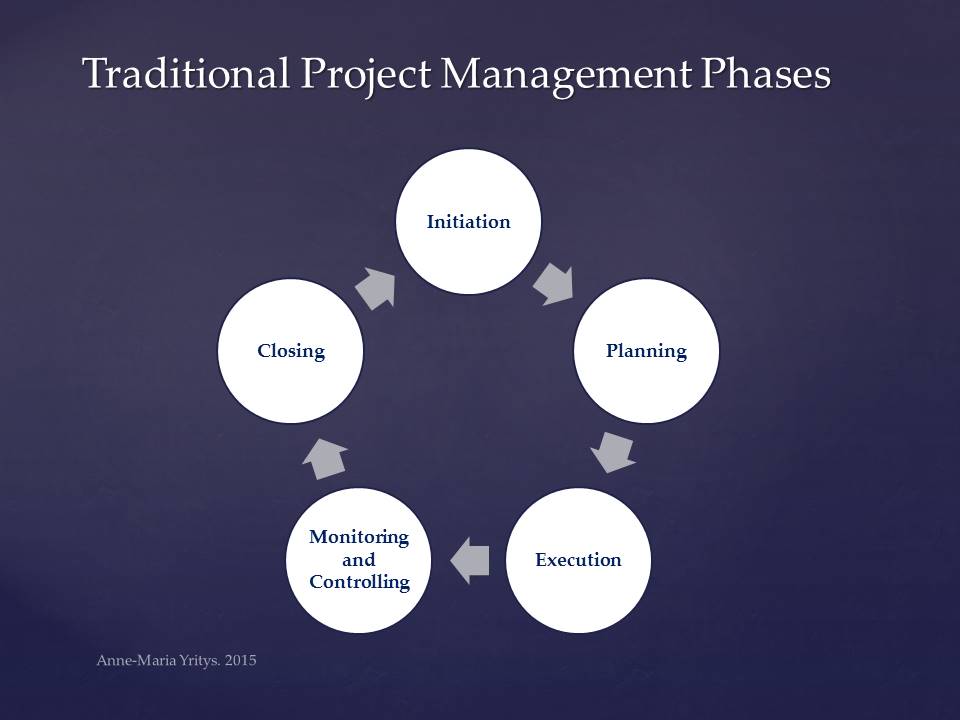
As applicable to business (and development projects), successful project management requires skillful application of a wide range of knowledge, tools and techniques in order to meet the requirements. Traditional project management distinguishes five process groups as the illustration below simply demonstrates:

Dia1

Depending upon the nature and the complexity of the project, various project management techniques can be utilized. Traditional project management, very structured, requires being well-organized, and as a supportive guide I can warmly recommend the American Project Management Institute´s “A Guide to the Project Management Body of Knowledge (PMBOK® Guide)”, a comprehensive book including all technical details required for managing a project, from product life cycle management to project communications management. It even includes a chapter about how to handle interpersonal communication.

Although project management, as anything else in (business) life, cannot be learned solely from books, the PMBOK serves as an excellent guide to almost any project. Of course, the guide can be accustomed to the nature, length, and complexity of the project. Here, as with anything else, common sense is applicable.

Furthermore, managing a project requires for the project manager, and the project team to:

– Identify requirements – without requirements, the project would not be needed in the first place

– Addressing needs, concerns, and expectations of the stakeholders

– Balancing the competing project constraints including at least the following requisites:

Dia1

As said, projects vary significantly from type, purpose, length, and complexity. An example of a long-term, complex, global, societal, and economical project are the United Nations Millennium Development Goals. The goals were set (the project was initiated) in 2000, with a deadline in 2015. So far, only three of the eight goals have been met, although significant progress has been made in each of the goals. Analysis regarding the reasons for failure is certainly possible, and assumption is that analysis is being made upon these within the UN organization. Despite of failing to reach all the goals within the project timeline, the UN in co-operation with different instances is already planning new goals, and continues its important work towards improvement of socioeconomic circumstances in geographical regions most affected e.g. by poverty.

Another type of project management is Agile PM.

Logic will get you from A to B. Imagination will take you everywhere. (Albert Einstein)

Whereas traditional management theory (and traditional project management) assumes that

– Regulating change requires rigid procedures

– Hierarchical organizational structures establish order

– Increased control results in increased order (organizations must be rigid and static)

– Employees are interchangeable particles of the organizational machine (rat race?)

– Problems are mainly solved through reductionist task breakdown and allocation

– Projects and risks can be managed only through complex up-front planning

Agile project management professionals, on the other hand, look for emerging management principles based upon “new science” of complexity exploiting an understanding of autonomous human behavior gained through studying living systems in nature. Complex adaptive systems (CAS), and complexity scientists have studied the collective behavior of living systems in nature: flocking of birds, schooling of fish, marching of ants and the swarming of bees, discovering that while the individual “agents” in these complex adaptive systems possess only local strategic rules and capacity, their collective behavior is characterized by an overlaying order, self-organization, and a collective intelligence that is greater than the sum of the parts.

CAS has been applied successfully in several areas, including economics, and management. In CAS, the (project) manager becomes an adaptive leader, encouraging constant feedback and collaboration. CAS in Agile PM enhances the ability to deal with change, views organizations as elastic, fluid systems composed of intelligent human capital, and an overall humanistic problem solving approach. Every project needs a leader, and in Agile Methodologies the PM is rather a leader than a taskmaster with qualities such as vision, communication skills, and soft management skills, in addition to technical and organizational skills. (Agile Project Management. http://www.ccpace.com; Highsmith, J. 2004. Agile Project Management).

Agile Project Management, as Traditional Project Management, can be used in any kind of setting. Both methodologies can also be combined, utilizing the best parts of each in order to create the best possible result(s).

In summary, the most common reasons for project failure are:

– Poor planning in the first place, and poor requirements definition

– Unrealistic goal(s) from the beginning (dreaming, having goals and optimism is wonderful, but goals also need to be realistic) => Poor Scope Definition

– Miscalculations regarding time and budget

– Too many projects at once (project manager and team members are overloaded with work)

– Poor leadership (and thus poor project execution, e.g. teams are not integrated well enough)

– Poor communication

– Technological problems (although, depending upon the project – may be of most relevance in IT and technology projects)

– Poor risk calculation, and management

How to avoid project failure: 

SELECT A QUALIFIED PROJECT MANAGER, WHO KNOWS HOW TO SET UP A PROJECT TEAM AND HOW TO LEAD PEOPLE. (REMEMBER: TASKS ARE BEING MANAGED, PEOPLE ARE BEING LEAD).

SET REALISTIC GOALS. IT IS NICE TO DREAM BIG, BUT TO AVOID FAILURE, REALISM IS NECESSARY.

PLAN THE PROJECT THOROUGHLY, INCLUDING THE DEFINITION OF REQUIREMENTS, ORGANIZATION AND RISK MANAGEMENT OF THE PROJECT.

SET A REALISTIC TIME FRAME AND DEFINE AN APPROPRIATE BUDGET WITH A +/- CALCULATION.

MAKE SURE NOT TO OVERLOAD EMPLOYEES WHO ALREADY ARE INVOLVED IN (MANY) OTHER PROJECTS. MAKE SURE THAT PROJECT MEMBERS HAVE ENOUGH TIME, ENERGY AND ENTHUSIASM FOR THE REALIZATION OF THE PROJECT.

FOCUS ON LEADERSHIP RATHER THAN ON MICRO-MANAGEMENT, ESPECIALLY WHEN IT COMES TO LONG-TERM PROJECTS.

LEARN HOW TO COMMUNICATE EFFICIENTLY. COMMUNICATION SKILLS CAN ALWAYS BE DEVELOPED, HOWEVER GREAT A COMMUNICATOR YOU BELIEVE YOURSELF TO BE.

FORMULATE A RISK MANAGEMENT PLAN FOR YOUR PROJECT, INCLUDING POSSIBLE RISKS AND THEIR MINIMIZATION + WHAT ACTIONS NEED TO BE TAKEN IN CASE OF EMERGENCY.

AUDIT THE PROJECT ON A REGULAR BASIS WITH THE HELP OF PROFESSIONAL, UNBIASED AUDITORS.

Chaos in the world brings uneasiness, but also allows the opportunity for creativity and growth (Tom Barrett)

Reasons for Project Failure (IAG Consulting):

~~~~~~~~~~~~~~~~~~~~~~~~~~~~~~~~~~~~~~~~~~~

Thank you for reading, reflecting, commenting, and for sharing your experiences about successful/unsuccessful project management.


Natural Healing for Leaders

Wild flowers. Finland 2015. Photograph: Anne-Maria Yritys
Wild flowers. Finland 2015. Photo: Anne-Maria Yritys

Nature does not hurry, yet everything is accomplished. (Lao Tzu) 

Great leadership equals great responsibility, and great responsibility requires maturity and patience. Important, long-term decisions are not to be made in hurry, but rather with thoughtfulness.

Nature is our best teacher in making better leadership decisions, because when you look deep into nature, you will understand everything better (Albert Einstein).

Don´t haste through life, GROW through life. 

Adopt the pace of nature. Her secret is patience. (Ralph Waldo Emerson) 

Nature also cures, lowers blood pressure, acts as an antioxidant for your skin and body – a natural therapy, and a couple of hours spent in nature may be worth more than any other treatment.

Nature also calms your breath, helps you get rid of stress, anxieties, and a walk in nature is a great counterbalance for all kinds of athletes. Life cannot always be a race, a marathon, or a triathlon. Even high performers need a break, calm and peaceful activities that even out the hectic everyday life.

Get out in nature – go for a walk in the forest, for a hike, to a silent beach, up to the mountains or where ever you can truly relax and detach from all the noise in your life. Make it a regular activity/exercise, and notice how your life, and thoughts, start changing.

Thousands of tired, nerve-shaken, over-civilized people are beginning to find out that going to the mountains is going home; that wilderness is a necessity; and that mountain parks and reservations are fountains of life. (John Muir) 

Nature. Cheaper than Therapy. 

Relax 8 Hours-Relaxing Nature Sounds-Study-Sleep-Meditation-Water Sounds-Bird Song:

Thank you for spending time daily out in nature.