Climate Change Expected to Reduce Crop Yields

Global Climate Change (72).jpg

“WHO. Increasing temperatures and more variable rainfalls on our Planet are expected to reduce crop yields in many tropical developing regions, where food security already is a problem.”

================================================================

Note from author: Although WHO´s statement refers only to crop yields in many tropical developing regions, anyone who has even the slightest experience/understanding about agriculture and farming, along with general comprehension about biology/geography will realize that one of the major risks of agriculture involves weather. It also depends much upon fresh water, healthy soils and a healthy environment. If and when weather patterns change (drastically) by becoming less and less predictable, with e.g. too much rain, it can have significant impacts upon crop yields, or at worst, even destroy a whole crop.

With agriculture being the largest consumer of fresh water resources worldwide, there is a need for optimizing fresh water usage in the agricultural sector. FAO (2012) has published a report, Crop yield response to water with the purpose to serve primarily agricultural practitioners along with a number of other target groups with important information on how to possibly optimize fresh water usage in agricultural/farming practices. The complete report can be found here: Crop yield response to water

At another TEDx Talk, Mark Owen speaks about the future of water:


Connect with me on Twitter @annemariayritys – for climate-related posts only @GCCThinkActTank & to receive my newsletter delivered personally to you, subscribe to Leading With Passion

Half of World Population Already Affected By Water Scarcity

Global Climate Change (71).jpg

“WHO. Globally, (fresh)water scarcity already affects four out of every 10 people. Poor water quality also increases the risk of diarrhoea and trachoma.”

==============================================================

A lack of fresh water is (no longer) a nightmare that people in a number of African countries have to live with, as e.g. I was taught as a child. Another raw fact is that we actually do have enough fresh water resources for ALL living beings on Earth, humans, animals, and plants, but there is a greedy and corrupted elite that does not care about the welfare of others, and who instead consume at least thousand times more fresh water than they would actually need, leaving others to suffer.

The shortage of fresh water is not a question of availability, but rather of greediness and lack of empathy for those in need, and, of course, a firm belief by ruthless human beings who think they deserve better and more than others. What does not surprise me at all is that the United States is the biggest consumer worldwide, per capita, of the world´s fresh water resources, followed by the United Arab Emirates. If every greedy person on this planet would take a look in the mirror + after that long look make even small adjustments to his/her consumption habits, we could actually reduce fresh water usage drastically and enable that every person on this planet has access to clean, fresh water which is a BASIC HUMAN RIGHT. The problem is no longer only that the poorest people have no access to fresh water, since almost half of world population now lack access to clean, fresh water, including the “middle class” in many countries. So, act now and do something before it is too late.

Learn more here:


Connect with me on Twitter @annemariayritys – for climate-related posts only @GCCThinkActTank & to receive my newsletter delivered personally to you, subscribe to Leading With Passion


Rising Sea Levels Could Cause Population Displacements in Coastal Areas

Global Climate Change (70).jpg

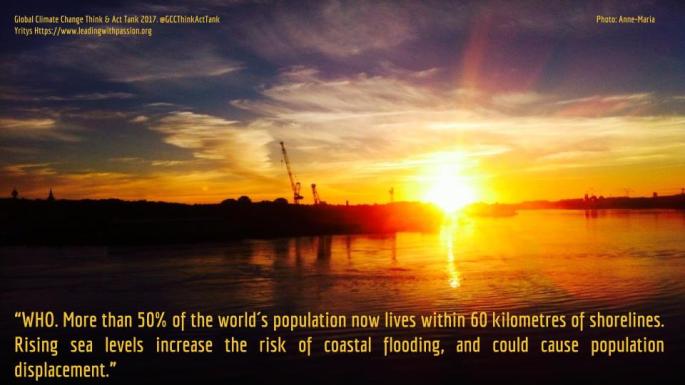
“WHO. More than 50% of the world´s population now lives within 60 kilometres of shorelines. Rising sea levels increase the risk of coastal flooding, and could cause population displacement.”

=============================================================

We are experiencing serious floods all over the world, not only in the United States that was hit by several hurricanes on its East Coast this Fall, causing billions of dollars of damage and leaving many people without a home to return to. In Europe, the amount of floods is expected to grow with 60% by 2050.

According to WeatherWar101 on YouTube, Paris and Europe Floods – Proof all are Entirely Manmade:

What do you think? Do we have a weather war going on in our world, where the weather is on purpose being manipulated through geoengineering, causing natural disasters such as extreme drought, wildfires, extraordinarily severe hurricanes, floods, and even mountains breaking apart? Let me know your thoughts.
Connect with me on Twitter @annemariayritys – for climate-related posts only @GCCThinkActTank & to receive my newsletter delivered personally to you, subscribe to Leading With Passion
Deaths Related To Climate Change On The Rise

Global Climate Change (69)

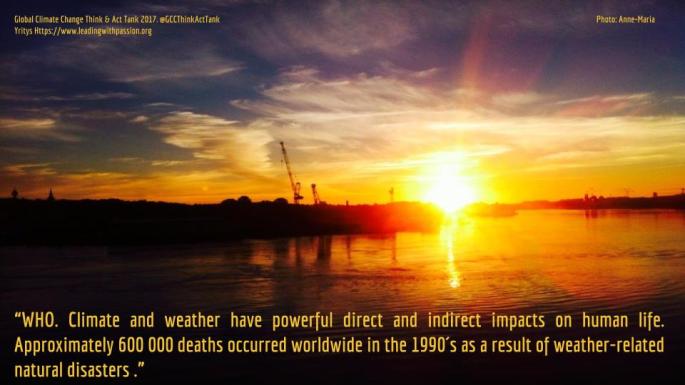
“WHO. Climate and weather have powerful direct and indirect impacts on human life. Approximately 600.000 deaths occurred worldwide in the 1990´s as a result of weather-related natural disasters.”

==================================================================

According to current research, hundreds of millions of people will face deadly weather events by 2100. In Europe alone, it is expected that up to 150.000 people could die every year due to climate change. The Study,  “Increasing risk over time of weather-related hazards to the European population: a data-driven prognostic study”, funded by the European Commission, reveals that at least 2/3 of European population (more than 350.000 million people in Europe alone) could be faced with climate change and weather related disasters by 2100. These numbers are enormous. (Forzieri, G., Cescatti, A., Silva B.e. & Feyen, L. Lancet Planet Health 2017;  1: e200–08).

If in Europe alone, which is the leading continent in environmentally friendly practices and actions against climate change, the prognosis suggests numbers like this, what will people on other continents face? Asia is the most populated continent on Earth, currently emitting the most greenhouse gases in total, while the Americas is the leading greenhouse gas emitter per capita, the U.S.A. currently emitting more greenhouse gases per person than any other country in the world. Our world cannot handle these increasing extreme weather events without serious damage in all areas of life, as we see as an example on National Geographic´s video where Firefighters Battle the Infernos of Climate Change:


Connect with me on Twitter @annemariayritys – for climate-related posts only @GCCThinkActTank & to receive my newsletter delivered personally to you, subscribe to Leading With Passion


Climate Change Poses Several Health Risks

Global Climate Change (68)

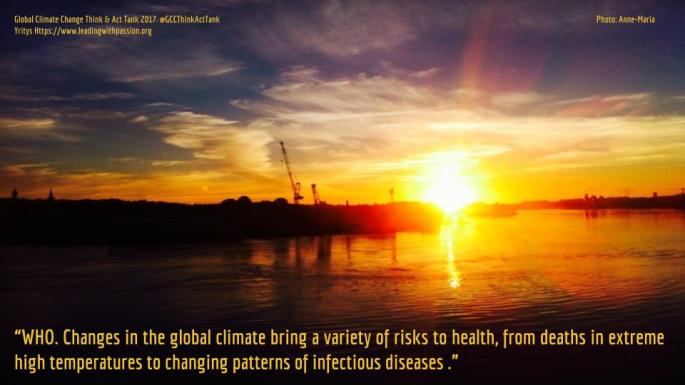
“WHO. Changes in the global climate bring a variety of risks to health, from deaths in extreme high temperatures to changing patterns of infectious diseases.”

================================================================

Note from author: The consequences of climate change affect not only our environment and livelihood on the planet in general, but does also endanger human health in a number of ways. Increasing droughts, extreme heatwaves, floods etc. expose people (and, all life on Earth) to e.g. tropical diseases. Natural disasters are followed-up by more risks of e.g. diarrhea and many other diseases. In addition, due to thawing permafrost in the Arctic regions we may be facing surprising health problems since decayed plants and animals get exposed, releasing e.g. methane which is at least 25 times as powerful as a greenhouse gas compared to carbon dioxide. Who knows for sure what lies ahead of us?

Following video, published by Climate State, discusses The Health Risks of Climate Change:

Connect with me on Twitter @annemariayritys – for climate-related posts only @GCCThinkActTank & to receive my newsletter delivered directly to you, subscribe to Leading With Passion

How Well Protected Is Our Ozone Layer?

Global Climate Change (67).jpg

“EC Climate Action. Environment fact sheet. Ozone layer protection: The ozone layer is crucial for life on Earth, protecting us from harmful UV rays. Experts blame ozone-layer depletion on man-made chemical. For more information, see the Montreal Protocol.”

==================================================================

Note from author: The original Montreal Protocol entered into force on January 1st, 1989, with the purpose of eliminated the use of ozone depleting substances (ODC), acting as a ratified international environmental agreement. (UNDP – Montreal ProtocolThe Montreal Protocol On Substances That Deplete The Ozone Layer).

Despite of the significant achievements and protection the Montreal Protocol has given, we still face many challenges. Although the ozone layer has been basically completely repaired in some parts of the world, keeping back and protecting us from harmful UV rays, there are regions at especially high risk, such as Antarctica.

UN Environment has published following video, The Antarctic Ozone Hole – From Discovery to Recovery, a Scientific Journey:

Connect with me on Twitter @annemariayritys – for climate-related posts only @GCCThinkActTank & receive my newsletter delivered personally to you by subscribing to Leading With Passion

Why Does Agriculture Emit So Much Greenhouse Gases?

Global Climate Change (66).jpg

“Worldwatch Institute. Vision for a Sustainable World. Agriculture is the 3rd largest contributor to global greenhouse gas emissions by sector, following the burning of fossil fuels for power and heat, and transportation.”

===============================================================

Note from author: According to research, agriculture is the 2nd (or, 3rd) largest greenhouse gas emitter of all industries. This may be a surprise to many who are not aware of how and why agricultural production releases e.g. so much carbon dioxide. The main causes to agriculture releasing so much greenhouse gas emissions include:

  • the release of nitrous oxide from different farming techniques
  • fertilizer manufacture
  • refrigeration
  • post-production: storage and transport

(Vermeulen, S. J.Campbell, B. M. & Ingram, J. S. I. Annu. Rev. Environ. Resour. 37195222(2012).).

Furthermore, according to FAO: Greenhouse Gas Emissions from Agriculture, Forestry and Other Land Use, there is a continuing growth in greenhouse gas emissions from agriculture, with Asia being the largest emitter (44%), followed by the Americas (25%), Africa (15%), Europe (12%) and Oceania (4%). Livestock-related emissions from enteric fermentation and manure contributed almost 2/3 of total emissions:

  • enteric fermentation (40%)
  • manure left on pasture (16%)
  • synthetic fertilizers (10%)
  • paddy rice (10%)
  • manure management (7%)
  • burning of savannahs (5%)

(FAO. Greenhouse Gas Emissions from Agriculture, Forestry, and Other Land Use).

Simply explained, animal farming contributes to much higher levels of greenhouse gas emissions compared to e.g. crops. Not only because agriculture first produces crops in order to feed animals. The longer the food chain, including storage and transportation, the higher the amounts of greenhouse gas emissions. This is why FAO in its recently updated strategy urges to sustainable food production, and a reason for choosing as many local products as possible, including consumption according to seasonal variations.
The following video material, Life Cycle Assessment and Greenhouse Gas Emissions from Animal Agriculture, published by Livestock & Poultry Environmental Learning Center, explains how this works:
Connect with me on Twitter @annemariayritys – for climate-related posts only @GCCThinkActTank & to receive my newsletter delivered personally to you, subscribe to Leading With Passion
 

Why Are We Raping Our Soils?

Global Climate Change (65)

“NSW Government. Office of Environment & Heritage. Examples of soil degradation: water erosion, wind erosion, salinity, loss of organic matter, fertility decline, soil acidity or alkalinity, structure decline, mass movement, soil contamination.”

====================================================================

Note from author: In addition to air pollution, ocean acidification, ruthless geoengineering, lack of recycling and a number of other environmental problems we are facing on our planet, you have to start taking soil degradation seriously. Why? Let me list a couple of hard facts:

  • Soil degradation through a number of activities, such as poor soil management, leads to serious problems that affects us all. It is not something that just occurs to your nasty neighbor or someone who lives in another country. If you have not yet realized this, let me get straight to the point: Unless you are a 100% self-sufficient farmer, you depend on about half of the world every day, even before your breakfast has been served. Think about that.
  • The more we rape our soils around the world, the less will we be able to produce. In addition, when we pollute our skies and water sources, the same pollution ultimately ends up in our soils. So stop being a co-criminal of raping our Earth´s ecosystems and make sure to take responsibility for your consumption and behavior.

If this was not enough of argument to convince you, watch this video:


Connect with me on Twitter @annemariayritys – for climate-related posts only @GCCThinkActTank & to receive my newsletter delivered personally to you, subscribe to Leading With Passion
 

What Is Happening To Our Soils?

Global Climate Change (64).jpg

“NSW Government. Office of Environment & Heritage. Soil degradation, a serious environmental problem, is the decline in soil condition caused by its improper use or poor management, usually for agricultural, industrial or urban purposes.”

=================================================================

Note from author: When speaking about soil degradation, we refer to a number of different factors affecting the quality of soils by making them become less healthy e.g. through losing nutrients. The reasons for soil degradation vary, including physical, biological and chemical factors, deforestation, misuse of fertilizers, industrial and mining activities, improper cultivation practices, urbanization, and overgrazing. (EF. Conserve Energy Future).

According to the FAO and the UN, it takes 1.000 years to create three centimeters of top soil. If the current development continues at this rate, we have only 60 years left of agriculture. (Scientific American). Alone in India, as an example, soil degradation has become an overall serious problem, endangering the whole agricultural sector. (Sustainability 2015 – Soil Degradation in India: Challenges and Potential Solutions).

Needless to say, if we do not take urgent action(s) around the world to solve environmental problems, including how we treat our air, land and water sources, we will not have much time left on this planet.

Learn more about soil degradation by watching e.g. this video published by the Food and Agriculture Organization of the United Nations:


Connect with me on Twitter @annemariayritys – for climate-related posts only @GCCThinkActTank & to receive my newsletter delivered personally to you, subscribe to Leading With Passion
Why Is Plastic Pollution So Harmful?

Global Climate Change (63)

“EF. Conserve Energy Future. Plastic pollution is when plastic has gathered in an area and has begun to negatively impact the natural environment and create problems for plants, wildlife and even human population.”

==================================================================

Note from author: Plastic pollution has become a serious problem around the globe, so serious that some countries, including Bangladesh, many countries in the African continent and so on, have either COMPLETELY banned the use of plastic or the use of plastic bags. It takes decades for a plastic bag to decay, and up to 450 years for a plastic bottle. It is devastating to see plastic items being thrown into nature e.g. here in Finland, and hear about the amount of plastic that ends up in our oceans each year. It is incomprehensible that many people lack the understanding about why throwing plastic waste into nature, much of which ends up in our oceans, is so damaging for our ecosystem.

Each year, thousands, or even millions of birds/sea animals DIE because of the plastic that human beings throw into nature, and if they do not die, they end up consuming our plastic waste, which ultimately ends up on our food plates. The next time you personally consume a portion of fish for example, take a moment to think about the fact that the fish you eat might have been polluted by toxic plastic waste that people throw into nature, and into our oceans, all the time. All chemicals and toxins are not visible to the human eye.

There are many efforts around the world to decrease plastic waste, including the complete ban of plastic waste in many countries, followed by the effort to minimize plastic waste e.g. by restricting the use of plastic bags and replace those with other options, recycling plastic (excellent!) so that consumers can bring their plastic waste to recycling to clear their conscience. There are even serious efforts to clean up our oceans from plastic waste, such as The Ocean CleanUp Project:


This young man has come up with a very brave idea, but he is smart enough to turn this idea into reality. Very impressive. Of course we have to thank everyone who is smart enough to minimize their plastic use, everyone who makes an effort to recycle plastic, everyone who cleans up the beaches, the lakes, the oceans and the nature from plastic waste. It is just devastating that some people take the freedom to pollute the environment carelessly, while others take the time to (mostly on a voluntary basis) clean up the mess caused by thoughtless individuals.


Connect with me on Twitter @annemariayritys – for climate-related posts only @GCCThinkActTank & to receive my newsletter delivered personally to you, subscribe to Anne-Maria Yritys