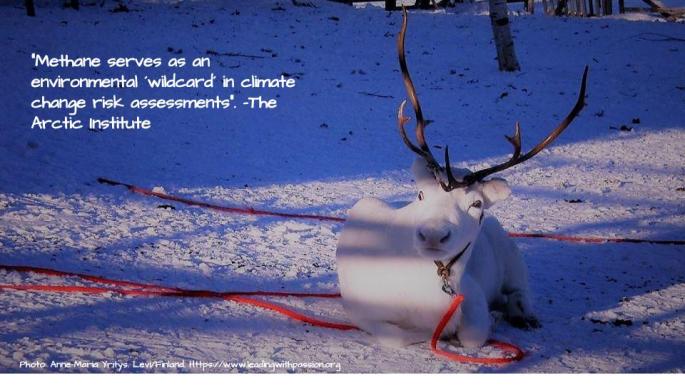
Methane is an Environmental Wildcard

Arctic (30).jpg

What does The Arctic Institute mean by methane being an environmental wildcard in climate change risk assessments? Should we call The Arctic Institute and ask, or perhaps find out more about methane by ourselves? We can do both, but let us start by finding out more through some research about methane.

According to the Environmental Defense Fund (EDF), methane is one of the greenhouse gases that pollutes our global environment. In the short-term, methane is 84 times more potent than carbon dioxide. In the long run, methane is at least 22 times stronger as a greenhouse gas in comparison to carbon dioxide.

The chemical compound methane (CH4 ) is a powerful greenhouse gas and source of energy, which can be found naturally below ground and under the sea floor. At room temperature methane is colorless, odorless and nontoxic, but may as an extremely flammable gas become explosive when mixed with air. Methane is a powerful energy source, which is why it has become so appealing to some energy markets. The risks of methane, however, may exceed its benefits. The usage of methane in energy production equals the usage of yet another fossil fuel, which have been proved to cause the greenhouse effect that is currently warming our planet so rapidly. Especially in the Arctic region, according to e.g. mother nature network, methane causes rapid warming and contributes strongly to climate change and glaciers melting.

Learn more about methane and its impacts on our climate by watching Environmental Defense Fund´s video “Methane – The other important greenhouse gas”:


Connect with me on Twitter @annemariayritys. For climate/environment-related posts only @GCCThinkActTank. Subscribe to Leading With Passion to receive my latest posts.


Take a step further to create YOUR online business. Learn more about the many benefits of how to create a beautiful website with WordPress.com and how to monetize your blog/website: 


WordPress.com – Create A Beautiful Website

Jetpack – The ideal way to experience WordPress – Code-free Customization

WooCommerce – The most customizable eCommerce platform for building your online business

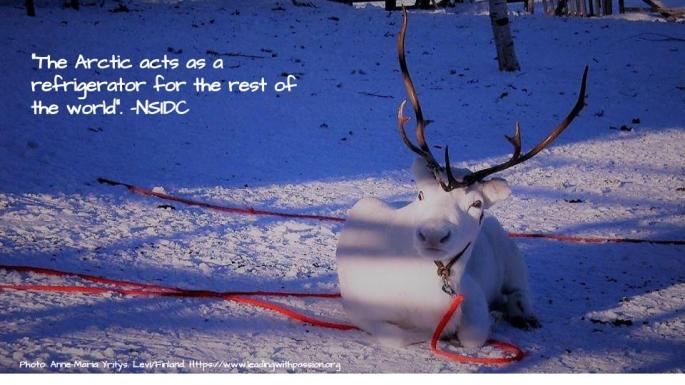
The Arctic Is The World´s Refrigerator

Arctic (28)

Our Earth has two natural refrigerators: The Arctic Region (surrounding the North Pole), with a surface of 14.5 million square kilometers (equivalent to 5.5 million square miles), and the Antarctica (surrounding the South Pole), which is about identical in size with the Arctic region. Our Earth´s radius is 6.371 km (3.950 miles), and its total surface size is 510.1 million square kilometers (196.9 square miles). The Arctic Region and Antarctica thus, together cover about 5,7 % (per cent) of Earth´s total surface, a significant amount of land and ocean especially when taking into consideration how important both polar regions are for our Earth´s overall climate.

In the past decades, both the Arctic region and Antarctica have warmed fast, in fact, at least twice as fast as the rest of the world. Both the Arctic and Antarctica have been populated for more than 20.000 years, and now the world is discussing the importance and significance of the warming of our South Pole and North Pole and the affect of this on the rest of our planet.

For many, realizing and understanding the meaning of climate change and especially climate change in the polar regions may seem distant. Especially when these regions are scarcely populated, distant, and far away from an average person´s daily life. However, since everything and everyone is somehow connected on our planet Earth, we must all comprehend at least the basics of WHY climate change even at a far distance has effects upon all of our planet, not only in a specific geographical area/region.

Perhaps one way of increasing one´s understanding about the effects of even distant changes, the impacts upon nature and all life on the other side of our planet, can be achieved by being open to learning about different cultures, geography, biology and this can be done in many ways, one of which is reading, another being traveling. Today, no one can afford not being a global citizen, global citizenship being something that the United Nations as an intergovernmental organization has discussed for long already.

Global citizenship involves taking responsibility not only for what happens locally, but also increasing one´s awareness and understanding what happens globally. What our choices are today, and how these affect people elsewhere. We have to take ethical and moral responsibility for our actions, be it in our place of birth, home country, or a country that is being affected e.g. through our way of living/consumption habits. This means that we all have to understand that if we pollute the environment in one geographical region on this planet, it will ultimately affect us all. We cannot outsource e.g. pollution/environmental toxins and go around thinking that it will not come back to ourselves.

What goes around, comes around. It is as simple as that. Our world is round, 360 degrees. It can absorb a lot, but in the end, all that we put out into the atmosphere will come back and take care of the rest. So, we should all be increasingly much careful and considerate about WHAT we put out into our atmosphere, and our environment. If we lose our two natural refrigerators, the Arctic region, and Antarctica, meaning that if these regions change drastically in terms of climate, please remember that it will have serious impacts on EVERYTHING and EVERYONE on planet Earth, including both YOU and ME, not only “some distant animals, plants, and people living somewhere where I do not have to care about”.

Have you ever given thought to what e.g. climate change in the Arctic region and a civil war e.g. in Yemen could have in common? If not, perhaps it is time to take some time for deep reflection and understanding what climate change in one region of the world, and extreme hunger in another, could have in common. Watch Al Jazeera English´s video “How can world leaders end Yemen´s crisis? – Inside Story:


Connect with me on Twitter @annemariayritys. For climate/environment-related posts only @GCCThinkActTank. Subscribe to Leading With Passion to receive my latest posts.


Take a step further to create YOUR online business. Learn more about the many benefits of how to create a beautiful website with WordPress.com and how to monetize your blog/website: 


WordPress.com – Create A Beautiful Website

Jetpack – The ideal way to experience WordPress – Code-free Customization

WooCommerce – The most customizable eCommerce platform for building your online business
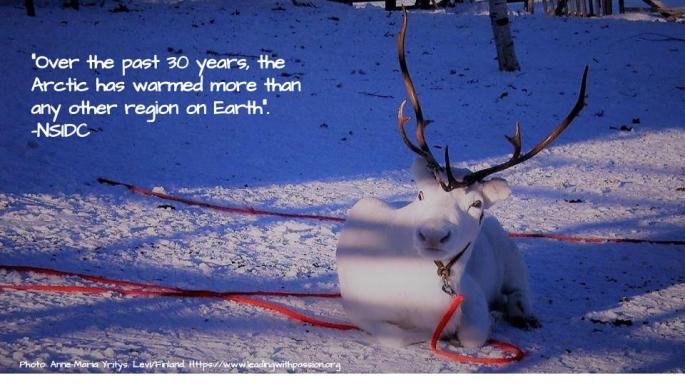
Why Has The Arctic Warmed So Much?

Arctic (27)

Why is the Arctic region warming so much? We already have scientific evidence for the fact that the rate of warming in the Arctic region, and elsewhere on our planet, is unnatural. Although climate change occurs naturally on our planet, research evidence indicates with 100 % certainty that the current warming of our planet is anthropogenic, i.e. man-made.

The current warming of our planet is caused by the immense amount of greenhouse gas emissions and other toxins released into Earth´s atmosphere through human activities, such as the burning of fossil fuels. Fossil fuels include oil, gas and coal, the origin of which are living organisms that were buried millions of years ago. Over time, pressure and heat have transformed these living organisms into fossil fuels, the usage of which releases harmful greenhouse gases, such as carbon dioxide, into Earth´s atmosphere, ending up everywhere around our planet, creating a(n) (artificial) greenhouse trapping heat inside of it.

According to e.g. NASA – What´s causing the poles to warm faster than the rest of Earth?, both the South Pole (Antarctica) and the North Pole (Arctic Region), are warming at least twice as fast as the rest of our planet. This can be explained through the Albedo effect, whereby light surfaces absorb less heat than dark surfaces. Thus, when an area is covered by thick layers of ice and snow, it reflects back the heat from the sun´s rays more efficiently than a dark surface.

Therefore, when large areas of ice and snow disappear, this development accelerates and causes the area that once was better protected by the light surface (ice, snow) to warm faster than before. Ultimately, the rapid warming of both poles, here especially the Arctic Region, causes our whole planet to warm more and more. This is the main reason for the warming of the Arctic Region (and, Antarctica) being of out most importance when conducting research upon the climate changes and changes in weather patterns around our globe.

Learn more by watching NASA Goddard´s video “NASA – The Arctic and the Antarctic Respond in Opposite Ways”:


Connect with me on Twitter @annemariayritys. For climate/environment-related posts only @GCCThinkActTank. Subscribe to Leading With Passion to receive my latest posts.


Take a step further to create YOUR online business. Learn more about the many benefits of how to create a beautiful website with WordPress.com and how to monetize your blog/website: 


WordPress.com – Create A Beautiful Website

Jetpack – The ideal way to experience WordPress – Code-free Customization

WooCommerce – The most customizable eCommerce platform for building your online business
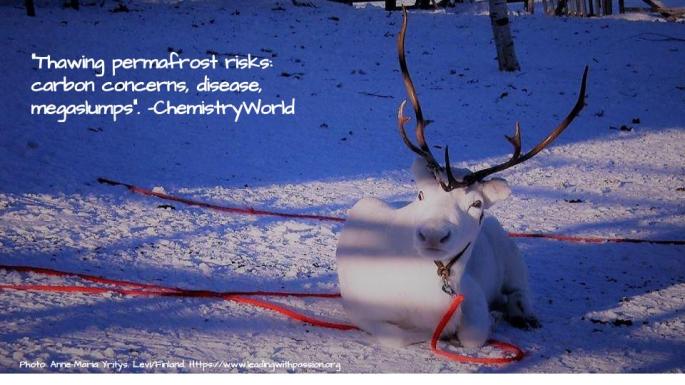
What is Hiding Within Permafrost?

Arctic (26)

Permafrost, defined as ground soil that has been at a freezing point of 0 degrees Celsius or below for at least two years in a row, has been covering at least 24% (per cent) of the whole Arctic region for thousands, or even tens of thousands, of years. According to e.g. the University of Copenhagen – Center for Permafrost, permafrost can go as deep as 700 meters where at its thickest, for example in parts of Russia and in Greenland. The Center for Permafrost at the University of Copenhagen reports that one of the risks of thawing permafrost is soil collapse as frozen ice melts into water.

Other risks of thawing permafrost, which is now taking place all over the Arctic, include the release of bacteria and toxic greenhouse gases; especially methane. Bacteria possibly  spreading diseases could be released by decayed animals and plants that have, for thousands of years, been kept frozen under the thick layers of permafrost.

According to NSIDC scientist Kevin Schaefer, studying permafrost carbon is important to understand how thawing permafrost and the frozen organic matter within the permafrost react to the atmosphere if and when coming into contact with it. This because the frozen organic matter, if and when thawing, releases carbon dioxide and methane into Earth´s atmosphere. Until now, as reported in Geophysical Research Letters Vol. 43, 28 June 2016, there has been no significant increase in long-term methane emissions in Alaska despite of warming air temperatures.

Learn more about thawing permafrost in Alaska through American Geophysical Union AGU´s “FM15 Press Conference Alaska´s thawing permafrost Latest results and future projections”:


Connect with me on Twitter @annemariayritys. For climate/environment-related posts only @GCCThinkActTank. Subscribe to Leading With Passion to receive my latest posts.


Take a step further to create YOUR online business. Learn more about the many benefits of how to create a beautiful website with WordPress.com and how to monetize your blog/website: 


WordPress.com – Create A Beautiful Website

Jetpack – The ideal way to experience WordPress – Code-free Customization

WooCommerce – The most customizable eCommerce platform for building your online business

What Are Thawing Permafrost Risks?

Arctic (25).jpg

If you read my previous post, Thawing Permafrost A Huge Risk, you are already at least one step closer to understanding what the risks of thawing permafrost in the Arctic region are. In short, thawing permafrost gives even the most knowledgeable climate scientists and environmental experts a reason to scratch their heads.

Who knows for sure what the consequences of thawing permafrost will be? It is not the first time in the history of mankind that we are faced with completely new problems, requiring for us to find completely new solutions to solve these. Natural warming of Earth´s climate is one thing, but what we have accomplished as human beings within only one century is something that we can only blame ourselves for. It is a proven fact that since the Industrial Revolution, climate change and the warming of our planet has been man-made. Thus, in order to stop this development of anthropogenic climate change, us human beings are responsible for taking necessary actions to stop emitting toxic pollutants, including greenhouse gases which are largely responsible for the climatic changes our Earth is today experiencing.

Do we have to wait until permafrost thaws further, and possibly experience its devastating consequences before we learn? Do we need more catastrophic climate change events and natural disasters before taking action? Do we want our atmosphere and the air we breathe, our lands, our oceans and other water sources to be further polluted with toxins, and the release of methane and other harmful greenhouse gases that destroy our planet?

If we want Earth to be habitable for future generations, the response must quite simply be NO to all of these questions.

We do not need climate catastrophes, environmental disasters, toxins, pollutants killing millions of people, animals and plants each year. We do not need to wait until it is too late to take action(s) to prevent the destruction of our home planet. We do not have to let all of this happen.

Learn more about the risks from permafrost thawing by watching YaleClimateConnections´s video “Permafrost: The Tipping Time Bomb”:


Connect with me on Twitter @annemariayritys. For climate/environment-related posts only @GCCThinkActTank. Subscribe to Leading With Passion to receive my latest posts.


Take a step further to create YOUR online business. Learn more about the many benefits of how to create a beautiful website with WordPress.com and how to monetize your blog/website: 


WordPress.com – Create A Beautiful Website

Jetpack – The ideal way to experience WordPress – Code-free Customization

WooCommerce – The most customizable eCommerce platform for building your online business
Thawing Permafrost A Huge Risk

Arctic (24).jpg

What is thawing permafrost? It may be difficult to understand for those who have lived their lives in completely different climates and environments than the climate and environment in the Arctic region.

Permafrost is unique to the Arctic region and Antartica, the first being the geographical region surrounding the North Pole, and the latter being the geographical region surrounding the South Pole. Now we are discussing the thawing permafrost in the Arctic region, which poses several risks for our whole planet, not only for the Arctic region.

Permafrost, as defined e.g. by the International Permafrost Association, is ground soil that remains at 0 degrees Celsius or below for at least two years in a row. Permafrost can be as thick as four (4) meters.

Now that much of the permafrost in the Arctic region is thawing, i.e. melting, due to climate change and warming, this poses several environmental and health risks both in the Arctic and elsewhere on our planet. Why?

When permafrost thaws, decayed plants and animals below the permafrost become exposed, beginning to release bacteria and huge amounts of greenhouse gases, especially methane, which is many times stronger a greenhouse gas than carbon dioxide. Why is this such a risk for our environment and overall climate on Earth?

Some of the possible consequences of thawing permafrost are yet unknown. However, if and when bacteria and greenhouse gases (methane) from decayed organisms, previously held in captivity within permafrost, get exposure to our atmosphere, the probability of bacteria spreading diseases grows. In addition, powerful greenhouse gases will be released into our atmosphere, warming our climate faster and faster. Methane is at least 22 times as powerful a greenhouse gas than carbon dioxide. This is why methane is often referred to by climate scientists as a possible climate amplifier and an environmental wildcard: its consequences are yet unknown, and it could lead to sudden changes in Earth´s overall climate if and when getting into contact with Earth´s atmosphere.

Learn more about thawing permafrost and its risks by watching National Science Foundation´s video “Thawing Permafrost – Changing Planet”:


Connect with me on Twitter @annemariayritys. For climate/environment-related posts only @GCCThinkActTank. Subscribe to Leading With Passion to receive my latest posts.


Take a step further to create YOUR online business. Learn more about the many benefits of how to create a beautiful website with WordPress.com and how to monetize your blog/website: 


WordPress.com – Create A Beautiful Website

Jetpack – The ideal way to experience WordPress – Code-free Customization

WooCommerce – The most customizable eCommerce platform for building your online business
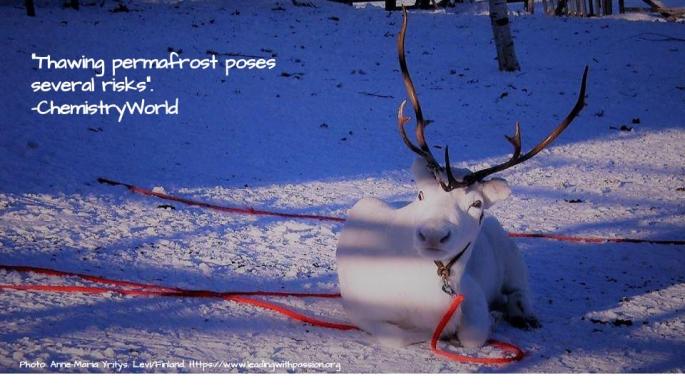
Climate Change Transforms Arctic Rivers

Arctic (23).jpg

Climate change is not only transforming Arctic rivers, but affecting and transforming rivers all over the world. Why is this happening, and why does it matter?

When the climate changes around the world, for instance in the Arctic region, it has irreversible impacts upon our environment everywhere. Just think about the evolution of the Sahara desert. It was not always such a vast area. Other examples of drastic changes in our world´s environment include lakes Chad and Victoria on the African continent. In India, river Ganges is suffering from extreme pollution, so bad that the government in India is currently investing huge amounts of effort and money to clean up the river. In many places worldwide, the regular cleaning up of e.g. water sources: rivers, lakes, and oceans is necessary in order to keep them healthy.

Everything we do on this planet has an impact upon our environment, including Arctic rivers. When we pollute the environment, releasing toxins into the atmosphere and into our water sources these do suffer as a consequence. When (Arctic) rivers are impacted, these may either suffer due to erosion, change their natural and/or usual routes, or even worse, disappear completely within the blink of an eye. Scary. When drastic changes like these occur in our environment, we have to be prepared to understand the significance of these changes upon the life in these rivers, but also all the life depending upon and surrounding these rivers. The price of these changes is immeasurable. In fact, there is no amount of money that can buy us back the environment that we have once the damage has been created.

Learn more about the impact of climate change on our environment, including rivers, by watching SmithsonianNMAI´s video “Impacts of Climate Change: Our Rivers and Coasts”:


Connect with me on Twitter @annemariayritys. For climate/environment-related posts only @GCCThinkActTank. Subscribe to Leading With Passion to receive my latest posts.


Take a step further to create YOUR online business. Learn more about the many benefits of how to create a beautiful website with WordPress.com and how to monetize your blog/website: 


WordPress.com – Create A Beautiful Website

Jetpack – The ideal way to experience WordPress – Code-free Customization

WooCommerce – The most customizable eCommerce platform for building your online business
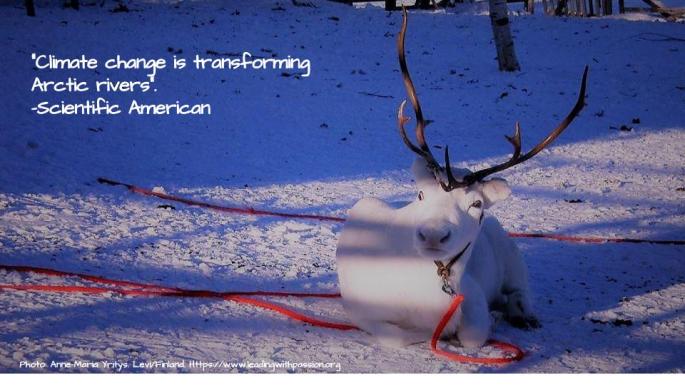
Who Protects Arctic Species From Climate Change?

Arctic (22).jpg

Whose job is it to protect Arctic species from climate change? Is it a mission dedicated to someone especially, or is there something we could all do to help these species from the threats of climate change? What can we do to help these species? By adopting a polar bear and keeping it as a pet in future?

We all know that keeping a polar bear as a pet would be impossible. Polar bears need their current home environment, surrounded by glaciers, ice, snow and water, to survive. In fact, if and when the Arctic region´s glaciers melt, as they are predicted to do during summer months in only a few years of time, polar bears is one of the Arctic species that will face serious challenges for survival, even become threatened by extinction. Where will polar bears live without any ice?

Do we have any universal laws for the protection of animals, different species and wildlife? It seems that we do not, although many people and organizations are dedicated to the protection of animals, such as the non-profit organizations WWF (World Wildlife Foundation) and Polar Bears International. Through these organizations we can for example make donations and become protectors of specific species. In Finland, for instance, we have a species called the Saimaa ringed seal, which is under serious threat of extinction due to its natural habitat changing so drastically due to e.g. fishing practices, lack of snow and ice. At this moment, according to the The Finnish Association for Nature Conservation (FANC), there are only 360 Saimaa ringed seals left. WWF and FANC are trying to protect the Saimaa ringed seal from facing extinction, and, through actions supporting the Saimaa ringed seal to be able to grow the population of this highly endangered seal species.

The Saimaa ringed seal and polar bears are two examples of species that are seriously being threatened e.g. through fishing practices and climate change. According to the WWF, other species under threat include reindeer, a number of plant species, and many migratory birds. Even the Arctic fox is under threat. And, how about the extremely shy snow leopard? Snow owls? Examples are many. What other animals and species can you come up with?

Learn more about how to protect endangered species by watching MsMojo´s video “Top 10 Ways To Protect Endangered Species”:


Connect with me on Twitter @annemariayritys. For climate/environment-related posts only @GCCThinkActTank. Subscribe to Leading With Passion to receive my latest posts.


Take a step further to create YOUR online business. Learn more about the many benefits of how to create a beautiful website with WordPress.com and how to monetize your blog/website: 


WordPress.com – Create A Beautiful Website

Jetpack – The ideal way to experience WordPress – Code-free Customization

WooCommerce – The most customizable eCommerce platform for building your online business
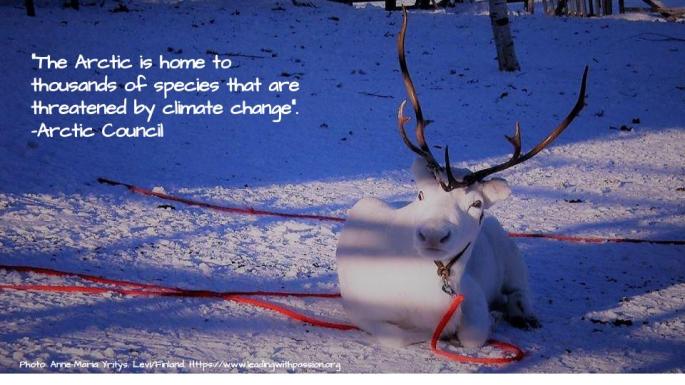
What is The Future of the Arctic?

Arctic (21)

“The future of the Arctic and its biodiversity requires an active and decisive approach to conservation and sustainability”. -The Arctic Council

When communicating about conservation and sustainability, it is necessary to have a lot of faith in addition to actually taking even radical actions towards creating a sustainable future for our environment and our whole home planet.

With so many disasters worldwide, all the catastrophic news and forecasts about what will soon happen with Earth, its environment and its population, it is easy to choose either to close one´s eyes and other senses, become insensitive, blind and indifferent to reality, or, become cynical, or, become skeptic, even angry and frustrated. However, this is not a time to give up. In times of (environmental) crises we need strong leaders and efficient leadership: people around the world who will step up and take necessary actions to ensure that we will have life upon Earth left by the end of this century, that we can create sustainable economies and save what is possible to save before we actually end up having a climate catastrophe.

It is up to both individual and co-operative practices everywhere upon Earth to prevent further damage through the release of dangerous toxins, including black coal, greenhouse gases and other pollutants that damage our environment as a whole, including everything and everyone that lives on Earth. How this can and will be done is a question about energy efficiency and overall consumption habits of human beings upon Earth. We already have all the necessary knowledge and technology to create sustainable environments. The question is, how well can our planet cope with the rapidly warming climate, the rapidly growing population and all the destruction that us human beings have already caused?

Who knows with certainty what the future of the Arctic looks like? If the current development continues, the Arctic glaciers will continue melting at an unimaginable speed, warming the climate in the Arctic region and elsewhere upon Earth. Who knows if we can afford the continued melting of the Arctic region´s glaciers, ice sheets, and permafrost? How will these changes affect other regions upon Earth? Will this e.g. accelerate the expansion of the Sahara desert into the South? Will the melting Arctic region lead to increasingly much drought and floods around the world? Who has the answers to these questions?

Learn more by watching Understanding Climate Change´s video “The Once and Future Arctic: Prof Stephanie Pfirman (February 2017):


Connect with me on Twitter @annemariayritys. For climate/environment-related posts only @GCCThinkActTank. Subscribe to Leading With Passion to receive my latest posts.

Take a step further to create YOUR online business. Learn more about the many benefits of how to create a beautiful website with WordPress.com and how to monetize your blog/website:

WordPress.com – Create A Beautiful Website

Jetpack – The ideal way to experience WordPress – Code-free Customization

WooCommerce – The most customizable eCommerce platform for building your online business

How To Guarantee Arctic Environmental Well-Being?

Arctic (20)

With so much dangerous toxins, greenhouse gases, and pollution from e.g. industrial waste and the inefficient burning of black coal in Earth´s atmosphere, how can we ensure that these toxins and pollutants do not end up anywhere in our environment, especially in the Arctic region which warms at least twice as fast as the rest of our planet?

There is no other way of preventing harmful pollutants of destroying our environment, including ourselves, than removing them completely from our way of living. Yet, with the technologies and methods of production we use today, this prevention seems impossible. How long will it take until we destroy ourselves and our home planet? According to the most optimistic prognoses, we have this century left. Others say, only a few decades. Others say, only a few years or at the maximum, a decade. Are we headed towards a climate catastrophe? Let us hope that we do not, and that we still have time to take action.

This is one of the main messages of the UN Sustainable Development Goals (SDG´s) that are a continuum to the Millennium Development Goals – UN SDG Goal Number 13: Take URGENT action to combat climate change and its impacts.

This is no joke, really. These goals were all set for an extremely important reason. In fact, all of the 17 Sustainable Development Goals are in one way or the other interlinked to climate action and climate change. Learn more about UN´s Sustainable Development Goals here.

We have NO time to wast. We must all take action now, both on individual, business, organizational, and governmental levels. Especially much responsibility must be taken by the largest emitters on this planet: China, The U.S.A. and the European Union. Those who destroy and pollute the most must act NOW and transform their economies into increasingly much sustainable places of living. This is not something concerning only the Arctic region, although this is where the warming of the planet is faster than elsewhere. Right now, in the COP23 Climate Summit in Bonn, hosted by Fiji, sea level rise and its threat to millions and millions of people worldwide is being discussed very seriously. If we cannot prevent sea levels from rising, swallowing up whole islands and coastal cities around the world, what will the future look like for these people? Where will they live? What will they eat? How will they produce food in environments and climates that change so rapidly that our current ways of producing food are unsustainable? If you have answers, please let me know, or at least take action upon them. For example in Finland completely new ways of food production are already being implemented by experimental and progressive businesses that have foreseen what we have ahead of us.

Learn more about the melting Arctic by watching European Environment Agency´s video “Melting Arctic: Environmental Atlas of Europe – Greenland”:


Connect with me on Twitter @annemariayritys. For climate/environment-related posts only @GCCThinkActTank. Subscribe to Leading With Passion to receive my latest posts.

Take a step further to create YOUR online business. Learn more about the many benefits of how to create a beautiful website with WordPress.com and how to monetize your blog/website:

WordPress.com – Create A Beautiful Website

Jetpack – The ideal way to experience WordPress – Code-free Customization

WooCommerce – The most customizable eCommerce platform for building your online business