Changes In Temperature & Storm Patterns Affecting The Arctic Life

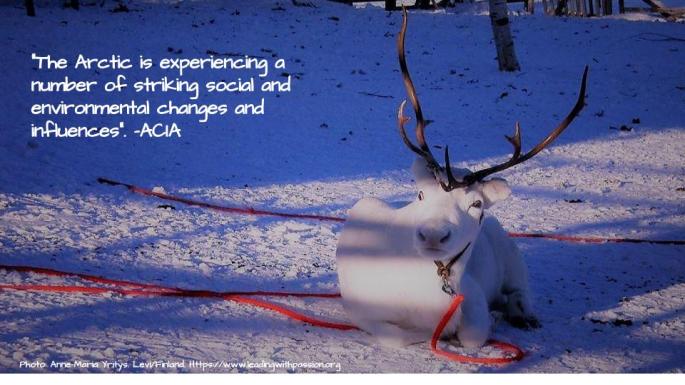
Arctic (48).jpg

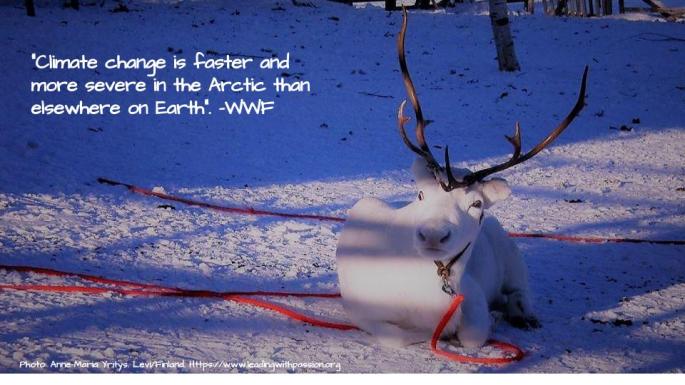
The Arctic region, including the Arctic sea, adjoining seas, Northern Canada, parts of the U.S.A., parts of Russia, Finland, Sweden, Norway, The Faroe Islands, Iceland and Greenland, is warming at a rate much faster than the rest of our world, despite of the fact that according to geoscientists, we are currently living in an ice age. The Arctic warms at an alarming rate, with up to twice as fast as the rest of our planet.

In Celsius degrees, we are talking about an increased rate of at least several degrees Celsius within the past century, from the beginning of the industrialized era, with research evidence upon the fact that this warming has been caused by human activities only – mainly the burning of fossil fuels, releasing carbon dioxide and other harmful greenhouse gases into Earth´s atmosphere. By releasing these greenhouse gases into Earth´s atmosphere, us human beings have built an artificial greenhouse effect on our planet, causing Earth to warm at unhealthy rates, ultimately leading to disastrous risks that will affect all of humanity, and, our flora and fauna upon Earth.

The problem with the fast warming of the Arctic region is that majority of the world´s fresh water resources are melting in Greenland, into salty oceans that causes sea level rise. And, unnecessarily wasting our planet´s already scarce fresh water resources. Another problem, and major risk to all life on Earth, is the melting of the sea ice. Huge areas of sea ice has already melt away, causing the Arctic to become completely ice free during summer months in near future. When this happens, the ice free ocean surface in the Arctic absorbs increasingly much of the sun´s energy and heat, causing our planet to warm at an even faster rate.

Let alone the fact that when Arctic regions warm, permafrost thaws, exposing decayed plants and animals which release further greenhouse gases into our atmosphere – especially methane, which is at least 25 times more powerful as a greenhouse gas compared to carbon dioxide. And, the thawing, decayed animals pose another risk of setting free (yet unknown) diseases. Is this the future we want for our planet? A melting, warming Arctic that causes the rest of the world to suffer from its effects?

Watch Climate State´s video “Climate Change in the Arctic and Model Projections 2017”:


Connect with me on Twitter @annemariayritys. For climate/environment-related posts only @GCCThinkActTank. Subscribe to Leading With Passion to receive my latest posts.

Take a step further to create YOUR online business. Learn more about the many benefits of how to create a beautiful website with WordPress.com and how to monetize your blog/website:

WordPress.com – Create A Beautiful Website

Jetpack – The ideal way to experience WordPress – Code-free Customization

WooCommerce – The most customizable eCommerce platform for building your online business

What is Arctic Climate Change?

Arctic (1)

According to research-based evidence, climate change in the Arctic is at least twice as fast as elsewhere on Earth. Numerous organizations and think tanks have internalized this long ago, and work effortlessly to create awareness about what Arctic climate change is, and how it (possibly) affects the rest of the world. Objective sources of media also dedicate more time, and create extra space for bringing these findings into the public, which is of course of great significance to every citizen.

Arctic climate change, naturally, is anthropogenic climate change occurring in the world´s northernmost region, the Arctic, including the Arctic ocean, adjoining seas, Northern Canada, Greenland, parts of Finland, Sweden, Norway, Russia, The Faroe Islands and even parts of the United States of America. Since the Arctic acts as a “refrigerator” for the rest of the world, Arctic climate change and warming, including melting of ice sheets and permafrost, is particularly hazardous and involves a number of partly yet unknown risks.

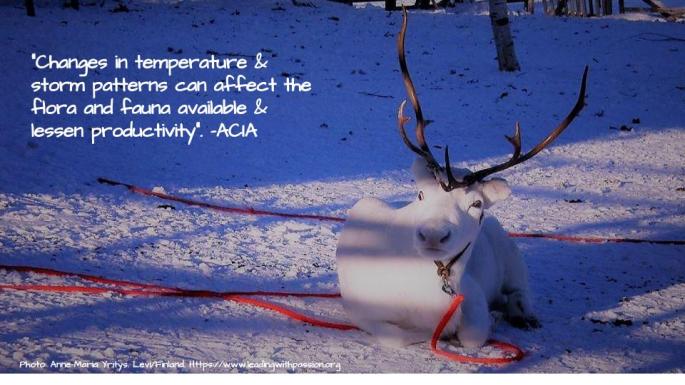
When the Arctic warms, it of course affects local flora, fauna, and all the livelihood in the region. Sea and lake levels rise, snowfall becomes different, weather patterns in general less predicable, all of which causes changes in the Arctic environments. The rapid changes in the Arctic region also affect the rest of the world: e.g. the melting of ice sheets causes rise in sea levels, increases the amount of floods, and even increases the amount of rainfall in parts of the world. Melting permafrost, on the other hand, increases the risks of additional greenhouse gases, especially methane, being released into Earth´s atmosphere, when decayed plants and animals unfreeze from below the permafrost. The risks of thawing permafrost also includes the release of bacteria and diseases.

Watch the Ocean Scientists “Arctic Ocean Climate Change Impacts” to learn more about what Arctic climate change signifies:


Connect with me on Twitter @annemariayritys. For climate/environment-related posts only @GCCThinkActTank. Subscribe to Leading With Passion to receive my latest posts.

Take a step further to create YOUR online business. Learn more about the many benefits of how to create a beautiful website with WordPress.com and how to monetize your blog/website:

WordPress.com – Create A Beautiful Website

Jetpack – The ideal way to experience WordPress – Code-free Customization

WooCommerce – The most customizable eCommerce platform for building your online business
Why is The Arctic Experiencing Social & Environmental Changes?

Do you know what and where the Arctic is situated on our planet? Have you ever visited any of the Arctic regions? If not, you may be surprised at the beauty of the different Arctic regions, its beauty and multitude of flora, fauna and landscapes. The Arctic is the northernmost part of planet Earth, also called the polar north. The Arctic is also the 2nd largest desert in the world, expanding over an area of almost 14 million (14.000.000) square kilometers (km2). As a geographical region, the Arctic includes the Arctic Ocean, adjoining seas, parts of Alaska, Northern Canada, Finland, Greenland, Iceland, Norway, Russia and Sweden. Geographically the Arctic lies between 66.5°N and the North Pole.

As a comparison, Tampere, where I currently live, is situated at 61.5°N. Each degree of latitude is approximately 111 km apart, so I live 5 x 111 km = 555 km south from the Arctic. In fact, the arctic/polar circle in Finland is in Rovaniemi, which lies approximately 600 km north from Tampere by flight. An hours domestic flight from Tampere to Rovaniemi. If not otherwise familiar to you, Rovaniemi is where Santa Claus lives with his reindeers and helpers. It is also where Mika and Marketa Häkkinen (née Ramesova) were wedded just before Christmas 2016.

Alternatively, several hours by bus or train, or by car it takes almost half a day since we have only little highways in Finland, and during winter months speed limits are lower due to weather conditions, something that is of course also better for the environment. If you travel across Finland by car you will notice how little traffic there is e.g. in comparison with Central Europe, e.g Germany and Italy. Of course, since we are a sparsely populated country. The further north you travel in Finland, the less people will you meet: most of population lives in southern Finland.

But how and why does the Arctic experience social and environmental changes? What I know about these changes is mainly through what I read, and hear from relatives living in Finnish Lapland. My father comes from Kittilä, a small municipality situated not far from several tourist resorts, such as Levi/Sirkka and Ylläs. Having spent many holidays in Lapland from childhood on, the region is of course near my heart. Despite of population declining in many sparsely populated areas in Finland, Lapland is perhaps our number one tourist destination, both for domestic and international visitors. Tourism is continuously expanding and growing in Lapland, and Levi/Sirkka has changed/expanded tremendously in the past couple of decades.

A growing tourism is of course beneficial for a region in many ways, especially in terms of economic value. A growing tourism may also have its setbacks, e.g. in terms of maintaining sustainability, taking care of the environment and ecological well-being.

In general, what comes to social and environmental changes and impacts in the whole Arctic region includes:

  • The Arctic is home to indigenous people, who have long traditions of living in accordance with nature without as little as possible destruction, if any at all. These indigenous Saami people now report how the climate is changing in the Arctic, e.g. in terms of warming, and weather patterns becoming less predictable.
  • Snowfall and snow quality is becoming different, with more icy snow. Sea ice is declining, and water levels in many lakes are dropping.

Learn more about the reported/studied climatic changes in the Arctic by reading e.g. following articles:

GreenFacts (Facts on Health and the Environment)

The Arctic as it is known today is almost certainly gone (The Economist April 29, 2017).

Also watch this short video by NASA – The Arctic and the Antarctic Respond in Opposite Ways:


Connect with me on Twitter @annemariayritys. For climate/environment-related posts only @GCCThinkActTank. Subscribe to Leading With Passion to receive my latest posts.

Take a step further to create YOUR online business. Learn more about the many benefits of how to create a beautiful website with WordPress.com and how to monetize your blog/website:

WordPress.com – Create A Beautiful Website

Jetpack – The ideal way to experience WordPress – Code-free Customization

WooCommerce – The most customizable eCommerce platform for building your online business
UN Women: Women To Be Heard When Tackling Climate Change

Global Climate Change (99).jpg

“UN Women. UN Women calls for women to be heard at all levels of decision-making, from households to political arenas.”

===============================================================

On October 24th is the annual United Nations Day which marks the anniversary of the UN Charter that entered into force in 1945. On this day, it is worthwhile to remember WHY the United Nations was established in the first place. Do you know WHY the UN was established?

The original purpose of the United Nations, as an intergovernmental organization, was to ensure peace (and, peaceful resolution of conflicts) after World War II. Gradually, the organization grew its original role from maintaining peace to the protection of human rights, the promotion of social and economic development, and disaster aid/relief in times of famine, natural disasters and armed conflicts. (United Nations Day, 24 October).

Furthermore and inclusive to the protection of human rights, the United Nations organization UN Women is dedicated to enhancing and protecting the rights of girls and women around the world, with a focus upon campaigning especially for and in regions where girls and women´s rights need attention and ought to be developed and improved e.g. through legislation and enabling equal rights for girls and women in terms of education and work life opportunities.

Even developed countries, including Finland, have work to do in order to ensure 50/50, i.e. complete gender equality. Every country on this planet has work to do in terms of gender equality, be it eradicating domestic violence or ensuring that human beings have equal rights e.g. in terms of equal payments/ salaries. Iceland will be the first country in the world to end salary inequality and discrimination through changing its legislation to enable this.

UN Women is one of the leading organizations worldwide driving gender equality issues, including the fact that girls and women should be heard and involved concerning climate change issues equally much as boys and men. It is important to enable this,  allow women to participate, and empower women especially in developing countries to get their voices heard on every level in the society. Only by giving women the possibility to use their knowledge, resources, and take the lead in terms of climate change related activities can we reach our goals to end anthropogenic climate change and create sustainable change across societies worldwide.

Watch International Labour Organization´s video “Why gender matters in climate change financing”:


Connect with me on Twitter @annemariayritys. For climate/environment-related posts only @GCCThinkActTank. Subscribe to Leading With Passion to receive my latest posts.

Take a step further to create YOUR online business. Learn more about the many benefits of how to create a beautiful website with WordPress.com and how to monetize your blog/website:

WordPress.com – Create A Beautiful Website

Jetpack – The ideal way to experience WordPress – Code-free Customization

WooCommerce – The most customizable eCommerce platform for building your online business


How Can Women´s Expertise Be Of Value in Tackling Climate Change?

Global Climate Change (98).jpg

“UN Women. Through their experiences and traditional knowledge of many natural resources, women can offer valuable insights into better managing the climate and its risks.”

=================================================================

As equally valuable human beings with equal human rights, girls and women make up around half of world population (the human sex ratio for women in 2013 was 49.6% of total world population according to Worldometers Population by Gender, Age, Fertility Rate, Immigration). If it was not for gendercide, including illegal and selected abortions, the number of females in certain countries would be higher. This has to end. Girls and women are equally important human beings as boys and men, and should be treated as such – without having to live in fear of being discriminated, harassed, or, assaulted because of gender inequality and discrimination.

According to UN Women, women are especially important when it comes to climate change and (natural) disasters thanks to their multitude of experience and skills in terms of risk management, including disaster preparedness and response. (UN Women APAC: Climate Action: Women hold the key).

Watch DW English Women in Bangladesh fight climate change / Global Ideas:

What are your thoughts regarding the empowerment of women and ending gender inequality? How can we tackle a) gender inequality b) empower women c) climate change with the help of women especially?

Connect with me on Twitter @annemariayritys. For climate/environment-related posts only @GCCThinkActTank. Subscribe to Leading With Passion to receive my latest posts.

Take a step further to create YOUR online business. Learn more about the many benefits of how to create a beautiful website with WordPress.com and how to monetize your blog/website:

WordPress.com – Create A Beautiful Website

Jetpack – The ideal way to experience WordPress – Code-free Customization

WooCommerce – The most customizable eCommerce platform for building your online business
Why Are Women Especially Vulnerable To Climate Change?

Global Climate Change (97).jpg

“UN Women. The most vulnerable people are most at risk from climate change, including many poor women.”

===============================================================

I will start by admitting that the headline of this post is somewhat misleading, stating that women are especially vulnerable to climate change. The truth is that we ALL are vulnerable to climate change, regardless of gender. However, as stated by UN Women, an organization dedicated especially for women worldwide, especially vulnerable people in this world are in fact most at risk from climate change, and many of the world´s most vulnerable people are women. Majority of the world´s poorest people are women: at least 70 % of ALL poor people worldwide are female.

Why is that? The main reason for extreme poverty among women worldwide is the amount of unpaid work women do. Not all girls and women worldwide have access to e.g. even primary or secondary education, since poor families often prefer sending their boys to school, while girls have no other option than to stay at home and carry out unpaid work. Moreover, many young girls in poor families worldwide are being married off as child brides, often to men who are relevantly much older than themselves. Due to a lack of gender equality and a respect for girls and women being equally worthy in a specific culture/society, girls and women also risk becoming targets of sexual exploitation e.g. through human trafficking, which is a significant global problem.

These inequality issues and gender discrimination in different cultures are also being transferred into how girls and women suffer from climate change: According to UN Women, e.g. Pacific Women have limited economic opportunities, making them especially vulnerable in all areas of life, including climate change. (UN Women: Why Is Climate Change A Gender Issue?).

Launched by UN Women in December 2016, the report Gender Dimensions of Vulnerability to Climate Change in China, summarizes that women in China, having limited access to resources as opposed to men, are more at risk to the severe impacts of climate change. The lack of resources, according to the research, include the capacity of building resilience (income, land, loans, employment opportunities, and training).

Watch United Nations video “Philippines: Women and Climate Change”:


Connect with me on Twitter @annemariayritys. For climate/environment-related posts only @GCCThinkActTank. Subscribe to Leading With Passion to receive my latest posts.

Take a step further to create YOUR online business. Learn more about the many benefits of how to create a beautiful website with WordPress.com and how to monetize your blog/website:

WordPress.com – Create A Beautiful Website

Jetpack – The ideal way to experience WordPress – Code-free Customization

WooCommerce – The most customizable eCommerce platform for building your online business


How Do Fishing and Hydropower Impact Our Marine Environment?

Global Climate Change (96).jpg

“Marine Stewardship Council. Sustainable fishing. Fishing has an impact on our marine environment. The impacts of fishing are complex, hard to measure and vary from one fishery to the next.”

================================================================

You do not have to be a genius to understand that all human activity on this planet, including fishing, has an impact on our environment. Over-fishing, pollution, and warming of water sources have, in fact, led to the collapse of many marine ecosystems.

In Finland for example, where we have lots of dams and hydroelectric power (which generated 23,6 % of total electricity in Finland in 2016: Sähköntuotanto energialähteittäin 2016 (Electricity production per energy source in 2016), hydroelectric power is referred to being a renewable energy source, although it is a known fact how much dams and hydropower damage our rivers and lakes, e.g. influencing the natural habitat of flora and fauna. We have currently 423 classified dams in Finland (Patojen vahingonvaara/Accidental risks of dams) , and the consumption of hydroelectric power has drastically decreased in the past decades, from even up to 90% of total electricity generation still in the 1960´s to the approximately 20% today (Ympäristövaikutuksia on, mutta ei ilmstopäästöjä/Effects on the environment, but no greenhouse gases). Finnish Energy admits on its homepage that dams have an ecological influence, and e.g. prevent fishes from wandering freely in their natural environment.

How can something that affects ecology and harms fish be called a renewable energy source? This year in Tampere, for example, signal crayfish population has almost completely disappeared, according a local news source, Tamperelainen. Apparently, the situation has been bad for years already, but this year the situation has been especially alarming.

Finland is often said to be one of the leading countries worldwide what comes to ecology, preservation of our environment, and clean technology. In reality, we have many alarming environmental problems in this country as well. If the situation is alarming in Finland, just think about and learn about all the environmental problems around the world.

Learn more about Climate change vulnerability of global hydropower generation by watching American Geophysical Union´s video:


Connect with me on Twitter @annemariayritys. For climate/environment-related posts only @GCCThinkActTank. Subscribe to Leading With Passion to receive my latest posts.

Take a step further to create YOUR online business. Learn more about the many benefits of how to create a beautiful website with WordPress.com and how to monetize your blog/website:

WordPress.com – Create A Beautiful Website

Jetpack – The ideal way to experience WordPress – Code-free Customization

WooCommerce – The most customizable eCommerce platform for building your online business
 

What Is Sustainable Seafood?

Global Climate Change (95)

“Marine Stewardship Council. Certified sustainable seafood. There are more than 20.000 MSC labelled, certified sustainable seafood products on sale around the world.”

=================================================================

For all of us who love fish and seafood, it is sad news to hear and read about the state of certain fish and seafood around the world. Not only do we have reckless fishers and consumers who do not care about the marine environment, often due to lack of awareness and/or knowledge, but also suffering of marine species due to over-fishing and/or poor fishing practices. As a novice fisher, I am basically not to teach anyone sustainable fishing practices, but I would urge all consumers and fishers to learn more about our marine environments, including rivers, lakes, seas and oceans, and how vulnerable these are to a number of human activities.

Be a responsible consumer, and a responsible fisher. Use common sense, obey laws, and contribute to healthy water sources, i.e. marine environments. Much of the pollution, including millions of tons of plastic waste, that us human beings cause, end up in our lakes, rivers, seas and oceans, harming everything that lives underwater. Being a responsible consumer also signifies that you do not eat species that are especially vulnerable, or under threat, including shark, and whale meat. If you consume fish and seafood, make sure to check that the product has been caught with sustainable fishing practices, ensuring that it has not harmed other marine creatures, such as dolphins.

Learn more about sustainable fishing practices here (Marine Stewardship Council: Our fisheries, our future. Sustainable fishing in the developing world):


Connect with me on Twitter @annemariayritys. For climate/environment-related posts only @GCCThinkActTank. Subscribe to Leading With Passion to receive my latest posts.

Take a step further to create YOUR online business. Learn more about the many benefits of how to create a beautiful website with WordPress.com and how to monetize your blog/website:

WordPress.com – Create A Beautiful Website

Jetpack – The ideal way to experience WordPress – Code-free Customization

WooCommerce – The most customizable eCommerce platform for building your online business


Climate Change Knows No National Boundaries

Global Climate Change (94).jpg

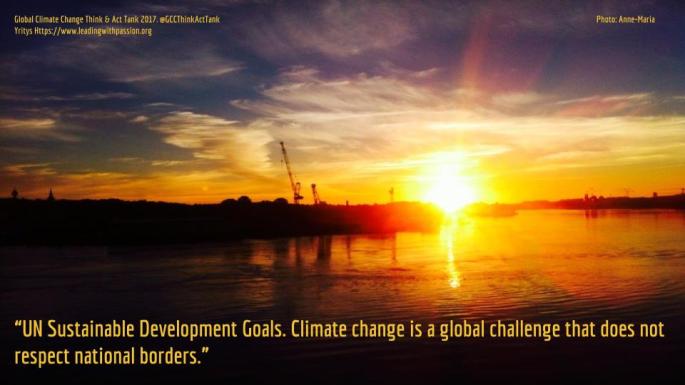
“UN Sustainable Development Goals. Climate change is a global challenge that does not respect national borders.”

=============================================================

The message is clear and simple: Climate change does and will not ask anyone of us, or our countries, whether we want our climate(s) to change. However, one thing is certain: we all have an influence upon our climate, through our consumption habits, and we can all influence how our climate is being shaped now, and in the future. Are you aware of the fact that even a slight increase in our global mean average temperature will have significant impacts on our environment, and on the climate? This is the reason for the Paris Agreement, whereby nations all over the world agreed upon and signed up for the Paris Agreement, legally stating that the signatory countries WILL TAKE ACTION to prevent our climate from further warming through human activities on this planet.

The Paris Agreement does not bind only nations/states and/or decision-makers, but requires for all citizens in the world to take action. Instead of playing a blame-game by throwing dirt on decision-makers only, let YOUR individual voice (and, action!) be heard and seen in how you make necessary changes in your consumption habits, and become a voice/role model for change.

Watch TEDx Talks “Why every action in the fight against climate change counts/Caroline Westblom/TEDxBergen:

Connect with me on Twitter @annemariayritys. For climate/environment-related posts only @GCCThinkActTank. Subscribe to Leading With Passion to receive my latest posts.

Take a step further to create YOUR online business. Learn more about the many benefits of how to create a beautiful website with WordPress.com and how to monetize your blog/website:

WordPress.com – Create A Beautiful Website

Jetpack – The ideal way to experience WordPress – Code-free Customization

WooCommerce – The most customizable eCommerce platform for building your online business


Climate Change Affects Weather Patterns And Causes Sea Level Rise

Global Climate Change (93).jpg

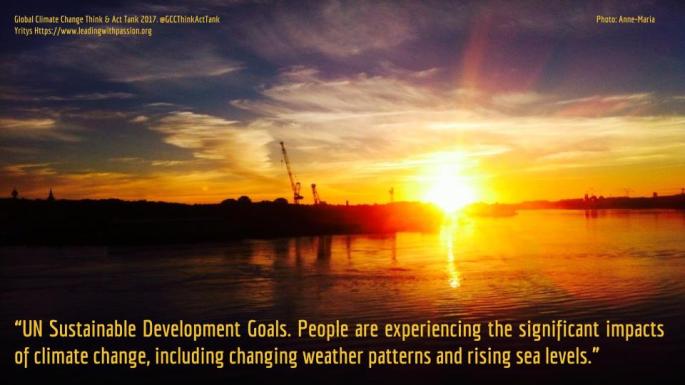
“UN Sustainable Development Goals. People are experiencing the significant impacts of climate change, including changing weather patterns and rising sea levels.”

===============================================================

One single sentence says it all. Weather patterns are changing, sea levels rising, rainfall becoming more frequent and heavy in parts of the world (e.g. here in Finland) while some geographical regions, e.g. even in Australia, suffer from extreme drought. There are areas in Australia where it has not been raining one single time for more than a decade, perhaps even longer. Heavy irrigation is therefore a necessity in Australia to grow anything at all, while in other parts of the world crop yields are being lost due to either too much rainfall, too much rainfall when harvest would be due, or, as in Southern Europe this year, heatwaves and drought destroying crops. Hurricanes in the Caribbean and in the East coast in the United States, extreme wildfires in California. Extreme floods in Asia, for example in Bangladesh.

And, what about the African continent, which so often seems to go completely forgotten? What about the extreme droughts and famine in e.g. Somalia? People here in Finland sometimes forget why we have refugees from Somalia in this country. These people would never have come here unless they had no other option. It is that simple. Climate change forces people to flee their homes, even their home countries, making them climate refugees. If and when proper action is being taken worldwide, we can possibly prevent further damage on our common environment instead of blaming e.g. refugees for a number of problems. Or, get to the root of the problem and start blaming those who cause and worsen these (climate) events.

Watch Extreme Environments video Climate Change – Future Change – Know About Weather, Facts, Effects, Climate Condition:


Connect with me on Twitter @annemariayritys. For climate/environment-related posts only @GCCThinkActTank. Subscribe to Leading With Passion to receive my latest posts.

Take a step further to create YOUR online business. Learn more about the many benefits of how to create a beautiful website with WordPress.com and how to monetize your blog/website:

WordPress.com – Create A Beautiful Website

Jetpack – The ideal way to experience WordPress – Code-free Customization

WooCommerce – The most customizable eCommerce platform for building your online business