Forest Protection

What Does The Earth Day Signify to You?

What Does The Earth Day Signify to You?

I hope you are paying attention to the amount of garbage that people throw into our environment and our nature, almost everywhere. At least here in Finland, some people think it is normal to throw all kinds of garbage e.g. through the car window, from their boat etc. It looks horrible when you walk on the streets, and in nature. All the garbage on the walkways and streets, in the forests, lakes, everywhere. Throwing garbage into nature should be illegal.

You are smarter than that. You do not throw any kind of garbage/waste into nature. Perhaps you make others aware of this too, or even pick up some garbage while walking in nature.

Natural resources are becoming scarcer and more vulnerable. Our environment and nature cannot keep up with our current consumption habits. It is time to rethink, recycle, manage our resources better and with improved sustainability, because with a rapidly growing world population this planet becomes more crowded than ever before, while our environment has already suffered significantly. The evidence is everywhere: in our air, in our soil, in our water bodies.

In many major urban areas and cities worldwide, the air has become so polluted that people have to wear respirator masks due to toxic air quality. In many polluted cities, the air quality is so poor that you cannot even see the sky, at least not a natural sky. Instead, it is blocked by dirt and pollution, falling down on the ground as toxic rain or simply as toxic particles.

As a result of poor soil and wastewater management, whereby most of all wastewater is being dumped directly back into nature without any kind of prior purifying treatment, our soils are suffering from many kinds of problems, including acidity. Poor soil management leads to many additional problems, such as erosion, and a significant fall in nutrients in crops and plants.

Our water bodies, rivers, lakes, seas, and oceans, are more acidic than before. The actual numbers may sound low, but even small changes in acidity or chemical structure of a water body will have significant impacts and (possibly) lead to major problems not only in the water bodies themselves, including flora and fauna, but also to all life on Earth.

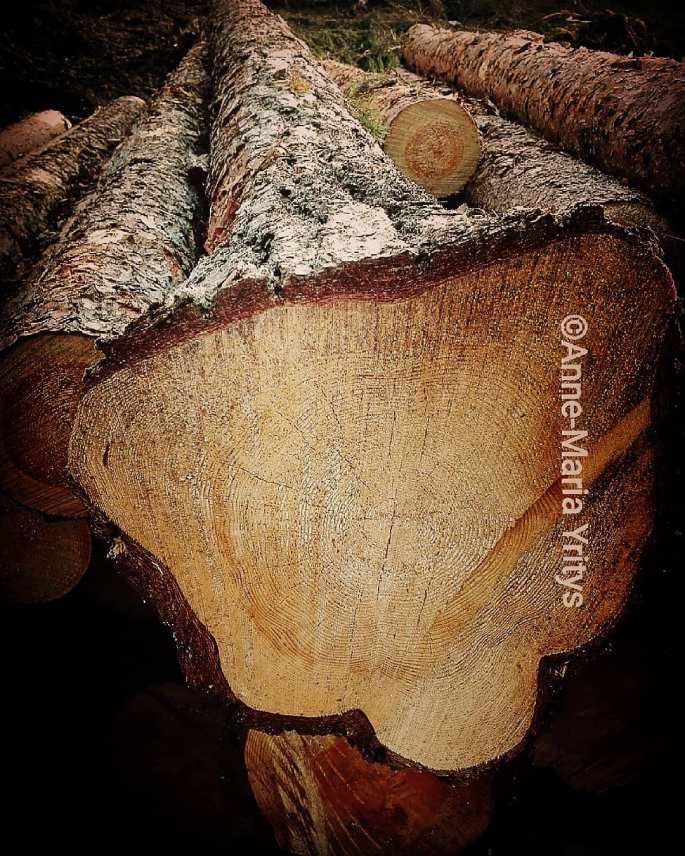
All vegetation on this planet, including forests, protect us from harmful toxins in the environment and in nature. Forests and trees all around our planet absorb much of the carbon dioxide and other pollution released into our atmosphere by human activities. Growing deforestation and poor forestry lead to additional environmental problems. Depending upon the environment and type of tree, it takes many years, even several decades, to replace a cut down tree by a new one.

Environmental protection and sustainable development is not only a task for environmentalists. It is something that concerns all of us. Every day. Everywhere. Us human beings cannot keep up with current practices, or how industrialization in the past century or two have impacted our environment and nature. Protecting the environment is not equal to giving up a good lifestyle. On the contrary, protecting our environment and developing sustainable economies will in fact improve our lives in terms of a healthy environment, air, soil, and water quality.

Thank you for taking the time to read this post. Looking forward to your comments. If you found this post helpful, do share it with your digital networks.

Connect with me on Twitter @annemariayritys – for climate/environment-related posts only @GCCThinkActTank. Subscribe to Yritys Executive Services to receive my newsletter delivered personally to you.
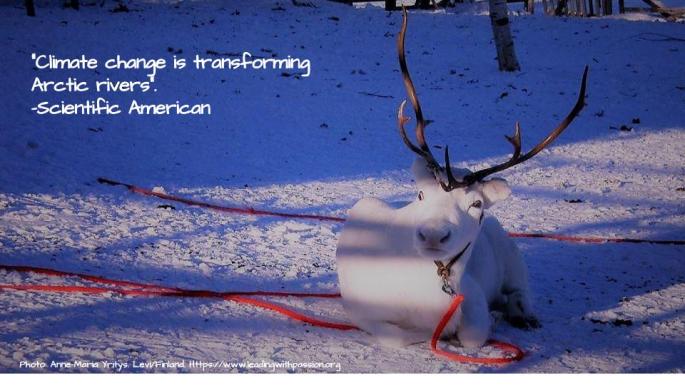


Climate Change Transforms Arctic Rivers

Arctic (23).jpg

Climate change is not only transforming Arctic rivers, but affecting and transforming rivers all over the world. Why is this happening, and why does it matter?

When the climate changes around the world, for instance in the Arctic region, it has irreversible impacts upon our environment everywhere. Just think about the evolution of the Sahara desert. It was not always such a vast area. Other examples of drastic changes in our world´s environment include lakes Chad and Victoria on the African continent. In India, river Ganges is suffering from extreme pollution, so bad that the government in India is currently investing huge amounts of effort and money to clean up the river. In many places worldwide, the regular cleaning up of e.g. water sources: rivers, lakes, and oceans is necessary in order to keep them healthy.

Everything we do on this planet has an impact upon our environment, including Arctic rivers. When we pollute the environment, releasing toxins into the atmosphere and into our water sources these do suffer as a consequence. When (Arctic) rivers are impacted, these may either suffer due to erosion, change their natural and/or usual routes, or even worse, disappear completely within the blink of an eye. Scary. When drastic changes like these occur in our environment, we have to be prepared to understand the significance of these changes upon the life in these rivers, but also all the life depending upon and surrounding these rivers. The price of these changes is immeasurable. In fact, there is no amount of money that can buy us back the environment that we have once the damage has been created.

Learn more about the impact of climate change on our environment, including rivers, by watching SmithsonianNMAI´s video “Impacts of Climate Change: Our Rivers and Coasts”:


Connect with me on Twitter @annemariayritys. For climate/environment-related posts only @GCCThinkActTank. Subscribe to Leading With Passion to receive my latest posts.


Take a step further to create YOUR online business. Learn more about the many benefits of how to create a beautiful website with WordPress.com and how to monetize your blog/website: 


WordPress.com – Create A Beautiful Website

Jetpack – The ideal way to experience WordPress – Code-free Customization

WooCommerce – The most customizable eCommerce platform for building your online business

How To Guarantee Arctic Environmental Well-Being?

Arctic (20)

With so much dangerous toxins, greenhouse gases, and pollution from e.g. industrial waste and the inefficient burning of black coal in Earth´s atmosphere, how can we ensure that these toxins and pollutants do not end up anywhere in our environment, especially in the Arctic region which warms at least twice as fast as the rest of our planet?

There is no other way of preventing harmful pollutants of destroying our environment, including ourselves, than removing them completely from our way of living. Yet, with the technologies and methods of production we use today, this prevention seems impossible. How long will it take until we destroy ourselves and our home planet? According to the most optimistic prognoses, we have this century left. Others say, only a few decades. Others say, only a few years or at the maximum, a decade. Are we headed towards a climate catastrophe? Let us hope that we do not, and that we still have time to take action.

This is one of the main messages of the UN Sustainable Development Goals (SDG´s) that are a continuum to the Millennium Development Goals – UN SDG Goal Number 13: Take URGENT action to combat climate change and its impacts.

This is no joke, really. These goals were all set for an extremely important reason. In fact, all of the 17 Sustainable Development Goals are in one way or the other interlinked to climate action and climate change. Learn more about UN´s Sustainable Development Goals here.

We have NO time to wast. We must all take action now, both on individual, business, organizational, and governmental levels. Especially much responsibility must be taken by the largest emitters on this planet: China, The U.S.A. and the European Union. Those who destroy and pollute the most must act NOW and transform their economies into increasingly much sustainable places of living. This is not something concerning only the Arctic region, although this is where the warming of the planet is faster than elsewhere. Right now, in the COP23 Climate Summit in Bonn, hosted by Fiji, sea level rise and its threat to millions and millions of people worldwide is being discussed very seriously. If we cannot prevent sea levels from rising, swallowing up whole islands and coastal cities around the world, what will the future look like for these people? Where will they live? What will they eat? How will they produce food in environments and climates that change so rapidly that our current ways of producing food are unsustainable? If you have answers, please let me know, or at least take action upon them. For example in Finland completely new ways of food production are already being implemented by experimental and progressive businesses that have foreseen what we have ahead of us.

Learn more about the melting Arctic by watching European Environment Agency´s video “Melting Arctic: Environmental Atlas of Europe – Greenland”:


Connect with me on Twitter @annemariayritys. For climate/environment-related posts only @GCCThinkActTank. Subscribe to Leading With Passion to receive my latest posts.

Take a step further to create YOUR online business. Learn more about the many benefits of how to create a beautiful website with WordPress.com and how to monetize your blog/website:

WordPress.com – Create A Beautiful Website

Jetpack – The ideal way to experience WordPress – Code-free Customization

WooCommerce – The most customizable eCommerce platform for building your online business

Heavy Metals & POPs Concerning Pollutants in the Arctic Region

Arctic (49)

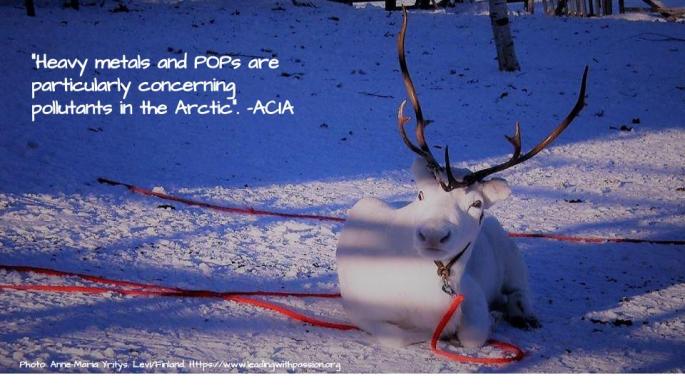
What causes environmental damage in the Arctic? According to ACIA (ACIA Scientific Report 2005, Cambridge University Press), heavy metals and POP´s are especially concerning pollutants in the Arctic region. Especially damaging heavy metals include in the Arctic region include mercury, cadmium and lead (AMAP 2002: Arctic Pollution Issues: A State of the Arctic Environment Report; McConnell* Joseph R. and Edwards Ross. PNAS 2008. vol. 105 no. 34 – Coal burning leaves toxic heavy metal legacy in the Arctic), sources of which were largely unknown until the 1980´s when modern measurements started. Today it is known that industrial activities, including coal burning, emit toxic heavy metals that travel through the atmosphere, ending up deposited in the polar regions (McConnell* Joseph R. and Edwards Ross. PNAS 2008. vol. 105 no. 34).

POP´s (Persistent Organic Pollutants) in the Arctic region, on the other hand, transported through the atmosphere through a number of ways, e.g. air and water, are toxic chemicals that pose severe risks to both human health and the environment worldwide. (The Arctic Institute 2016. Persistent Organic Pollutants in the Arctic – Infographic). Furthermore, according to the Arctic Institute, these POP´s (e.g. PCBs, DDT and dioxins) are especially dangerous due to their persistence and longevity in the environment, posing risks not only to our environment in general, but to the whole food chain. Most of the POP´s originate not from the Arctic but from industrial processes such as municipal and medical waste. (The Arctic Institute 2016. Persistent Organic Pollutants in the Arctic – Infographic).

Learn more about Heavy Metals in the Environment – NRES Seminar Series (Natural Resources and Environmental Sciences Secondary Major at Kansas State University):


Connect with me on Twitter @annemariayritys. For climate/environment-related posts only @GCCThinkActTank. Subscribe to Leading With Passion to receive my latest posts.

Take a step further to create YOUR online business. Learn more about the many benefits of how to create a beautiful website with WordPress.com and how to monetize your blog/website:

WordPress.com – Create A Beautiful Website

Jetpack – The ideal way to experience WordPress – Code-free Customization

WooCommerce – The most customizable eCommerce platform for building your online business

If We Don´t Take Care of Nature, Nature Will Take Care of Us

21167153_10154734210682093_7697003682470668384_o
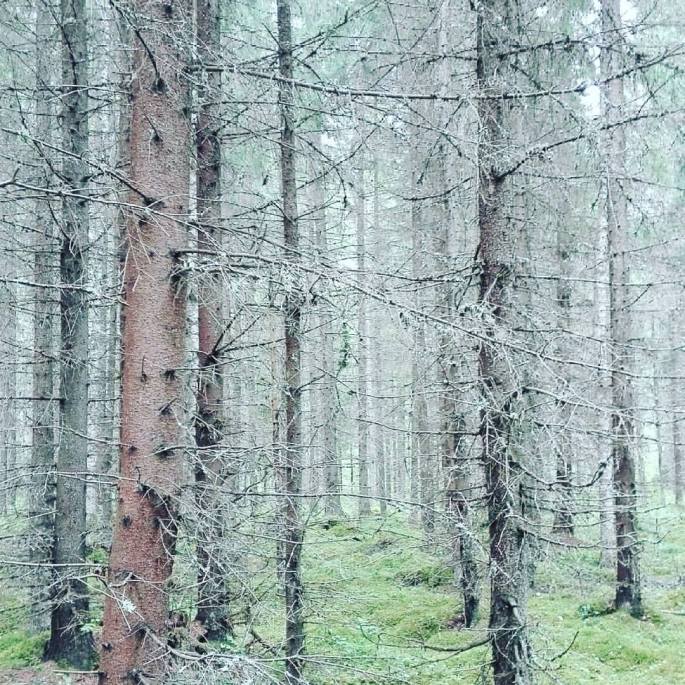
Dead trees in a forest in Tampere, Finland. Photo: Anne-Maria Yritys 2017. All rights reserved.


According to The Finnish Forest Association  , the state of Finland owns around 26% of all the forests in Finland while private persons own the rest. As a forest owner in Finland you basically have the obligation to take care of the forest you own. As an individual, whether living in Finland or visiting the country as a tourist, you have the right to walk around in any forest in Finland which I currently do almost daily. On my walks I see lots of dead forest/trees that seem neglected. 

Someone asked me why something like this happens to trees. To be honest, I do not know the answer. What I know for a fact (and personally see) is that garbage is being dumped in our forests. Every time I walk around/hike, I collect some trash thrown into our nature but I cannot clean up every piece of dirt/trash that is being thrown into nature.


I see all kinds of garbage being dumped into nature, and into our forests, including hazardous waste, such as motor oil. Some of the findings include plastic bottles/other plastic, aluminium cans/other metal objects, glass bottles, old chairs, even mattresses and old tires. It is a horrible sight!
If there is one book I recommend for you to read this year is the non-fiction thriller “Gomorra”, written by Italian journalist Roberto Saviano. It is a true story about how Saviano himself got infiltrated into the Italian mafia in Southern Italy, and his observations over several years. Not only does this non-fiction include quite horrible details about how the mafia operates around the world, but also how they have monopolized the recycling and waste industry in Italy, and how they have dumped poisonous materials/waste into the environment. 
Anne-Maria Yritys 2017. All rights reserved.

Paris Agreement Aims To Strengthen Global Response To The Threat of Climate Change

Have you taken the time to ponder upon what YOU can do to prevent/stop human-caused climate change? As a suggestion, take the time to research the topic, e.g. starting by learning what the Paris Agreement says.


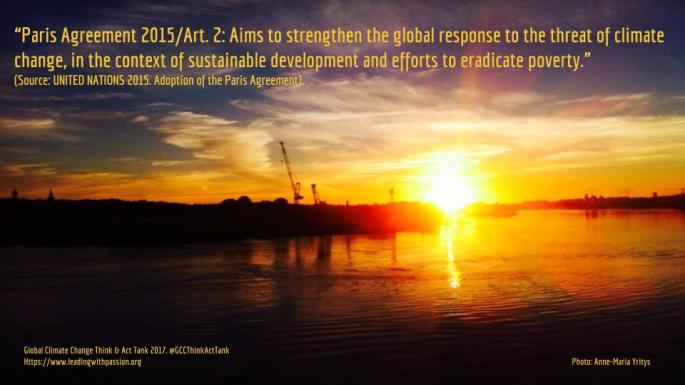
An excerpt from The Paris Agreement 2015/Art. 2: “Aims to strengthen the global response to the threat of climate change, in the context of sustainable development and efforts to eradicate poverty.” (UN 2015. Adoption of the Paris Agreement).


Water and air are not garbage cans

Water and air, the two essential fluids on which all life depends, have become global garbage cans. ~ Jacques Cousteau

#GCC @GCCThinkActTank

Plant a tree for the environment

The best time to plant a tree was 20 years ago. The next best time is today.

~ Chinese Proverb

#GCC @GCCThinkActTank

staygroundedamy2016

Environmental preservation

Preservation of our environment is not a liberal or conservative challenge; it is common sense. ~ Ronald Reagan

#GCC @GCCThinkActTank

Environmental protection

I do not want to protect the environment. I want us to create an environment that does not need protection.

#GCC @GCCThinkActTank

gccmission