UN: Take Urgent Action To Combat Climate Change

Global Climate Change (91).jpg

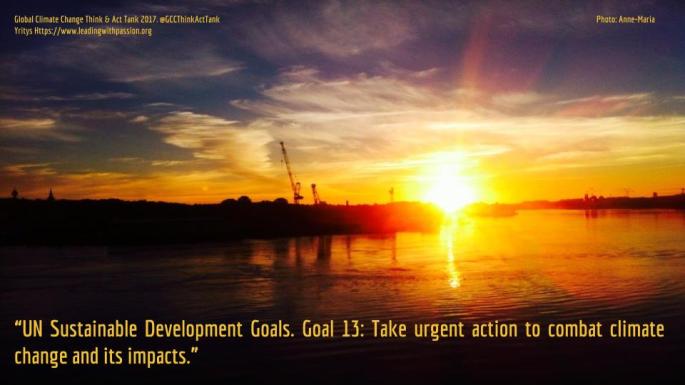
“UN Sustainable Development Goals. Goal 13: Take urgent action to combat climate change and its impacts.”

=====================================================================

In 2015 the UN launched its Sustainable Development Goals with a target of reaching these by 2030. When looking at these Sustainable Development Goals and analyzing them, you will soon realize what they all have in common: climate change and climate action. Putting these goals together as pieces of a puzzle one realizes that climate change (and, especially anthropogenic climate change) is a common denominator, having a significant impact upon our ability to solve all other major local/global problems, such as hunger and malnutrition, poverty, HIV/malaria and other major infectious diseases, child/maternal mortality rates and so on. Climate change, in fact, makes everything even worse than it already is, and the effects of climate change throughout the world are jeopardizing all the good work and all the achievements that have already been made in the past decades to achieve zero hunger around the world and so on. In addition, completely new problems, such as overweight and obesity, have risen throughout our world in the past decades.

The UN is often being criticized for inefficiency in tackling global problems, and reaching the goals that have been set. Much is being discussed about the UN as an organization needing a face-lift, or at least renewing the organization in some ways. Of course, all businesses and organizations, in addition to individuals, are in need of constant improvement and change, because change is the only constant in this world, and the most dangerous thing for anyone to say is that things have always been this way, or we have always done things this way. Any individual or organization making these kinds of statements is wrong, and swimming in very deep waters. Never ever take things for granted or expect them to remain similar for a very long time.

As an intergovernmental organization, UN member states have signed up to provide the organization with 0,7% of its national budget each year. Most of the member countries never deliver even half of this, while some countries pay more than 0,7% of the national budget as a support for the work provided by the UN. The reasons for this may differ from country to country, but it is a fact that the lower the budget, the more tight it becomes for the UN to reach its goals. And, with constant opposition around the world, with e.g. high levels of corruption, any (charitable) organization will face difficulties. Instead, try to focus upon the achievements of the UN, its positive influence in the world, all the data, research and statistics provided by the UN and its organizations. Without these, our world could look darker than it is today, along with the fact that the UN has, through its work, inspired new NGO´s and startups.

Connect with me on Twitter @annemariayritys. For climate/environment-related posts only @GCCThinkActTank. Subscribe to Leading With Passion to receive my latest posts.

Take a step further to create YOUR online business. Learn more about the many benefits of how to create a beautiful website with WordPress.com and how to monetize your blog/website:

WordPress.com – Create A Beautiful Website

Jetpack – The ideal way to experience WordPress – Code-free Customization

WooCommerce – The most customizable eCommerce platform for building your online business


Climate Change Impacts Food Safety & Health

Global Climate Change (89).jpg

“FAO Strategy on Climate Change. Rome, July 2017. Climate change affects food utilization primarily through its impacts on food safety and health.”

=================================================================

What does the FAO mean by food utilization? Food utilization means our ability as human beings (or, even animals!) to have a balanced diet, whereby our bodies ingest and metabolize everything that we intake, either through drinks and/or food. It starts with drinking enough clean, fresh water, which helps our bodies function properly. Without enough clean, fresh water intake our bodies dry out, which naturally affects our metabolism. Clean, fresh water is the most valuable fluid for our bodies. Many groceries, especially fruits, salads, and vegetables, are rich in water. E.g. cucumbers consist to at least 90% water, which makes them part of a healthy diet. Some of the water our bodies need to function properly can thus be taken in through eating a balanced and healthy diet.

The problems that climate change creates to food safety and health include:

  • Environmental pollution causing complex problems to all our ecosystems, e.g. pesticides in agriculture and plastic pollution in our water sources and oceans. All that we put out into our atmosphere, including greenhouse gases, end up EVERYWHERE in our local and global ecosystems, affecting all life upon Earth. The more we pollute our environment, the more we end up polluting ourselves. If we for example consume seafood that has digested micro-plastics, this micro-plastic may very well end up in our personal digestion when we eat the seafood that has been polluted.
  • When our soils are being damaged e.g. through poor soil management and unsustainable agriculture practices, the soils lose valuable nutrients, resulting in a vicious circle where land must constantly be managed more and more efficiently while at the same time losing valuable nutrients. This has been understood by responsible farmers who are taking action and focusing upon organic agriculture.


Learn more about sustainable food by watching Earth Horizon Production´s video “Eco Eye 14, EP07 – Sustainable Food:


Connect with me on Twitter @annemariayritys. For climate/environment-related posts only @GCCThinkActTank. Subscribe to Leading With Passion to receive my latest posts.

Take a step further to create YOUR online business. Learn more about the many benefits of how to create a beautiful website with WordPress.com and how to monetize your blog/website:

WordPress.com – Create A Beautiful Website

Jetpack – The ideal way to experience WordPress – Code-free Customization

WooCommerce – The most customizable eCommerce platform for building your online business


Food Availability Worldwide Will Be Compromised By Climate Change

Global Climate Change (87).jpg

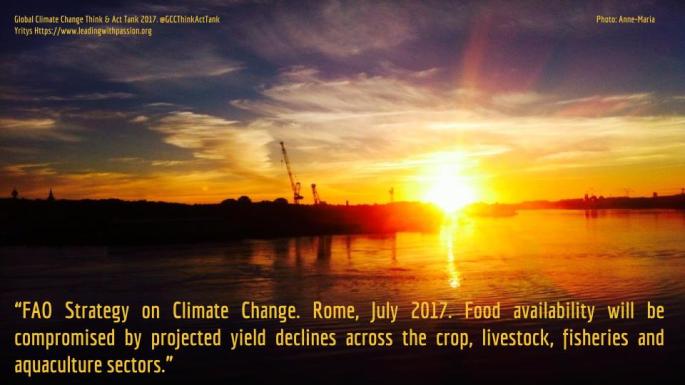
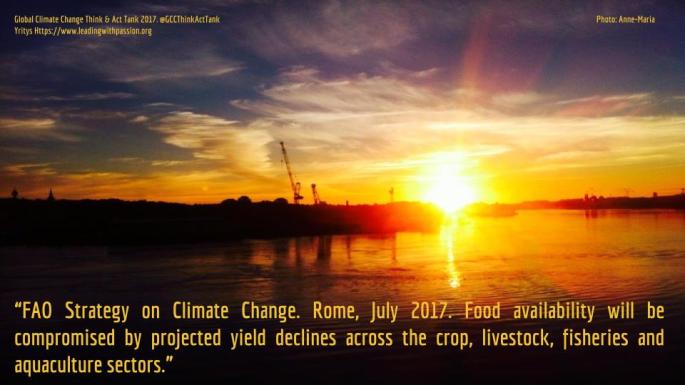
“FAO Strategy on Climate Change. Rome, July 2017. Food availability will be compromised by projected yield declines across the crop, livestock, fisheries and aquaculture sectors.”

================================================================

It is time for the world population to rethink and to change old habits, find completely new solutions and innovate to create a sustainable world. There is no single country in this world that will be spared from the consequences of climate change. We have already consumed most of this world´s fresh water resources, and are now consuming ground water. Needless to say, nothing on this planet can exist without fresh water. We need fresh water for EVERYTHING.

We simply cannot afford continue poor soil management practices, cutting down too many forests/tropical forests, polluting our environment and the air we breathe, over-fishing, and consuming too much of everything without any proper action and or understanding of what kinds of impacts this has on our environment and nature, ourselves and our livelihoods, and ultimately, future generations. How we live and consume today has a direct impact on our society as a whole, and on what we leave behind to our children, or the children of other people for those who have no biological children.

Anthropogenic climate change is not something that occurs only to a number of regions or people in this world. It affects all of us. And, the faster we take responsible actions and reshape our consumption habits, the faster will we experience positive results, and, can look forward to more healthy years on our planet. Climate change, affecting all of us, also requires that everyone of us takes action on a personal level by improving our individual consumption habits. We can all very easily make smarter choices and influence businesses to become increasingly much sustainable, because healthy environments and healthy lives are rights that belong to all of us. We all deserve to live in clean and peaceful environments and societies.

Anne-Maria Yritys. All rights reserved.

Connect with me on Twitter @annemariayritys – for climate-related posts only @GCCThinkActTank & subscribe to my newsletter at Leading With Passion


Why Take Climate Change Seriously?

Global Climate Change (77).jpg

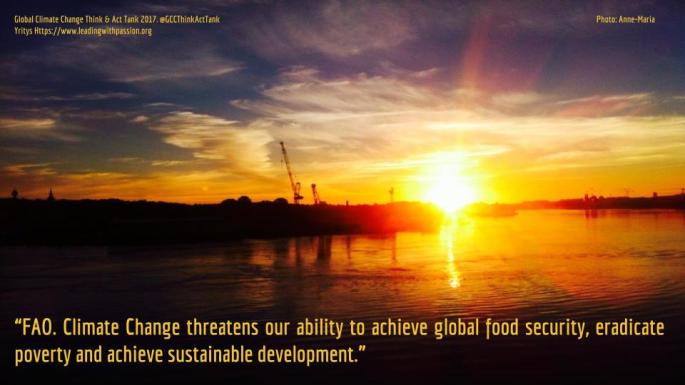
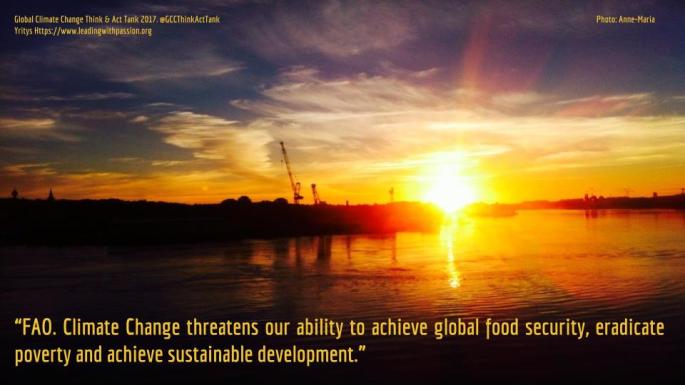
“FAO. Climate Change threatens our ability to achieve global food security, eradicate poverty and achieve sustainable development.”

==============================================================

Anthropogenic climate change is altering our environment heavily through a number of factors, including the increase in ocean acidity, extreme droughts in a number of geographical locations worldwide, more rainfall in other regions – leading to a huge increase in floods even affecting current agricultural practices and crop yields, thawing permafrost in the Arctic, and overall problems with agricultural soils around the world due to a number of reasons, such as poor soil management. The Food and Agriculture Organization of the UN (FAO) states in its updated strategy (Rome, July 2017) that we have to implement sustainable agriculture and farming techniques to ensure global food security. This alone is not enough, however, since the risks and threats of human-caused climate change expand to all our activities, and our consumption habits.

Despite of the many problems we are facing in today´s world, where climate change is the number one threat to our planet and its ecosystem, progress is being made all over the world e.g. in terms of transforming local energy systems into renewable sources, such as solar energy. The question is, whether this transformation is rapid enough to meet the goals that were set and signed in the Paris Agreement?

Watch this video presentation, published by IRENA, the International Renewable Energy Agency – “Are we deploying renewables fast enough to stay below 2 degrees of global warming”?

Connect with me on Twitter @annemariayritys. For climate/environment-related posts only @GCCThinkActTank. Subscribe to Leading With Passion to receive my latest posts.

Take a step further to create YOUR online business. Learn more about the many benefits of how to create a beautiful website with WordPress.com and how to monetize your blog/website:

WordPress.com – Create A Beautiful Website

Jetpack – The ideal way to experience WordPress – Code-free Customization

WooCommerce – The most customizable eCommerce platform for building your online business


Lowering Greenhouse Gas Emissions Necessary To Combat Climate Change

Global Climate Change (5)

Paris Agreement 2015/Art. 4. 19 “All parties should strive to formulate and communicate long-term low greenhouse gas emission development strategies, mindful of Article 2 taking into account their common but differentiated responsibilities and respective capabilities, in the light of different national circumstances.” (United Nations 2015. Adoption of the Paris Agreement).

Action Against Climate Change Requires Consistent Finance Flows

Global Climate Change (4)

“Paris Agreement 2015/Art. 2. 1(c) Making finance flows consistent with a pathway towards low greenhouse gas emissions and climate-resilient.” (United Nations 2015. Adoption of the Paris Agreement).

Communicate, Educate, Inspire, Involve, Lead Change

This post is part the LinkedIn Take Action series in which Influencers and members discuss how to drive change that matters. Read all the posts here and write your own; include the hashtags #action2015 and #2030NOW in the body of your post. 

We do not inherit the Earth from our ancestors; we borrow it from our children

To ensure that sustainability is created and achieved across our Globe, actions have to be taken NOW, involving not only state heads and governments as responsible actors, but leading change throughout societies in a way that makes this a necessary target for all human beings and individuals, and a responsibility for all citizens of the world.

Steps for involving all citizens of the world:

COMMUNICATE

Communication is a powerful tool for leading sustainable change. Create a communication strategy. Execute it in a way that increases awareness and understanding. Repeat. Involve advertising, communications and marketing experts who know how to spread the message in targeted ways.

EDUCATE

As Nelson Mandela said:

Education is the most powerful tool to change the world

Educate people at all levels to increase awareness and understanding. Ensure that every individual comprehends what sustainability signifies, and how each individual can lead change and make a difference in society. Coach, educate, learn, teach, and repeat until everyone, regardless of social status or level of experience is involved and cares about sustainability.

Watch WISE Channel´s video, Bhutan´s “Feeding Programme”: Free & Organic food for better learning (Learning World: S5E33, 1/3):

INSPIRE

Inspire individuals, groups of people, and whole societies to take action. Inspire to make people see the benefits and positive changes that sustainability brings with it, and focus upon communicating the new possibilities that sustainability creates, and the improvements sustainability has upon everyone´s life, including health and well-being.

INVOLVE

Involve citizens throughout societies and make it a necessity for everyone, not only for designated leaders or individuals with a certain status to take action. Everyone has a voice, and every individual´s choices and actions do make a difference. If emphasis, focus, and responsibility is put only upon a handful of people, results will take forever to be seen, if ever. Instead, involve everyone, and give everyone a possibility to actually live in a sustainable way and exercise influence regardless of social status, position, or ranking.

LEAD CHANGE

Lead change through strategic communication, involve the right people to begin with, educate, inspire, and repeat.

Lead change or change will lead you (Steve Jobs)

Read my previous post What Successful Change Leadership Really is About to learn more about how to lead change successfully, in any context or setting.


✍ ✍ ✍ ✍ ✍ ✍ ✍ ✍ ✍ ✍ ✍ ✍ ✍ ✍ ✍ ✍ ✍ ✍ ✍ ✍ ✍   If you care about sustainability, and sustainable development, please comment, like, and share this post with your (online media) networks. Engaging in discussion and taking actions, both on individual, organizational, and societal levels demonstrates awareness and responsibility, both essential in leading sustainable development. Comments upon how sustainable development can be achieved in societies are very helpful, and welcome. Thank you for caring, and for taking action. Peace and blessings. ✍

☮ ☮ ☮ ☮ ☮ ☮ ☮ ☮ ☮ ☮ ☮ ☮ ☮ ☮ ☮ ☮ ☮ ☮ ☮ ☮ ☮ ☮ ☮ ☮ ☮ ☮

GCC Think Act Tank cover 2019

CSR Deficit = Modern Day (Corporate) Imperialism?

"Business Team Stacking Hands". Freedigitalphotos.net.
“Business Team Stacking Hands”. Freedigitalphotos.net.

Overcoming poverty is not a task of charity, it is an act of justice. Like Slavery and Apartheid, poverty is not natural. It is man-made and it can be overcome and eradicated by the actions of human beings. Sometimes it falls on a generation to be great. YOU can be that great generation. Let your greatness blossom. (Nelson Mandela).

In these days of globalism, a new digital era triggering change in communication and increasing awareness across nations, corporate social responsibility and actions towards improving circumstances and conditions are more actual than ever.

Consumers can no longer be fooled. After a century of industrialization mankind is finally realizing that our past actions have been a foundation for a new sustainability needed to save planet Earth from destruction.

Learning takes time, and requires repetition, but fortunately our globe is inhabited by individuals who have managed to take the necessary steps to progress and take the necessary actions towards creating a completely New Green Economy.

Examining and evaluating the developments of the 20th Century gives us the possibility to build an image about the most significant changes that took place, and how much society has changed since then. One only needs to take a look at significant developments shaping and changing our societies in the past decade, or two decades, only. Things we hardly knew about 20 years ago are today evolving and affecting us all more than we could ever have imagined.

The 21st century will be different. We are in the middle of a transforming global economy, where intelligent and morally aware, responsible individuals will reshape economies in completely new ways, enhancing economic development across our globe, leading to completely new ways of life and increased well-being of all citizens across the world.

New standards and actions will lead to improvements in global businesses operations, and in how states are being led. Individuals and corporations involved in corruption and unethical practices will have to step aside, giving way to conscious leaders both rebuilding and developing businesses and societies in a fresh manner, excluding anything outside generally accepted and legal behavior.

The importance of corporate social responsibility, including ecology, social responsibility, and taxation (including changes in how e.g. thin capitalization and transfer pricing currently used at micro-economic level), can no longer be neglected. Future trends are being created, and the lessons learned from past mistakes are a foundation for wiser actions now, and in future.

Business has a responsibility of giving back to the community.

Today we are making a difference for tomorrow.

Conscious capitalism is mindfully making decisions and staying core to your purpose (Kate Walker, Conscious Capitalism)

We hired a CSR person at Twitter, years before we hired our first sales person, to make sure we had a culture and impact of doing good. (Biz Stone).

Three types of Corporate Social Responsibility:

1. Environmental

2. Philanthropic

3. Ethical

:::::::::::::::::::::::::::::::::::::::::::::::::::::::::::::::::::::::::::::::::::::::::::::::::::::::::::::::::::::::::::::::::

Thank you for taking time to make it your daily habit to execute social responsibility, be it in your private or business life. Thank you also for reading, liking, commenting, and sharing your experiences about corporate social responsibility. 

:::::::::::::::::::::::::::::::::::::::::::::::::::::::::::::::::::::::::::::::::::::::::::::::::::::::::::::::::::::::::::::::::

Sustainable Societies Developed by Ethical & Responsible Individuals

It takes less time to do things right than to explain why you did it wrong. (Henry Wadsworth Longfellow)

As citizens of planet Earth, those of us who have been fortunate enough to have access to education and good living standards have to take responsibility and progressive actions in order to improve living conditions for less fortunate individuals.

There are certainly many ways of contributing to sustainable global development, starting with using the knowledge that we have in responsible ways through integrating ethics and sustainability into our societies, into our business practices, and into political activities. In fact, into all activities, be it political or non-political.

According to forecasts by the UN, two-thirds of all world population will live in water scarcity in 2025. If and when this occurs, it is not difficult to understand that this will affect every single citizen of the world either directly or indirectly. Actions need to be taken NOW.


Currently about 57 million children worldwide have no access to primary schooling. The reasons behind this vary, starting from the fact that there is a shortage of about one million teachers in the regions affected (the situation is worst in Sub-Saharan Africa, but also many other geographical regions worldwide suffer from shortages in the very basic human needs, and human rights). Those who have the privilege of education ought to realize how important it is for all children worldwide to have access to primary AND secondary education, and support the development of regions where education is a luxury that currently only wealthy families can afford for their children.

Primary and secondary education is a cost that poor families cannot afford. Instead, poor parents are obliged to send their children to work rather than giving their children the opportunity to work themselves out of poverty through the benefits that education could offer them.

Around 168 million children worldwide work every day instead of going to school. Girls are obliged to drop out of school more often than boys, due to cultural traditions supporting the old beliefs that a girl is a burden for a family rather than a gift like a male child. Nevertheless, both boys and girls are being exploited and utilized as workforce, many of them working long hours in hazardous working environments or forced into becoming child soldiers (in certain areas).

The majority of child labor occurs in Asia and the Pacific, and Sub-Saharan Africa. The reasons for this vary – often due to the fact that poor parents prefer sending their children to work because they need the money to support their families, or, parents prefer sending their children to work because the job is too poorly paid – thus, it “makes more sense” to send the child to the poorly paid, often hazardous job (slavery?). Agriculture is by far the largest sector employing children. Child labor is a violation against human rights, and against the UN Convention of the Rights of the Child.

Why, in a world with so many laws, conventions, declarations, standards, policies, and transparent business processes, do we still have to face child labor and lack of education?

Poor people, including children of poor families, without any external support or support from their state´s governments, are weak to defend themselves taking into consideration the fact that they lack the skills and knowledge to defend themselves and their human rights. Our world has 750 million illiterates alone. Having no reading or writing skills makes it so much more difficult for an individual to improve his/her living standards, unless given the opportunity to learn these basic human skills for thriving and having access to a human life.

Developing sustainable societies and economies brings along many benefits for mankind and helps us leave a legacy for our children and for generations to come, rather than destroying our planet through unethical business practices, ignorance and intolerance.

What are the benefits of creating, and developing ethical and sustainable business/societal practices? A few suggestions to start with:

SAVE OUR PLANET AND ITS INHABITANTS. Sad but true: Our world is running out of water. Instead of panicking, take action NOW and do what you can to improve/prevent the situation. It is not hard to figure out what an impact water shortage will have upon all mankind. If one region runs out of water, it most definitely will have a huge impact on all other regions worldwide as well, leading to significant problems around the world.

IMPROVE YOUR BUSINESS PROCESSES AND MAKE THEM TRANSPARENT (UNLESS THEY ALREADY ARE). Your business activities and consumption have direct and indirect impacts on just about everything, including child labor. It is never too late to make a difference.

SUPPORT ORGANIZATIONS & GOVERNMENTS TO TRANSFORM AND TO GIVE ALL CHILDREN ACCESS TO BOTH PRIMARY AND SECONDARY EDUCATION. Education improves people´s lives and helps them to work themselves out of poverty & to develop their societies. It is a long-term investment serving us all.

EMPOWER WOMEN WORLDWIDE. Women are suffering in many countries (in fact, in most countries worldwide), and the suffering of women increases the suffering of children as well. The best way to help children is to help their mother´s first.

PLEASE SPREAD THIS MESSAGE AND TAKE ACTION. It will benefit us all.

The Importance of Developing an Effective Ethics Program (The ACFE):

Ethical behavior is doing the right thing when no one else is watching – even when doing the wrong thing is legal (Aldo Leopold)

A leadership strategy without ethical clarity produces moral and economic bankruptcy (Bill Donahue)

Our Planet does not need more successful people. Our planet craves for more peacemakers, healers, restorers, storytellers, and lovers of all kind. (The Dalai Lama)

Ethics is the aesthetics of the soul. (Pierre Reverdy)

Thank you for reading, reflecting, commenting, for taking action to improve living conditions for all human beings.


Developing World Class Transformational Leaders

(Little Asian Girl With Computer At Home. Artist: pat138241. Freedigitalphotos.net. 280513)

Take a profound look at the photo above. Do you recognize this girl? She could be you, your daughter, me, or any one of us. Realizing this and the fact that we are all interconnected is integral in our growth and development into a truly humanitarian world, where leadership is based upon living and leading according to virtues and selflessness, rather than merely fulfilling the often evil needs of the ego. Learning to observe other individuals as a part of ourselves is a key factor in our willingness to express love, and compassion, towards other human beings. Mirroring ourselves in other people enhances our spiritual growth, as we realize that we receive what we do send out to others.

The girl on the photo above is one of all 1,9 billion children worldwide. She is one of our future leaders. The continuous growth of young population worldwide presents us with an ever-increasing, huge potential for greatness enabling us to develop the world into a positive direction, focusing upon virtuous leadership qualities, individuals growing and developing into responsible leaders who focus on creating sustainability and thus developing stable economies across the world.

Nelson Mandela, one of the greatest leaders throughout the history of mankind, already long ago highlighted:

“Education is the most powerful catalyst for change in the world”.

Through education we are given the opportunity to improve, and to influence, the course of evolution. Education is not only a privilege for a certain amount of children – it is a basic human right for every child in this world. Nevertheless, in today´s world, an estimated amount of 57 million children worldwide do not have access even to primary schooling, due to a number of reasons contextual to poverty. In certain geographical regions, there is an immense shortage of teachers. This is especially the case in Sub-Saharan Africa.

Child labor is another reason for children being denied access to education. Although child labor has decreased, currently an estimated amount of 168 million children are part of the global workforce. This alarming number is an actual problem that needs to be resolved, and we are all driving forces in allowing this positive change to take place.

Every child has the right to education, to a safe childhood, and to at least one responsible adult taking care of them. If this particular adult is having problems with raising a child according to the Rights of the Child, he or she needs support, education, and interaction from adults who possess a larger amount of awareness and wisdom in regard with this. A child, not knowledgeable about his or her rights, needs support and protection from responsible adults.

Child labor and a shortage of education lead to multidimensional problems across our globe. Solving these problems across societies is possible, and will quickly lead to improvements that benefit us all:

  • Education is helpful in decreasing poverty, increasing both welfare and justice in the world.
  • Education allows us to develop a more balanced world, where sustainable economic development can be created and maintained.
  • Abolishing child labor and granting every child the possibility of having a childhood also leads to a world where an increased amount of adult population has access to work. The major industry employing children is agriculture (almost 100 million children involved), followed by the services sector (54 million), and industry (12 million). In addition, there is an estimated amount of 300.000 child soldiers in our world today. The APAC region (Asia and the Pacific), employs an estimated amount of 78 million children, followed by Sub-Saharan Africa (59 million), Latin America and the Caribbean (13 million), and Middle East and North Africa with 9 million. Would you send your own children to work while personally staying at home? Could you imagine seeing your own child, or children in your neighborhood, being forced to become child soldiers? However much this may sound as a cliche, the capability of putting ourselves in the shoes of others, even thinking about our personal childhoods, helps us understanding that we are all responsible for helping children of this world.
  • Education allows us to create and to build a better future, a future where children of today become responsible adults of tomorrow, making better decisions, and developing humanity into a greater state than the reality we are living in today.

How does this involve businesses, and business decision-makers? In EVERY possible way!

Responsible organizations all over the world, global enterprises, multinationals, but also small business owners, understand the importance of developing sustainable business practices, reducing poverty through participation in the creation of a balanced global economy, and the implementation of a CSR strategy together with an action plan in all activities, including at least following major factors:

  • The definition of what CSR (corporate social responsibility) signifies in the first place.
  • In all business activities, making sure that the CSR strategy is successfully actualized, especially in terms of supply chain and human resources management. In other words, this signifies a transparency in all business activities, making sure that no child labor is involved at any stage of production processes.
  • Efficient and thorough communication of the CSR strategy to all stakeholders, including business owners, shareholders, employees, customers – anyone, who is involved in the activities of the organization.

Mankind is more peaceful than ever throughout its history. Despite of this, we are faced with severe societal problems that need to be resolved. An increasingly globalized world and technological evolution, where access to information has become easier than ever for the majority of world population, together enhance and help us in the development of increasingly sustainable economies, where every child has, not only the right, but also the possibility, to a childhood it deserves, and where every adult has access to work, and being part of the global labor force – working together for the development of a sustainable, flourishing global economy.

More information, detailed reports, and numbers are available through a number of sources, including the following:

Amnesty International. Children and Human Rights: http://www.amnesty.org/en/children

ILO. Child Labour: http://www.ilo.org/global/topics/child-labour/lang–en/index.htm

ILO. Global Employment Trends 2013: Facts and figures by regions: http://ilo.org/global/research/global-reports/global-employment-trends/2013/WCMS_202299/lang–en/index.htm

UNICEF FACTSHEET: Child Soldiers:http://www.unicef.org/emerg/files/childsoldiers.pdf

UN Millenium Development Goals. Millenium Project: http://www.unmillenniumproject.org/goals/

Thank you for taking the time for reading, liking, commenting, and sharing this article! Together we can drive essential changes and be catalysts for positive improvements, and development, on a global level. 

Your participation, and becoming part of a global change and development movement, is extremely valuable.

Keep in mind:

“You are not a drop in the ocean – you are the entire ocean, in a drop” (Rumi).

Every voice counts and every positive action is needed.