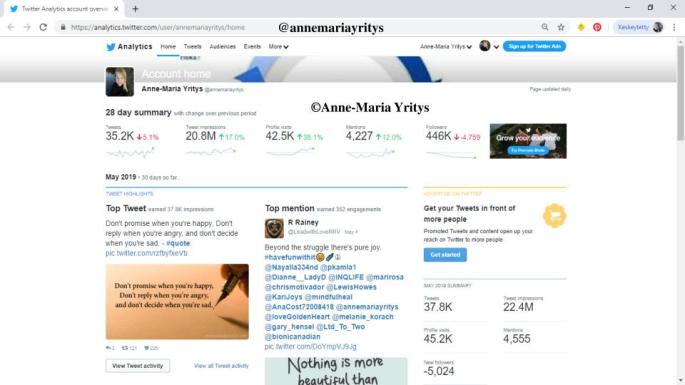
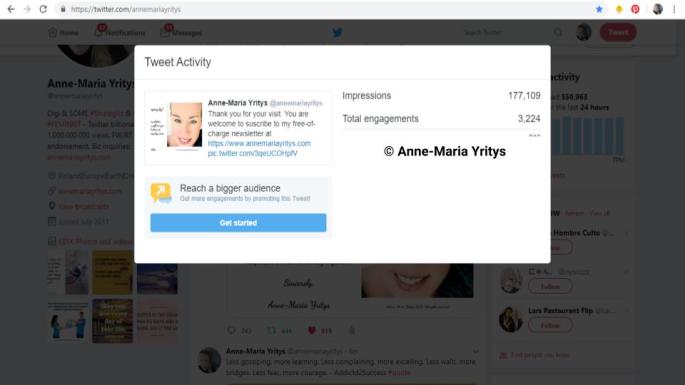
28 day summary with change over previous period
Top media Tweet earned 34.3K impressions


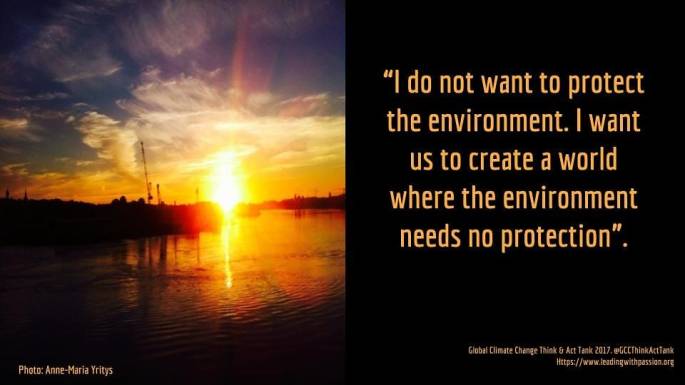
I do not want to protect the environment. I want us to create a world where the environment needs no protection. Anne-Maria Yritys
Why should you even have to protect the environment? Would it not be much easier to create a world where the environment needs no protection?
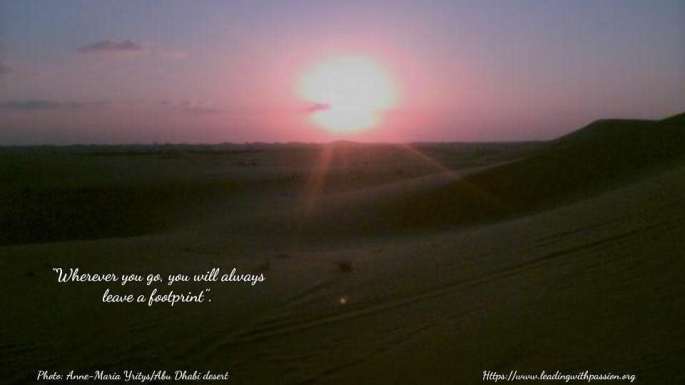
How can this be achieved in a world where man leaves a heavy footprint wherever he goes?
In brief: to create an economically more sustainable future for ourselves and for future generations, we must focus upon developing following sectors:
Contact me directly for further discussion.
Anne-Maria Yritys May 29th 2019.
I am writing this post due to the fact that Finland´s broadcasting company YLE, which is funded through tax income, today announced that Finland´s upcoming Prime Minister Antti Rinne (Social Democrats) has promised that Finland´s next European Commissioner will be a female.
In its more than 24 years of membership in the European Union, Finland that joined the EU on January 1st 1995, has never before had a female European Commissioner.
Why does this matter?
Well, in the European Commission currently all major decisions are being made by 28 commissioners, one from each current EU member state. EU Commissioners hold the real power, and only 32 % of current EU commissioners are females. 68 % are males.
Antti Rinne, currently running negotiations to create a new government in Finland after the parliamentary elections held in April 2019, said on the YLE news today that it is about time for Finland to elect a female EU Commissioner to break the glass ceiling that has been holding back female candidates from powerful leadership positions for far too long. The EU Commissioner will be assigned by the upcoming government in Finland.
To achieve one of its main goals in addition to being a Union of peace, the European Union should take into consideration how equality, including gender equality, can be reached within the Union. Currently only 9 out of 28 commissioners are females. The vast majority of decisions concerning more than 512 million of inhabitants within the European Union are thus made by males. If we are going to build and to maintain an equal European Union, it is about time for its decision-makers to take into consideration the fact that at least 50 % (or more) of the EU´s members are females. Thus, the representation of females in the EU Commission should represent an equal share (at least 50 % females of Commissioners). How this will be organized is a minor problem to be solved by the European Commission. Rotation could be one possibility, as in the Chairmanship of the European Union.
The European Commission should not only consist of 50 % females and 50 % males, but also be willing to delegate and to share its power to for instance the European Parliament. If 28 people, one from each EU member state, make decisions on behalf of more than 512 million citizens within the European Union, we are far from democracy. If decision-making in the EU were more democratic, perhaps more people would be interested in voting in the EU Parliament elections in the first place. At the time being, it is a miracle that more than 51 % of citizens are interested enough to give their vote in the elections. In Finland, only 42,9 % of citizens with a right to vote gave their vote in the May 2019 EU parliament elections.
Anne-Maria Yritys 28.5.2019
During my studies/research on climate and environmental topics from a wide variety of angles since several years back, I have noticed how much progress has been made around the world in terms of environmental protection, and concrete climate action.
With climate change deniers, resistants, apathetic individuals and those who talk the talk without actually walking their talk, our world has plenty of individuals who actually are fully dedicated in their everyday lives to tackling both climate change and environmental destruction. These individuals take action in their personal lives, create businesses and contribute to/make significant political decisions in terms of protecting our local/global environment without which things could look much worse than they actually are today.
In terms of communicating climate and environment-related topics local and global journalism/media play a significant role; how else would the crowd be informed about any development that is taking place? Well-informed citizens of any country, or people who dig deep into specific topics out of personal or business interest of course know how to search for information through a wide variety of sources, which today is even more simple than ever thanks to the Internet and people around the world having public access to information and reports, many times for free.
Nevertheless, and despite important political decisions and legislative changes in terms of environmental protection, journalism and media have a huge responsibility and lots of power when it comes to bringing public awareness about specific issues, climate change and environmental protection. Anthropogenic climate change and environmental protection are both no new topics.
Those with longer life experience and more years behind them know that specific climate/environmental issues have been discussed for several decades. In recent years, however, there has been a significant increase in climate change and environmental topics brought up by various media outlets. Since the Paris Agreement was signed on April 22nd 2016, most countries on our planet have actually pledged to concrete climate action; some countries with more ambition than others.
The main goal of the Paris Agreement is for all countries that have signed (and ratified) the agreement to take concrete actions in order to stop global warming and to prevent global average temperatures from rising above 1,5 degrees Celsius (34,7 Fahrenheit), since research indicates that even slight increases in global (or regional) average temperatures can and will lead to drastic changes worldwide in terms of for instance food security. The purpose of the Paris Agreement is also to ensure that countries take all possible action to reduce GHG ́s (greenhouse gas emissions), which are found to be increasing the global average temperatures through the warming effect that these create.
The question is, however: Do We Take Climate Action Fast Enough?
In the global energy sector, renewable energy sources (excluding nuclear energy), today account for 25,6 % of the total global energy sector, a vast majority of which comes from hydropower (15,9 %). (IHA 2019). Despite the growing capacity of renewable energy sources worldwide in recent years, energy-heavy sectors such as cooling, heating and transport lag behind and renewable energy sources such as solar and wind today account for 2,1 % respectively 4,6 % of total global energy. (IHA 2019; REN21 2018).
Climate marches and school strikes on behalf of climate action and environmental protection that gather millions of people together around the world of course bring an important message and put increasingly much pressure on both educational institutions and schools, businesses in all industries, and governments/politicians, but the focal point here is to focus upon concrete action, which can be taken on various levels throughout societies: in our personal lives, in businesses, and in terms of legislation.
It is comforting to notice that despite of certain climate change resistance or complete ignorance even among world leaders, major cities around the world and in countries such as the U.S. are committed to taking action and concrete measures to either eliminate or reduce their carbon emissions, including for instance New York, Los Angeles and Chicago. Furthermore, research and reports published by IRENA and OPEC reveal how even traditional oil-drilling/oil-producing regions invest into renewable energy sources such as solar and wind.
Nevertheless, with a rapid population growth globally and a continuous increase in energy consumption worldwide, environmentally more sustainable solutions are much needed to keep up with the current development in order to meet the demands of the Paris Agreement which aims not only to protect, but in fact to save our planet Earth from complete destruction.
Anne-Maria Yritys 13.5.2019
With a rapidly growing world population and an extensive exploitation of Mother Earth ́s natural resources it is not to wonder that we are facing a global environmental crisis.
What else is to be expected when (rain) forests are being cut down at the current rate? Much of our world’s land area being turned into buildings, skyscrapers or poorly managed farming land.
In less than one century, man has managed to destroy most of this planet in what may deceive many human eyes by its architectural extravagance, or go unseen by most of humanity by the amount of garbage and poisons thrown vastly into the environment, including our oceans, around the world.
For the future belongs to those who create it; so humanity can only blame itself for the upcoming environmental disaster and catastrophe.
Those who created this contemporary industrialized world where our global environment is the currency, are old enough not to have to personally face or live the destruction of our planet.
Younger generations, and human children yet unborn, are those who will have to deal with the consequences of all the evil that mankind has done to our planet within the past 100 years alone.
The only way to really make a difference is to change from within; to change your personal behavior and consumption habits.
When you change yourself, society must follow. Businesses must follow. Legislation must follow. There is no other way than radical change among all of humanity. Otherwise, we will all soon be lost.
Do you know how your personal/business lifestyle affects the environment?
If not, find out by using a carbon footprint calculator. You can find one with an Internet search, for instance at WWF (World Wildlife Fund).
Moreover, you can calculate your personal/business fresh water consumption. Check out for instance The Friends of The Earth (water footprint calculator).
Anne-Maria Yritys 7.5.2019
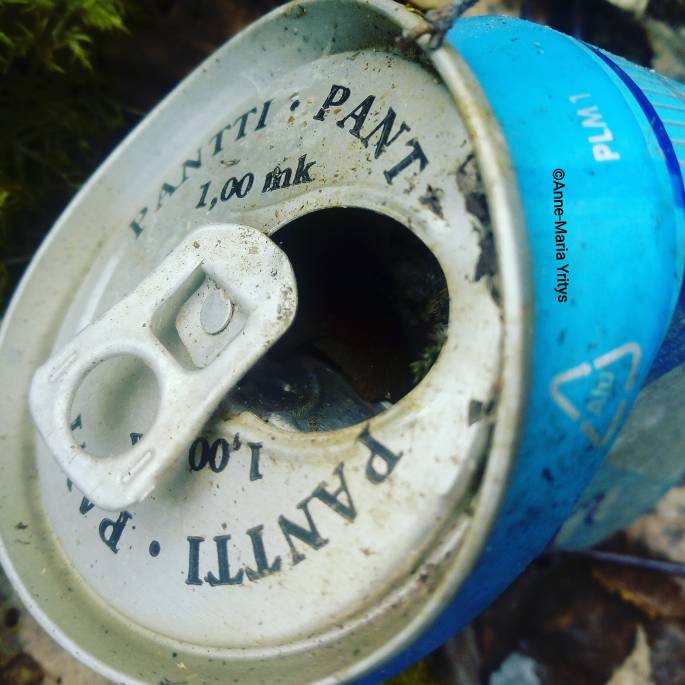
Finding museum waste in the forest devastates me. This aluminium can is from a time period when Finland was not yet a member of EMU and did not have the Euro € as a currency, but the Finnish mark.
Finland has been a euro country since 1.1.2002 so this aluminium can has most probably been in the forest for more than 17 years now. I found it in a local forest today.
With a recycling fee on aluminium cans + glass and plastic bottles, it should not be such a hard task to actually recycle. Or, throw waste into a waste bin instead of dumping it in nature.
Aluminium, other metals, glass or plastic is NOT biodegradable materials.
The level of stupidity among human beings does not cease to amaze me.
#recycling #dontthrowyourwasteintonature #environmentaldamage #wastemanagement
Learn more @annemariayritys and @GCCThinkActTank

According to polls, more than 30% of youth in Finland want to vote green. It, along with the continuous climate strikes among students in Finland, speaks for how concerned children and youth are about the state of the environment. We live in important times.
Finland’s parliamentary elections take place on April 14th, followed by European Parliament elections in May, and Finland’s Presidency of the European Council starting on July 1st.
Finland aims to act as a role model for the rest of the world in terms of taking action upon anthropogenic climate change and in meeting the targets of the 2015 signed Paris Agreement.
Cities are cooperating to find ways of becoming increasingly much sustainable, and Nordic countries have agreed upon increased cooperation to tackle climate change, its consequences and what needs to be done.
Contrary to certain attitudes and beliefs according to which it is pointless for sparsely populated countries like Finland to do anything in terms of climate change or in terms of taking climate action, it is a fact that developed, high-tech, welfare countries such as Finland do play a significant role in terms of environmental well-being.
Although e.g. China and India are among the most populous countries on our planet, western societies and developed countries contribute more together than most developing countries, with for instance production being outsourced to low-cost developing countries such as India, China, Turkey, Vietnam, and Cambodia.
Anne-Maria Yritys 6.4.2019
Although I live in a country (Finland) where WWF’s Earth Hour every year falls onto a date when it is already so light outdoors that you do not need any artificial lights, I have in my heart and in my mind celebrated Earth Hour for as long as I can recall WWF having started its campaign for spreading awareness about important topics including environmental wellbeing and the protection of animal species, which all are under some kind of threat due to human activities on this common planet that we share.
Each year, Earth Hour has been more of an ideology to me:
I do not need a separate Earth Hour, because since many years I aim to live in a way that harms the planet as little as possible.
That includes cutting down on “luxury” basically to a minimum level.
I sold my first (and probably last) car 12 years ago.
I have not used an airplane for more than four years. Not for business, nor privately.
I have made it my priority to consume more wisely, including my eating habits and the clothes I wear.
I only buy what I need.
I use as little electricity as possible.
I walk or bike most of the time.
I clean up the nature around me every day, 365 days a year.
To me, real luxury in life is to have awareness, and be conscious of what is taking place around me.
I am not saying that I will never again drive a car or fly around the world. That is something I have done already, in my past.
There is a saying: “Every sinner has a future, and every saint has a past”.
None of us is perfect. We all have our flaws and weaknesses.
As human beings, we all destroy the environment. We all consume too much.
But what makes a difference are those small everyday choices.
Make smarter choices.
You don’t have to give up on all “luxuries” in your life, but you can try to make small efforts to improve your way of living and your impact on this planet that we share together, with now around 7.5 billion other human beings, and millions of animal species that suffer from the consequences of human greed.
WWF’s Earth Hour is really not about turning off the lights for one hour per year.
It is about turning on your inner light for 8750 hours per year, and for becoming increasingly conscious of what needs to be done for the well-being of our environment.
Anne-Maria Yritys 29.3.2019
You must be logged in to post a comment.