Progressive Leadership

international-womens-day-3

Read more here:

Progressive Leadership

365 Days a Year Dedicated for Women Globally

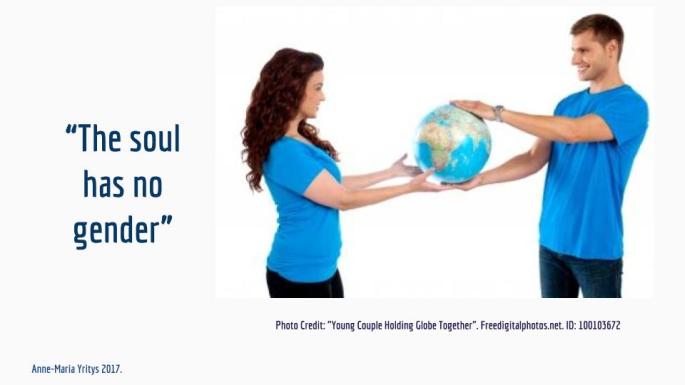
The Soul has no Gender

international-womens-day-1

Read more here:

Gender Equality

365 Days a Year Dedicated for Women Globally

International Women´s Day

international-womens-day-21

Read more/download presentation here:

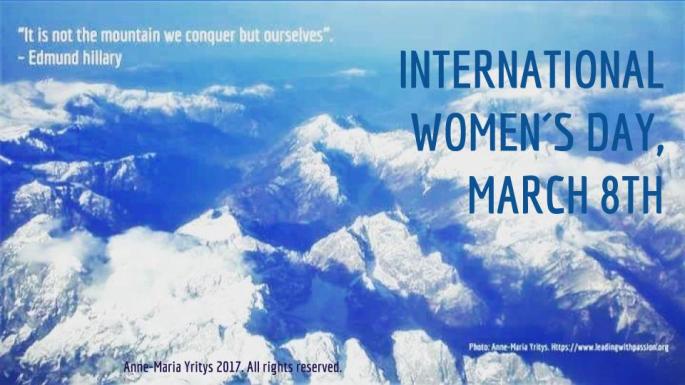
INTERNATIONAL WOMEN´S DAY MARCH 8TH

365 Days a Year Dedicated for Women Globally

Female Leadership

Act Like a Lady. Think Like a Boss.

ladyboss

Why is Balanced Leadership More Important than Ever?

A well-balanced, inclusive approach, according to certain standards and ideals, is essential for the proper governance of any country (Laisenia Qarase) 

One of the core responsibilities for leaders of the 21st century is to create, and to develop organizations and societies where both femininity and masculinity are well-balanced. This is a responsibility for men and women equally. Women have to stand up for their rights as equal citizens and human beings regardless of, and forgetting about, what may have been true in history, and in the past. It is time to leave the past behind, and focus upon improving organizations and societies holistically by giving women equal opportunities in any cultural setting. Although a challenge for women themselves to stand up for their equal rights and for justice to be served in a currently male influence and power dominated world, also men have to support this development.

The Nordic countries, including Finland, are among the most equal countries in the world, where women have since long had equal rights with men, including the right to vote, the right to study and to practice a profession of their choice, the right to engage in activities such as riding a bicycle, something that is regarded as a taboo for women in certain countries. For a Nordic woman and for women in the developed world economies it is difficult to understand why riding a bicycle would be somehow unacceptable for the other gender. Why should this not be the case when the same human rights apply for every individual? Although the right for women to ride a bicycle is among the smallest of problems on our path towards gender equality and balanced leadership, it is among one of the most ridiculous taboos from a feminist perspective.

Leaders have to be trained and mentored to see things from a completely new perspective. Regardless of the equal status of both men and women e.g. in Finland, even in this what we like to call progressive state, women still do face, and have to deal with gender biases and discrimination due to gender. In the past years, developments have taken place to include a certain percentage of women into the decision-making boards of organizations. Some have criticized this, stating that leadership is not about gender, but rather about personality, suggesting that there need not be a legislation regarding board structures, or how organizations and countries are governed.

Of course these changes and structures are needed, and they are urgently needed throughout our globe because a) our world needs to be balanced, and balance can only be created and developed when all human beings are treated according to the Universal Human Rights Conventions, and not according to which gender they belong to; b) femininity and masculinity are part of every human being, and it is about time that leaders, and citizens in general, allow for both femininity and masculinity to thrive in a balanced way throughout our world.

In a balanced organization (society/world), working towards a common objective, there is success (Arthur Helps)

Why do leaders have to create, and to develop balance in the world?

To simplify the arguments for the response to this question, leaders (and people in general) could ask themselves the question: Why is a banana yellow? Or, why is sea water so salty? Why do we have roses in so many colors in this world? Why do we, as human beings, even see colors? When we have been given all the beauty that exists in our world, and in the Universe, should we ignore this beauty or give all colors equal opportunities, and equal rights to thrive in a Universe that was created not to satisfy the egos of some, but to serve as a home and place of well-being for all living, including flora and fauna.

Our world as a whole, including animals, nature and people, regardless of gender or other external attributes, deserves balance. Everyone deserves balance. Everyone deserves peace.

How can we achieve balance?

Balance is a way of being, and in order to create change, and develop ourselves and the world around us, we need to empty our minds and see things from a completely new perspective. Forget about old patterns and behaviors, and allow for ourselves and for other individuals to think in completely new ways. Balance has to be achieved inwardly so that it can be mirrored into the outside world, and create the changes that our world both deserves and needs.

The Business of Gender Balanced Leadership:

Thank you for reading, commenting, liking, sharing, and for unlearning certain behaviors and patterns that may not serve your personal growth and development as a leader and a globally aware, unbiased professional. Thank you also for developing qualities in yourself and in your environment that support the creation and development of balanced, equal, and non-discriminating leadership. 

☯☯☯☯☯☯☯☯☯☯☯☯☯☯☯☯☯☯☯☯☯☯☯☯☯☯☯☯☯☯


Life is a Universal Human Right (Regardless of Gender)

("Asian New Born Infant Sleep in Towel". Artist: Keerati/Freedigitalphotos.net. ID: 100213901)
(“Asian New Born Infant Sleep in Towel”. Artist: Keerati/Freedigitalphotos.net. ID: 100213901)

Gendercide, the systematic extermination of a particular gender, is a socioeconomic injustice caused by a number of reasons: poverty, cultural traditions, lack of education and comprehension about the fact that every human being has a right to live, regardless of gender.

In certain highly populated countries, and regions, 20-30 % of all baby girls, unwanted, are being killed before birth through sex selective abortion. If not killed before birth, in some poor, rural areas, it is common that an infant girl is being either killed, given away, or simply thrown away because she is regarded to be a burden, rather than a gift, to her family.

Although illegal, the abortion and/or killing of baby girls is “socially acceptable”, affected by deeply rooted cultural traditions, poverty, and social ostracism. The killing of baby girls has gone so far that whole generations of male population in certain geographical regions have difficulties in finding a female partner, leading to further socioeconomic problems such as kidnapping of children (girls), and sex trafficking.

Gendercide alone has led to the death of more girls/women than all genocides combined. Our world is estimated to be missing as many as 100 million women, caused by either feticide and/or infenticide. Females are being dehumanized.

For more information about human rights, women´s rights, and related topics, please visit:

The Universal Declaration of Human Rights:

un.org/en/documents/udhr/

The War on Baby Girls:

economist.com/node/15606229

Gendercide – All Girls Allowed:

allgirlsallowed.org/gendercide

World Health Organization. WHO: Gender Based Violence:

who.int/gender/violence/gbv/en/

Women´s Rights Without Frontiers:

womensrightswithoutfrontiers.org/

Thank you for reading, sharing, and for helping the world overcome gendercide, and other gender inequality problems.

365 Days a Year Dedicated for Women Globally

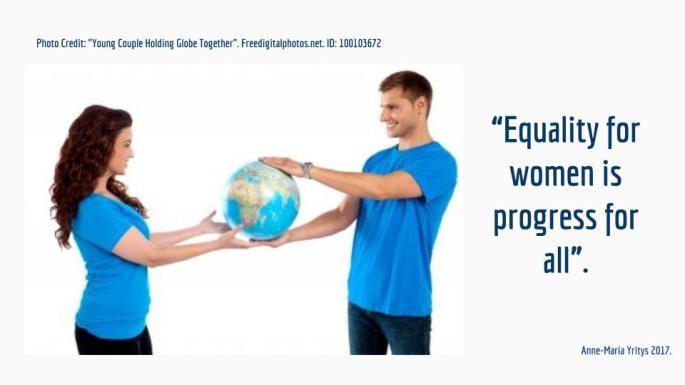
"Young Couple Holding Globe Together". Freedigitalphotos.net. ID: 100103672
“Young Couple Holding Globe Together”. Freedigitalphotos.net. ID: 100103672

“Women are the largest untapped reservoir of talent in the world” (Hillary Clinton)

Although officially celebrated by the United Nations on March 8th each year since 1977, the history of International Women´s Day dates back to the early 20th Century. In New York, The United States, women workers from the garment industry started protesting against working conditions, led by The Socialist Party of America.

Well-known for strong-minded women, Finland was one of the first countries in the world to follow the footsteps of Socialist International, the movement that came to establish the International Women´s Day in Copenhagen in 1910.

The real purpose of the International Women´s Day is the promotion of women to have equal human rights across the globe with men in an effort to achieve sustainable development, peace, and security. Empowering women worldwide is essential both for women and men in order to overcome social, economic, and political challenges being obstacles on our common path towards a world where every citizen has equal human rights. Until these goals have been achieved, both men and women should make each day of the year The International Women´s Day.

Although Finland is one of the most equal states worldwide in terms of gender equality, even this country of a thousand lakes (well, in fact we have almost 188.000 lakes) needs improvement in many areas, especially when it comes to abolishing (domestic) violence. Surprisingly enough, Finland as one of the most equal states in the whole world is reported to have the 2nd most domestic violence in the whole EU, with 47 % of all women of age 15 or above having experienced physical or sexual violence in some form.

Nevertheless, and apart from (domestic) violence, Finland is one of the safest and most equal countries in the world for women to work, and to live. In comparison with most other countries, women do officially have exactly the same human rights as men, including the right to own land – a major obstacle for women to progress economically, and socially, in many countries worldwide.

The most important reasons for both men and women to support the initiative to achieve gender equality worldwide:

– Abolishing poverty: The majority of poor people worldwide are women, due to various reasons such as women being hindered from participating in workforce, low wages, not having equal rights with men e.g. in terms of owning land (although women do most of the agricultural work worldwide).

– Empowering women and strengthening women´s position across the globe reduces severe economic and societal problems. The empowerment of women simultaneously leads to the empowerment of children, and men. Women are as important as men in societies, and by no means inferior.

“The Rise of Women Does Not Mean the Fall of Men”

Dedicated for MEN across the world especially –

A Movement is Building:

“All over the world, men are taking a stand for gender equality. See how many men in your country have committed. Join them and move your country into the lead”:

http://www.heforshe.org/

Click the link above and see how you as a MAN can support gender equality, and also watch this inspiring video where UN Women Goodwill Ambassador, Emma Watson encourages world and corporate leaders to take action for gender equality:

http://bit.ly/HEFORSHEEmmaWatsonWEF

…………………………………………………………………………………………………………………….

Thank you for supporting gender equality and thus creating sustainable development and reducing poverty across our globe.

Let us celebrate International Women´s Day 365 days a year until gender equality has been achieved.

"Jumping For Joy Outdoors". Artist: imagerymajestic/Freedigitalphotos.net. ID: 10068587.
“Jumping For Joy Outdoors”. Artist: imagerymajestic/Freedigitalphotos.net. ID: 10068587.

……………………………………………………………………………………………………………………………………………………………………

Why 2015 is THE Year of Emerging and Empowered Female Leadership

(Business Lady Showing Thumbs Up. Artist: imagerymajestic. Freedigitalphotos.net. Published on 28062012).
     

Many people, in a number of cultures, have prejudices towards female leaders, very often subconsciously. This is due to a number of reasons, including the fact that women do not always even support one and another in business life, of course depending upon the organization. In many cultures stereotypes are more than strong, leaving a woman either having to adapt to the local culture and manners, or giving her the choice to become a catalyst for change, an emancipated woman driving changes both in her personal and professional lives. 


Stereotypes and cultural manners are not easily changed, since everything starts from early childhood, where small girls are often dressed in pink color and expected to behave in a certain way. If you are a girl, or a woman, behaving differently from what has been expected from you, you are often regarded as being either a complicated personality, or simply difficult. Even by other women. Being different, and driving change, is not easy, but it is possible.


I come from a culture where women have equal rights with men, which is not self-evident in most cultures in the world. In Finland, a woman has the freedom to do anything she wants to, just like men. We had a female president, Tarja Halonen, from 2000-2012. Women have also been eligible to vote since 1906, as the 2nd country in the world after New Zealand. However, on a global basis, 80 % or more of all poor people worldwide are still women. Even in Scandinavia, and Finland, domestic violence and an abuse of women is still high, among other injustices that women worldwide, unfortunately, have to deal with on a daily basis. 


As a woman, and a man, what can you do to improve the global conditions of women?


1. Check out organizations supporting and empowering women, and female leadership. For example, UN Women is campaigning for a more equal world through the empowerment of men to support women in its “He for She-campaign”. 


2. As a woman, make sure to support other women and their aspirations. Too often, women are said to act as wolves against each other, although many women support each other as well. You lose nothing by supporting other people, and individuals of the same gender. 


3. Leadership is not about gender, but considering the current state of the world, there is definitely a need for more balance between genders in regard to leadership, and decision-making in societies.


4. We have many strong and competent female leaders worldwide. Yet, the current situation is not enough. More women need to take action, responsibility, and step into leadership. 


5. As a woman – believe in yourself. We are biologically somewhat different from men, which does not make us lesser from males. What male leaders have not managed to achieve, is “left over”, or possible, for women to manage and to take care of. The potential is huge.


6. As long as gender is an issue, and people are not being treated equally, there is work to do, both for men and women. 

“Any woman who understands the problems of running a home will be nearer to understanding the problems of running a country”. (Margaret Thatcher).

Merry Christmas to everyone, and a blessed & successful year 2015!

How Can Women Be Empowered and Gender Gaps in Economies and Societies Be Narrowed Down?

Majority of poor people worldwide are women. The reasons for this are manifold, with large regional differences, starting with a global illiteracy rate of 17 %. Two thirds of all illiterates are women, which makes gender equality even more difficult to achieve. 37 % of all 775 million illiterates worldwide are Indian, followed by China, Pakistan, Bangladesh, Nigeria, Ethiopia, Egypt, Brazil, Indonesia, and the Democratic Republic of Congo. Three regions predominate in illiteracy rates: South Asia, West Asia, and Sub-Saharan Africa. 

In addition to the illiteracy problem, women continue to face many barriers in entering labor markets, holding not only women back, but also being an obstacle for economic growth and development in countries with large gender gaps.

Worldwide, between 2002 and 2007, women’s employment-to-population ratio remained constant at about 49 %, compared to about 73 % for men. On a global level, differences are large, with regional narrowings in the Developed Economies and European Union, Latin America, Caribbean, and in the Middle East. Only Central and Eastern Europe, and East Asia increased their gender gaps in employment.  

Furthermore, a lack of knowledge, together with deeply rooted cultural traditions and expectations as well as a complexity of the labor market, are general reasons for gender inequality – affecting and hindering women from having equal access to the labor market. 

Whereas conventional economic analysis is a comprehension of economic actors in mainstream economics, it excludes much of unpaid work, and sees people simply as labor inputs to production processes. Even in developed countries, most unwaged (home)work is still done by women – more than 60 BILLION hours per year including childcare, and women providing 59 % of unpaid services. In general, women ́s home work is ignored, classically “feminine” jobs are poorly paid, and of low status. 

A number of local and global organizations, either independently or/and in co-operation with the private and public sectors, are driving changes in order to improve women’s lives worldwide, and to narrow down gender gaps, including UN Women as perhaps the most widely known.

Gender equality is more than a matter of social justice – it is a fundamental human right, making good economic sense. Women having equal access to education, and women participating fully in business and economic decision-making, are a key driving force against poverty. Women with equal rights are better educated, healthier, and have greater access to land, work, and financial resources. The enhancement of women ́s control over decision-making in households, gender equality also leads to better prospects and greater well-being of children, reducing poverty of future generations. (UNDP. Gender and Poverty Reduction. 23.10.2014).

Women need to drive these changes, but equally, strong support from men is relevant, including an understanding of why gender equality is so important for humanity in the first place. 

Sources (quoted 23.10.2014): 

Coe, N., Kelly, P., Yeung, H.W.C. Economic Geography: A Contemporary Introduction. 2007.

Elborgh-Woytek, K. & al. IMF Staff Discussion Note. Women, Work, and the Economy: Macroeconomic Gains from Gender Equity. September 2013.

ILO. Global Employment Trends for Women. 2012.

Mapsofworld.com. World Illiteracy Map.

UNDP. Gender and Poverty Reduction.

Unesco. Statistics on Literacy. 

UNFPA. State of World Population 2002. Poverty and Gender. 

UNWOMEN.ORG. Economic Empowerment. 

world.time.com. 29.1.2014. 37 % of All the Illiterate Adults in the World Are Indian. 


UN Millennium Development Goals: III. Promoting Gender Equality and Empowering Women

The third UN MDG (Millennium Development Goal) is concerned with promoting gender equality and empowering women. As sad as it sounds, on both global and national levels, we are far from having reached this goal. On the current agenda, however, the empowerment of women around the world is in a key position.

The goal, in general, means:

-Improving girl ́s participation in education around the world

-Increasing the amount of women in work life

-Increasing the amount of women in parliaments

Currently, two-thirds of all illiterates globally are girls or women. Child mortality numbers are highest in countries where girl ́s educational levels are at their lowest.

  • The human rights declaration guarantees equal rights for both women and men.
  • Gender differences in primary schooling have narrowed down, however, gender equality at all educational levels worldwide has still not been reached.
  • Women account, on a global level, for about 40 % of all workforce involved in other than agricultural work.
  • The major part of unpaid household work, worldwide (even in developed countries), is taken care of by women.
  • 70 % of all poor worldwide are women.
  • Only 1 % of all wealth worldwide is currently in the hands of women.
  • Under 20 % of all leading positions worldwide are held by women.
  • The number of women in parliament is about 20 % worldwide => large regional differences.
  • At whole, the situation is at its worst in Southern and Western Asia and in Africa.

(Source: UNA of Finland. Printed material. 2014).

In order to accelerate the promotion of gender equality worldwide and the empowerment of women everywhere, the UN General Assembly created UN Women in 2010. UN Women comprises:

– Division for the Advancement of Women (DAW)

– International Research and Training Institute for the Advancement of Women (INSTRAW)

– Office of the Special Adviser on Gender Issues and Advancement of Women (OSAGI)

– United Nations Development Fund for Women (UNIFEM)

and its main roles are:

– Supporting inter-governmental bodies

– Helping member states in the implementation of these standards

– Holding the UN system accountable for its own commitments

Despite of the hard work and the progress in improving the lives of women worldwide, there is still a huge amount of work ahead in helping women all over the world e.g. in getting access to decent work and in abolishing violence and discrimination.

(UN Women. Quoted 7.5.2014).

According to Helsingin Sanomat (25.10.2013) and the World Economic Forum (Quoted 7.5.2014), the world’s most equal countries (top 10) are currently:

  1. Iceland
  2. Finland
  3. Norway
  4. Sweden
  5. Philippines
  6. Ireland
  7. New Zealand
  8. Denmark
  9. Switzerland
  10. Nicaragua

(World Economic Forum. The Global Gender Gap Report 2013. Quoted 7.5.2014).

According to the WEF Global Gender Gap Report 2013, progress in gender equality has been made in 80 % of the 136 countries researched. The top most equal countries are, however, still 20 % behind from full gender equality. Indicators include: participation in politics, economic equality, rights to participate in education and access to healthcare. Progress in equality was not made in the Middle-East and North Africa: especially in Yemen the situation for women, according to the WEF, is bad. (Helsingin Sanomat 25.10.2013. Quoted 7.5.2014).

Global Finland, the platform for development communication of the Foreign Ministry of Finland, indicates that development does not take place without gender equality. Women are needed throughout societies in order to operate with full efficiency. Educating and employing women enhances the welfare of families and accelerate the growth of prosperous societies. Scary enough, more women between the ages 15-44 get killed and become disabled by violence than by cancer, malaria, traffic accidents and wars together. 80 % of all human trafficking victims are women, and they usually end up becoming sex slaves or prostitutes. (Global Finland. Quoted 7.5.2014).

There are enormous problems, sometimes deeply rooted in cultural behavior, that still need to be solved before the world is fully equal for both sexes. Luckily, the UN, many other organizations and people work hard to enhance gender equality.

  • Can you think of ways to improve conditions on a regional and national level?
  • What actions can you take to make sure that this basic human right of gender equality is fulfilled?

WHEN EACH ONE OF US (BOTH MEN AND WOMEN) COMMITS TO TAKING THE NECESSARY ACTIONS TOWARDS REACHING GENDER EQUALITY, WE WILL REACH THE GOAL.