How To Guarantee Arctic Environmental Well-Being?

Arctic (20)

With so much dangerous toxins, greenhouse gases, and pollution from e.g. industrial waste and the inefficient burning of black coal in Earth´s atmosphere, how can we ensure that these toxins and pollutants do not end up anywhere in our environment, especially in the Arctic region which warms at least twice as fast as the rest of our planet?

There is no other way of preventing harmful pollutants of destroying our environment, including ourselves, than removing them completely from our way of living. Yet, with the technologies and methods of production we use today, this prevention seems impossible. How long will it take until we destroy ourselves and our home planet? According to the most optimistic prognoses, we have this century left. Others say, only a few decades. Others say, only a few years or at the maximum, a decade. Are we headed towards a climate catastrophe? Let us hope that we do not, and that we still have time to take action.

This is one of the main messages of the UN Sustainable Development Goals (SDG´s) that are a continuum to the Millennium Development Goals – UN SDG Goal Number 13: Take URGENT action to combat climate change and its impacts.

This is no joke, really. These goals were all set for an extremely important reason. In fact, all of the 17 Sustainable Development Goals are in one way or the other interlinked to climate action and climate change. Learn more about UN´s Sustainable Development Goals here.

We have NO time to wast. We must all take action now, both on individual, business, organizational, and governmental levels. Especially much responsibility must be taken by the largest emitters on this planet: China, The U.S.A. and the European Union. Those who destroy and pollute the most must act NOW and transform their economies into increasingly much sustainable places of living. This is not something concerning only the Arctic region, although this is where the warming of the planet is faster than elsewhere. Right now, in the COP23 Climate Summit in Bonn, hosted by Fiji, sea level rise and its threat to millions and millions of people worldwide is being discussed very seriously. If we cannot prevent sea levels from rising, swallowing up whole islands and coastal cities around the world, what will the future look like for these people? Where will they live? What will they eat? How will they produce food in environments and climates that change so rapidly that our current ways of producing food are unsustainable? If you have answers, please let me know, or at least take action upon them. For example in Finland completely new ways of food production are already being implemented by experimental and progressive businesses that have foreseen what we have ahead of us.

Learn more about the melting Arctic by watching European Environment Agency´s video “Melting Arctic: Environmental Atlas of Europe – Greenland”:


Connect with me on Twitter @annemariayritys. For climate/environment-related posts only @GCCThinkActTank. Subscribe to Leading With Passion to receive my latest posts.

Take a step further to create YOUR online business. Learn more about the many benefits of how to create a beautiful website with WordPress.com and how to monetize your blog/website:

WordPress.com – Create A Beautiful Website

Jetpack – The ideal way to experience WordPress – Code-free Customization

WooCommerce – The most customizable eCommerce platform for building your online business

Ice Sheet Loss in Greenland Accelerating

Arctic (19).jpg

The accelerating warming of the Arctic region´s climate leads to glaciers melting permanently, which causes sea level rise all over our planet. Why is this a problem, and, not only in and for the Arctic region?

To understand why sea level rise is so detrimental for our planet, think about all the people who live in so called climate hot spots, especially vulnerable regions such as (large) coastal cities with millions of inhabitants. If and when sea levels rise sufficiently much without any action being taken to prevent this, these cities and regions will end up being covered by water. Furthermore, especially vulnerable island states, are estimated to be inhabitable within only a few decades due to sea level rise.

Fiji, a group of around 300 islands, is one of the already affected island states. Some of its islands, including Tuvalu, Kiribati, Vanuatu and the Marshall Islands are already suffering from extreme weather events. Fiji is right now hosting the UN Climate Change Conference COP23 in Bonn. Learn more here.


Connect with me on Twitter @annemariayritys. For climate/environment-related posts only @GCCThinkActTank. Subscribe to Leading With Passion to receive my latest posts.

Take a step further to create YOUR online business. Learn more about the many benefits of how to create a beautiful website with WordPress.com and how to monetize your blog/website:

WordPress.com – Create A Beautiful Website

Jetpack – The ideal way to experience WordPress – Code-free Customization

WooCommerce – The most customizable eCommerce platform for building your online business
Arctic Hunting & Fishing Under Threat

Arctic (18).jpg

Why are hunting and fishing in the Arctic region under serious threat, and why does this have to be taken seriously? Do we not have enough marine life and wildlife to keep up with our fishing and hunting methods the way we always have? Even in the fragile and vulnerable Arctic region, which is home to millions of people, many of whom belong to indigenous communities and have always lived according to the laws of nature, depending completely upon the food that the Arctic region has to offer. The unique Arctic region, which is also home to a unique flora and fauna.

It is no longer news that the Arctic region´s climate is warming, and at least twice as fast as elsewhere on our planet. Nevertheless, the importance of bringing awareness about these changes in climate to citizens of this world is more important than ever. With incomplete understanding about what is taking place with the climate in the Arctic, it is challenging for people to take action. Thus, your voice does matter. Your improved actions do matter – despite of the fact that the inefficient burning of black coal is the major single contributor to climate warming in the Arctic region, and thus the industries burning black coal inefficiently. We can all contribute on an individual level, even through small actions and choices that contribute to improvements in how energy is being used worldwide.

According to EU Arctic – Strategic Environmental Impact Assessment of development of the Arctic, the inefficient burning of black coal is the one single largest contributor of climate warming in the Arctic region. Energy efficiency and the improvement of black coal-burning practices, or its complete abolishing, therefore, are pivotal in order to slow down the (Arctic) climate from warming. Currently, the majority of black coal pollution finds it way to the Arctic from Asian countries, drifting all the way to the Arctic region through air currents. Yet, the (inefficient) burning of black coal is not the only pollutant affecting the Arctic region.

In short, the Arctic region´s climate is warming drastically fast: when glaciers melt, many of the species at home in the Arctic environment are being threatened by complete extinction. Perhaps the best known of these species is the polar bear. If and when species that depend upon the Arctic region´s unique climate lose their living environment, this will lead to catastrophic consequences not only for all of these endangered species, but also to millions of people who depend upon these species in order to thrive and to survive.

Learn more by watching Al Jazeera´s reportage about “Arctic way of living under threat”:


Connect with me on Twitter @annemariayritys. For climate/environment-related posts only @GCCThinkActTank. Subscribe to Leading With Passion to receive my latest posts.

Take a step further to create YOUR online business. Learn more about the many benefits of how to create a beautiful website with WordPress.com and how to monetize your blog/website:

WordPress.com – Create A Beautiful Website

Jetpack – The ideal way to experience WordPress – Code-free Customization

WooCommerce – The most customizable eCommerce platform for building your online business
Arctic Glaciers & Permafrost Diminishing

Arctic (17).jpg

Climate change in the Arctic region is very real, and extremely rapid. Climate change skeptics, resisters and pseudoscientists want to claim the opposite, and who knows what else than ignorance and lack of awareness is behind the behavior of these people. At least it is a fact that the Arctic region holds most of the world´s remaining oil and gas resources, which certain businesses and countries would like to exploit without any concern about the Arctic region´s well-being, or the possible risks and consequences of oil and gas exploitation in the Arctic region.

On a daily basis, I encounter climate change skeptics, climate change deniers and pseudoscientists online, the majority of whom are active on Twitter. There are people who for example claim the Earth to be flat. I personally receive for example following kinds of Tweets: “Climate change is a hoax, which has only been made up by the EU and the UN elitists who want to make money with climate change”.

We already have more than strong evidence, and facts, about anthropogenic climate change, which is especially rapid in the Arctic region. Glaciers are melting at an alarming rate, and thawing permafrost is now a reality. Although, according to some research data, the Arctic Sea would be entirely ice free during summer months by 2040, more recent data suggests that the Arctic Sea could actually be completely ice free during summer months within a few years only. What this signifies for the Arctic region, and for our overall climate upon our planet is yet uncertain. What is known already is that with the ice and snow covers melting, increasingly much carbon dioxide and methane will be released into Earth´s atmosphere, causing our planet to warm even more rapidly.

Learn more about the Arctic region and why some businesses and countries do not seem to mind if the Arctic Sea becomes ice free. Free Documentary´s “Ice Race – Into the Unknown – the Story of the Arctic” reveals a lot:


Connect with me on Twitter @annemariayritys. For climate/environment-related posts only @GCCThinkActTank. Subscribe to Leading With Passion to receive my latest posts.

Take a step further to create YOUR online business. Learn more about the many benefits of how to create a beautiful website with WordPress.com and how to monetize your blog/website:

WordPress.com – Create A Beautiful Website

Jetpack – The ideal way to experience WordPress – Code-free Customization

WooCommerce – The most customizable eCommerce platform for building your online business

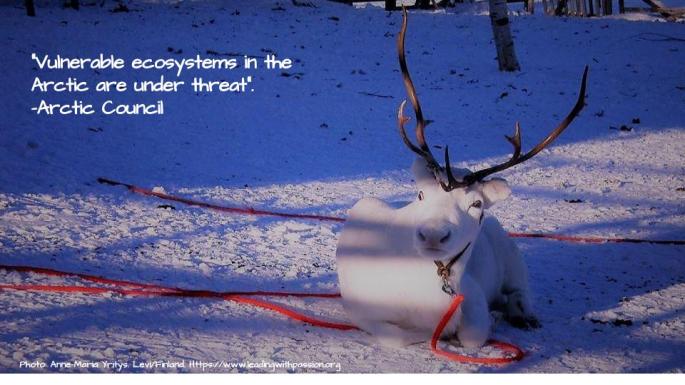
Arctic Ecosystems Are Under Threat

Arctic (16)

The Arctic Council with its eight member countries USA, Canada, Russia, Sweden, Norway, Denmark, Iceland and Finland, is one of many organizations dedicated to protecting and speaking up for the Arctic region. Other well-known, official organizations protecting and conducting research upon the Arctic region include Greenpeace, WWF, The Arctic Institute, NRDC, Alaska Conservation Foundation, The Pew Charitable Trusts, Arctic National Wildlife Refuge, Earthjustice and Polar Bears International, just to name a few.

What these organizations all have in common is their concern for the Arctic region, including conservation, protection and significant research upon the Arctic region. One major publication was published in 2005 with the Arctic Council initiating a research project whereby an international team of more than 300 scientists and experts shared their knowledge and created the Arctic Climate Impact Assessment. (ACIA, 2005. Arctic Climate Impact Assessment. Cambridge University Press, 1042p. http://www.acia.uaf.edu).

ACIA is a comprehensive report upon the Arctic region and its climate, including basically everything about the Arctic region´s climate historically and contemporary, analyzing and evaluating the future of the Arctic region through models and scenarios. AMAP (The Arctic Monitoring and Assessment Programme), which is one of the Arctic Council´s working groups, also provides a number of publicly available research reports on their website.

Arctic climate change is real, and it is faster than elsewhere on our planet. Evidence of this speaks for itself, and has been assessed through numerous research projects by the world´s leading organizations dedicated to the conservation and protection of the Arctic region, some of which have been mentioned in this article. With the Arctic region having a unique and fragile ecosystem, its conservation and protection is essential to protect our whole planet from the partly yet unknown consequences of continued warming in global average temperatures, which, as stated and signed in the Paris Agreement, have to be taken seriously, since even slight increases in global average temperatures can have catastrophic impacts upon Earth and all life on this planet.

Learn more about the fragile and vulnerable Arctic region´s ecosystem by watching Polar Bears International´s video “The Arctic Ecosystem: Tundra Connections Webcast with NWF”:


Connect with me on Twitter @annemariayritys. For climate/environment-related posts only @GCCThinkActTank. Subscribe to Leading With Passion to receive my latest posts.

Take a step further to create YOUR online business. Learn more about the many benefits of how to create a beautiful website with WordPress.com and how to monetize your blog/website:

WordPress.com – Create A Beautiful Website

Jetpack – The ideal way to experience WordPress – Code-free Customization

WooCommerce – The most customizable eCommerce platform for building your online business
Arctic Climate Change Affects the Whole World

Arctic (15)

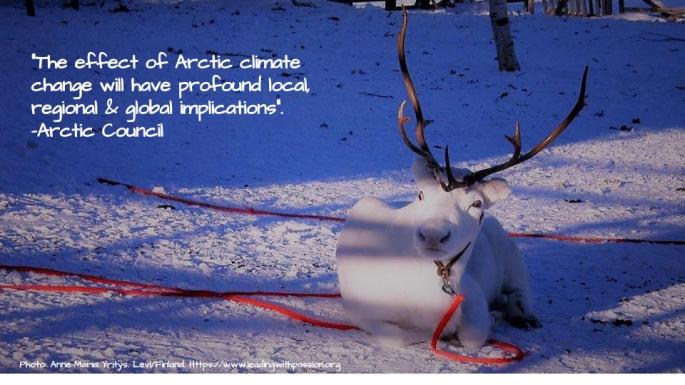
Many of you are probably aware of the fact that Finland holds the Chairmanship in the Arctic Council 2017-2019. The Arctic Council is the leading intergovernmental forum for addressing issues concerning and related to the Arctic Region. (U.S. Department of State – Diplomacy in Action – Arctic Council). The Arctic Council was established by the Ottawa Declaration in 1996, and its members consist of the eight countries with territory above the Arctic Circle: Canada, Denmark, Finland, Iceland, Norway, Sweden, Russia and the United States. (U.S. Department of State – Diplomacy in Action – Arctic Council).

According to the Ministry For Foreign Affairs of Finland, Finland during its Chairmanship in the Arctic Council will strengthen the Arctic cooperation and emphasize the implementation of the Paris Agreement on climate change and the UN sustainable development goals.

The Finnish Meteorological Institute, on the other hand, highlights the already available expertise of the Arctic region in Finland, stating that climate change is more rapid in the Arctic region compared to the rest of the world.

Learn more about the implications of Arctic climate change by watching U.S. Department of State´s video “The Global Implications of Arctic Climate Change”:


Connect with me on Twitter @annemariayritys. For climate/environment-related posts only @GCCThinkActTank. Subscribe to Leading With Passion to receive my latest posts.

Take a step further to create YOUR online business. Learn more about the many benefits of how to create a beautiful website with WordPress.com and how to monetize your blog/website:

WordPress.com – Create A Beautiful Website

Jetpack – The ideal way to experience WordPress – Code-free Customization

WooCommerce – The most customizable eCommerce platform for building your online business
Why Ban Oil Drilling in Arctic Waters?

Arctic (14)

How many reasons to ban oil drilling can you come up with? Write your reasons and arguments on the lines below:

  1. __________________________________________________________________________
  2. __________________________________________________________________________
  3. __________________________________________________________________________
  4. __________________________________________________________________________
  5. __________________________________________________________________________
  6. __________________________________________________________________________
  7. __________________________________________________________________________
  8. __________________________________________________________________________
  9. __________________________________________________________________________
  10. __________________________________________________________________________
  11. __________________________________________________________________________
  12. __________________________________________________________________________
  13. __________________________________________________________________________
  14. __________________________________________________________________________
  15. __________________________________________________________________________
  16. __________________________________________________________________________
  17. __________________________________________________________________________
  18. __________________________________________________________________________
  19. __________________________________________________________________________
  20. __________________________________________________________________________

If the space in these lines was not enough, you can send me an article/essay about the topic “Why Oil Drilling Should Be Banned”. Maximum length of article/essay: 800 words.

I will read all of the articles/essays personally and publish (with your permission of course) the best three articles/essays on my website and on Twitter @annemariayritys and @GCCThinkActTank.

Send your article/essay by November 30th through my contact form:

Go back

Your message has been sent

Warning
Warning
Warning
Warning

Warning.

Looking forward to reading your article/essay with arguments for “Why Oil Drilling Should Be Banned”.

You may find some inspiration by watching CAP/seeprogress´s video “Oil and Ice: The Risks of Drilling in Alaska´s Arctic Ocean”:


Connect with me on Twitter @annemariayritys. For climate/environment-related posts only @GCCThinkActTank. Subscribe to Leading With Passion to receive my latest posts.

Take a step further to create YOUR online business. Learn more about the many benefits of how to create a beautiful website with WordPress.com and how to monetize your blog/website:

WordPress.com – Create A Beautiful Website

Jetpack – The ideal way to experience WordPress – Code-free Customization

WooCommerce – The most customizable eCommerce platform for building your online business

Why Does The Arctic Region Influence Climate Change Worldwide?

Arctic (13)

Repetition is the mother of learning, so in order to really understand what is happening with our global weather patterns and climate, we have to repeat what is happening in the Arctic region until we internalize what is going on in the North Pole and the whole Arctic region.

The Arctic region, which consists of the Arctic Sea and adjoining seas, Iceland, the Faroe Islands, parts of the U.S.A., Canada, Greenland, Norway, Sweden, Finland and Russia, is home to millions of people, thousands of animal species and a unique environment. It has been an important source of food for a vast amount of world population through e.g. its fish population, and the region also holds around 25% of the world´s untapped oil reservoirs – oil reservoirs that some countries and companies would like to exploit, without any concern about the region´s sustainability or environmental well-being.

Within a few years only, the Arctic Sea will become completely ice free during summer months for the first time in human history. This, equally, seems to be a welcomed news to some corporations that see the possible economic benefits of shortened trade routes from Asia to Europe, careless about the environment.

The problem of a warming Arctic region is that the dangers and damages upon the Earth´s atmosphere and climate are far more concerning and pose a real threat to all life upon our planet. In my previous posts I have written many arguments to why climate change in the Arctic is detrimental, even dangerous for the whole world. According to already existing research, the warming of the Arctic region accelerates climate change all around the world. It also releases increasingly much carbon dioxide and methane into Earth´s atmosphere, damaging our planet even more with these harmful greenhouse gases.

Expand your knowledge about the Arctic region and its influences on our whole planet by watching Earth Institute´s “Warming Arctic, Changing Planet”:


Connect with me on Twitter @annemariayritys. For climate/environment-related posts only @GCCThinkActTank. Subscribe to Leading With Passion to receive my latest posts.

Take a step further to create YOUR online business. Learn more about the many benefits of how to create a beautiful website with WordPress.com and how to monetize your blog/website:

WordPress.com – Create A Beautiful Website

Jetpack – The ideal way to experience WordPress – Code-free Customization

WooCommerce – The most customizable eCommerce platform for building your online business

Arctic Climate Change a Global Problem

Arctic (12)

Climate change in the Arctic is a global problem. Why? If you have not yet read my previous posts about climate change in the Arctic region, you will find the response by doing so. You can access some of my previous posts here:

Why is The Arctic Experiencing Social & Environmental Changes?

What is Arctic Climate Change?

Changes In Temperature & Storm Patterns Affecting The Arctic Life

Changes In Temperature & Storm Patterns Affecting The Arctic Life

The Arctic Climate is Warming Dangerously Quickly

Heavy Metals & POPs Concerning Pollutants in the Arctic Region

Why is the Melting of Arctic Sea Ice Dangerous?

Why We Must Protect The Arctic Region

What is The Albedo Effect?

What Does Thawing Permafrost Signify?

Why Are Sea Levels Rising Worldwide?

Why Does Arctic Ice Extent Decrease?

How Do Temperature Shifts Impact the Climate and Environment (in The Arctic)?

Arctic Fisheries About to Disappear

Why is The Gulf Stream About to Halt?

What Contributes to Ocean Acidification?

Acidic Oceans a Threat to Arctic Life

If you are a global citizen, you are perhaps already aware of the fact that everything we do upon this planet has an effect upon life elsewhere. When you eat breakfast in the morning, you have already depended upon about half of this world. When production plants and dirty industry sectors are being transferred to developing countries where production costs are only a fraction of those in industrialized countries, savings may be possible for a certain time period. Nevertheless, it does not remove the problems of unsustainable production, or transport.

For example: many Finnish and international well-known brands have outsourced all of their production to countries like Bangladesh, Cambodia, China and Turkey, just to name a few. The consumer pays exactly the same price as before, for a branded design product that now has only been designed in the country of origin, but produced with the lowest labor costs possible in a country with low labor costs. Does this make any sense? I have personally noticed how the quality of these brands has suffered, and I am not willing to pay anything for e.g. a Finnish expensive brand product which has not been produced in Finland. Why would anyone want to pay a high price for a design product which is no longer produced where it originates? There is a difference between capitalism and sustainable capitalism.

In short, the more the Arctic region warms and is affected by climate change, the more will this affect and have an impact upon our global climate as well.

Learn more about why climate change in the Arctic region is a global problem by watching Link TV´s “Melting Arctic: Assessing the Global Impact”:


Connect with me on Twitter @annemariayritys. For climate/environment-related posts only @GCCThinkActTank. Subscribe to Leading With Passion to receive my latest posts.

Take a step further to create YOUR online business. Learn more about the many benefits of how to create a beautiful website with WordPress.com and how to monetize your blog/website:

WordPress.com – Create A Beautiful Website

Jetpack – The ideal way to experience WordPress – Code-free Customization

WooCommerce – The most customizable eCommerce platform for building your online business

Acidic Oceans a Threat to Arctic Life

Arctic (11)

In my previous post, What Contributes to Ocean Acidification?, I explained briefly what contributes to ocean acidification and why this is so harmful to our marine ecosystems. The response to why this is a serious threat to life in the Arctic region is thus quite simple, when we understand what contributes to ocean acidification and how this affects our ocean´s overall well-being.

The more greenhouse gases released into Earth´s atmosphere, a significant amount of which end up in our oceans, the bigger the damage in our marine ecosystems. When around nine million (9.000.000) people die each year worldwide due to pollution only, we can only imagine what all of the pollution, including dangerous toxins such as greenhouse gases, does to our atmosphere, our waters and our environment in general. In many parts of the world, e.g. coral reefs are already suffering and dying due to all of the pollution and toxins absorbed by our ocean´s and other water sources. Coral reefs are living beings, small animals, which are extremely important to our marine ecosystems. If we lose our corals due to human-caused release of toxins such as greenhouse gases, we will ultimately destroy ourselves.

ALL of our marine ecosystems are already endangered and damaged. What makes the Arctic region especially vulnerable is its unique ecosystem, which has until now been protected by thick layers of ice and permafrost. When glaciers melt, ice sheets melt, and permafrost melts, the release of dangerous and harmful greenhouse gases, especially methane, accelerates and causes even more damage to our (marine) ecosystem.

Learn more about Arctic Ocean Acidification by watching Nordisk Samarbejde´s video:


Connect with me on Twitter @annemariayritys. For climate/environment-related posts only @GCCThinkActTank. Subscribe to Leading With Passion to receive my latest posts.

Take a step further to create YOUR online business. Learn more about the many benefits of how to create a beautiful website with WordPress.com and how to monetize your blog/website:

WordPress.com – Create A Beautiful Website

Jetpack – The ideal way to experience WordPress – Code-free Customization

WooCommerce – The most customizable eCommerce platform for building your online business